INSIDE AXIS OF HARMONY · ARTICLE TEN
From Jewel to World
By Jabbi Delahaye · 10 October 2026
An artwork can suggest another form before I have finished thinking about the first. With Axis of Harmony, the original jewellery sculpture gave me a composition I wanted to explore further: the crown gemstone, the open ankh, the spreading wings, the paired eyes and the lotus gathered around a central line. Once that arrangement felt settled, I began asking where else its visual language could go.
The first development spread the design across a rectangular surface. The next carried it around an egg, with a miniature version of the original jewel revealed inside. Each transformation changed how the work could be encountered. A silhouette became an immersive field; that field became an enclosing shell; opening the shell returned attention to a freestanding form.
These are digital works and visual concepts. Their apparent goldwork, fantasy gemstones and mechanisms are imagined through the image. Within that freedom, I wanted each version to have a clear relationship to the others, while giving the viewer a different way to enter the same world.
Beginning with a silhouette
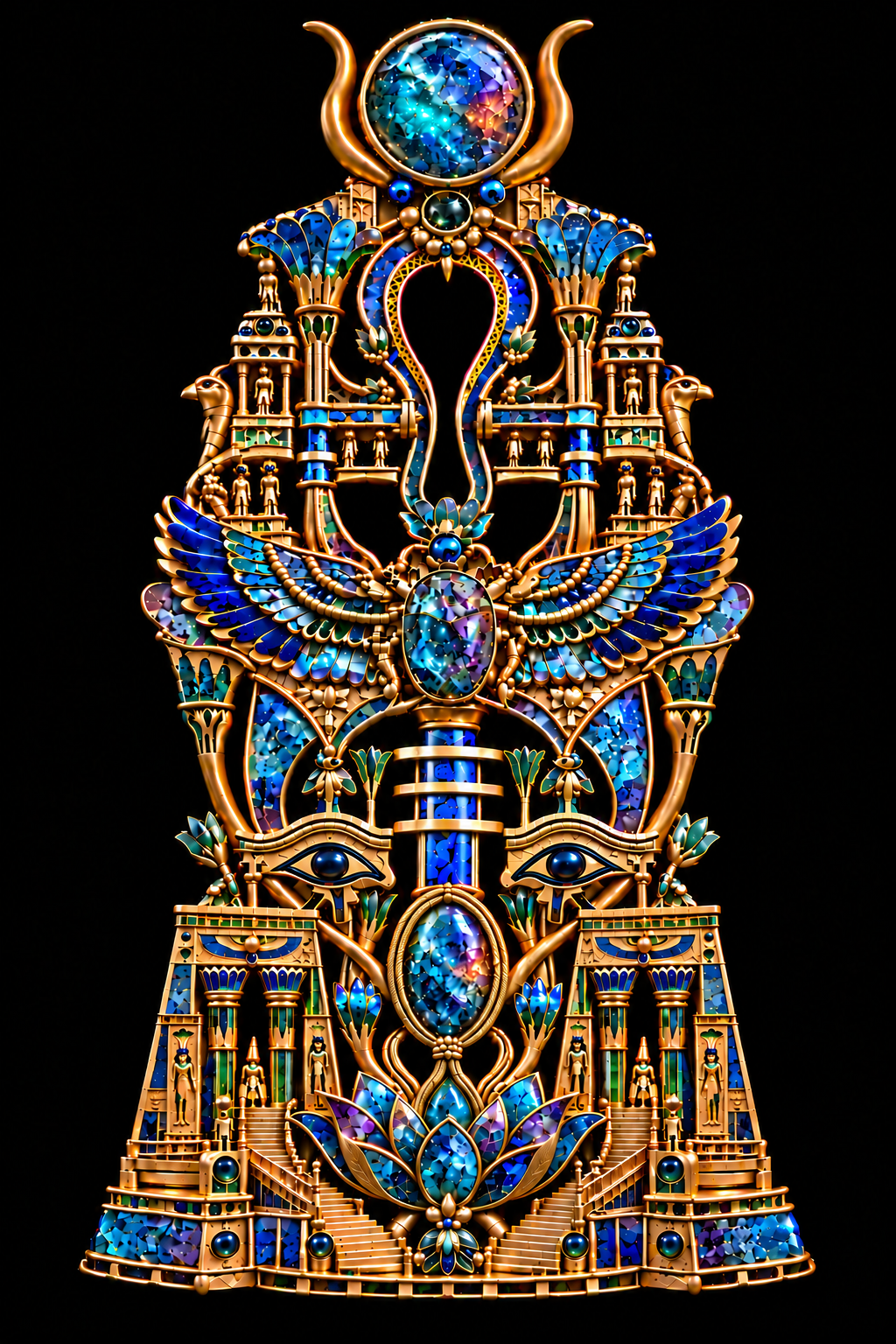
The original Axis of Harmony stands against black. Its outer contour is easy to follow, and the background remains visible through its open structure. That darkness contributes to the design, particularly within the ankh-inspired centre, where the surrounding gold and blue define an opening.
At this stage, the composition has a strong sense of an individual object. Its base grounds the arrangement; the crown establishes its height. Wings extend across the middle, while miniature architecture gives the lower sections a surprising change of scale.
The fantasy gemstones connect those different areas through colour. Blue, teal and violet recur within gold settings, but each gemstone occupies a particular place. The round crown gemstone holds the upper focus. The elongated gemstone between the wings gathers their movement. The lower oval gemstone leads towards the lotus and gateways.
That distribution became important when I considered a new format. I needed to understand which relationships gave the work its identity before changing the space around them.
Spreading the design across a surface
For the flattened version, I wanted the gemstone colour and gold architecture to reach the edges of an A3 composition. This called for an adaptation of the image. Simply enlarging the upright jewel would leave much of its black surround intact; spreading its language across the surface required supporting detail around the central arrangement.
The added passages gave the work a different presence. Arches, columns, gemstone inlays and curved gold forms extended the visual field. The centre remained recognisable, but it now belonged to an environment that continued towards the boundaries of the artwork.
The ankh's interior also changed. Where the original used open darkness, the adapted version carried gemstone imagery within the form. Keeping that inset darker and quieter helped its outline remain legible within the richer surface.
That change made the two versions distinct. I could retain the approved upright master and develop the expanded composition separately. Each had its own relationship between detail and space, and each needed to be judged within its own framing.
What reaching the edges changes
An image that runs to the edges gives the eye fewer places to leave the composition. The surrounding detail becomes part of the first encounter, rather than waiting within the silhouette of an isolated object.
I wanted that fuller surface for the proposed aluminium panel presentation. The architectural and gemstone passages could carry the viewer towards the perimeter, while the crown, ankh, wings and lotus maintained a clear centre. The material presentation was an intended next step; the digital preview alone could not tell me how the colours and highlights would appear on a finished panel.
The expanded areas also needed refinement. Crowded gold intersections required clearer overlaps. Wing attachments needed separation. Tiny figures, rails and stair edges needed enough definition to remain understandable within the larger pattern.
Those adjustments brought me back to the questions behind the original work. Where does one component end? How does another begin? Which passage should carry attention? Extending the composition increased the area to be considered, but the purpose of the detail remained the same.
A pattern that could become a shell
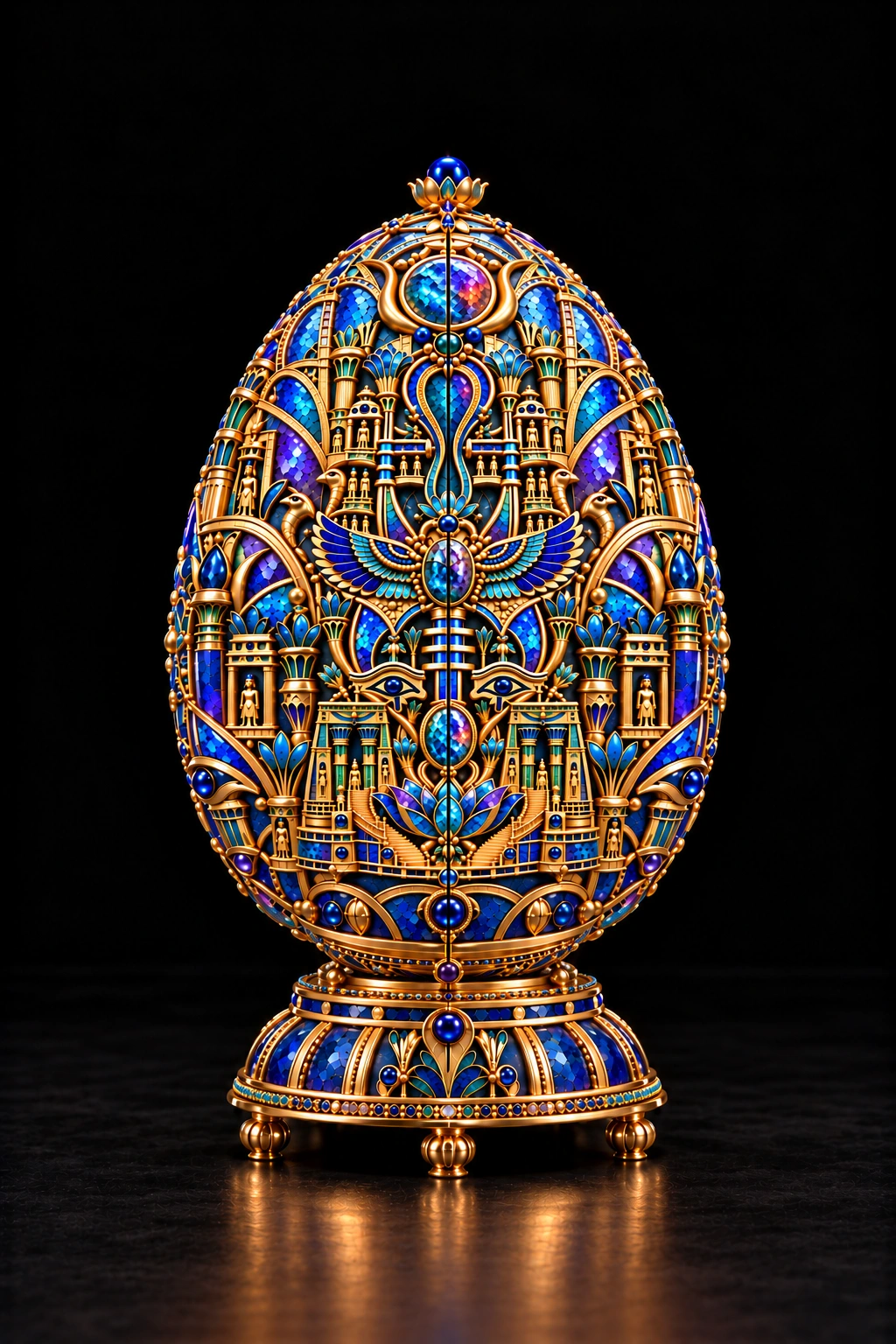
The egg experiment grew from looking at that expanded surface. I wondered whether the flattened design could become the exterior of a jewelled egg, carrying its architecture and fantasy gemstones around a curved form.
I had already been exploring Fabergé-inspired eggs and the intricate visual language of fine jewellery. Here, I wanted the exterior and the surprise inside to come from the same artwork. The shell would carry the expanded pattern, and the interior would reveal the original Axis of Harmony as a freestanding miniature.
That relationship gave the experiment a strong direction. The exterior could introduce the imagery in one form, then opening it could offer another encounter with familiar elements. The viewer would recognise the colour and goldwork while discovering a change in scale and arrangement.
The closed image needed to hold together as an egg. Its curved outline, central seam and decorated base had to remain readable beneath the intricate surface. The pattern also needed enough continuity for the shell to feel like a single object when closed.
Returning to the jewel inside
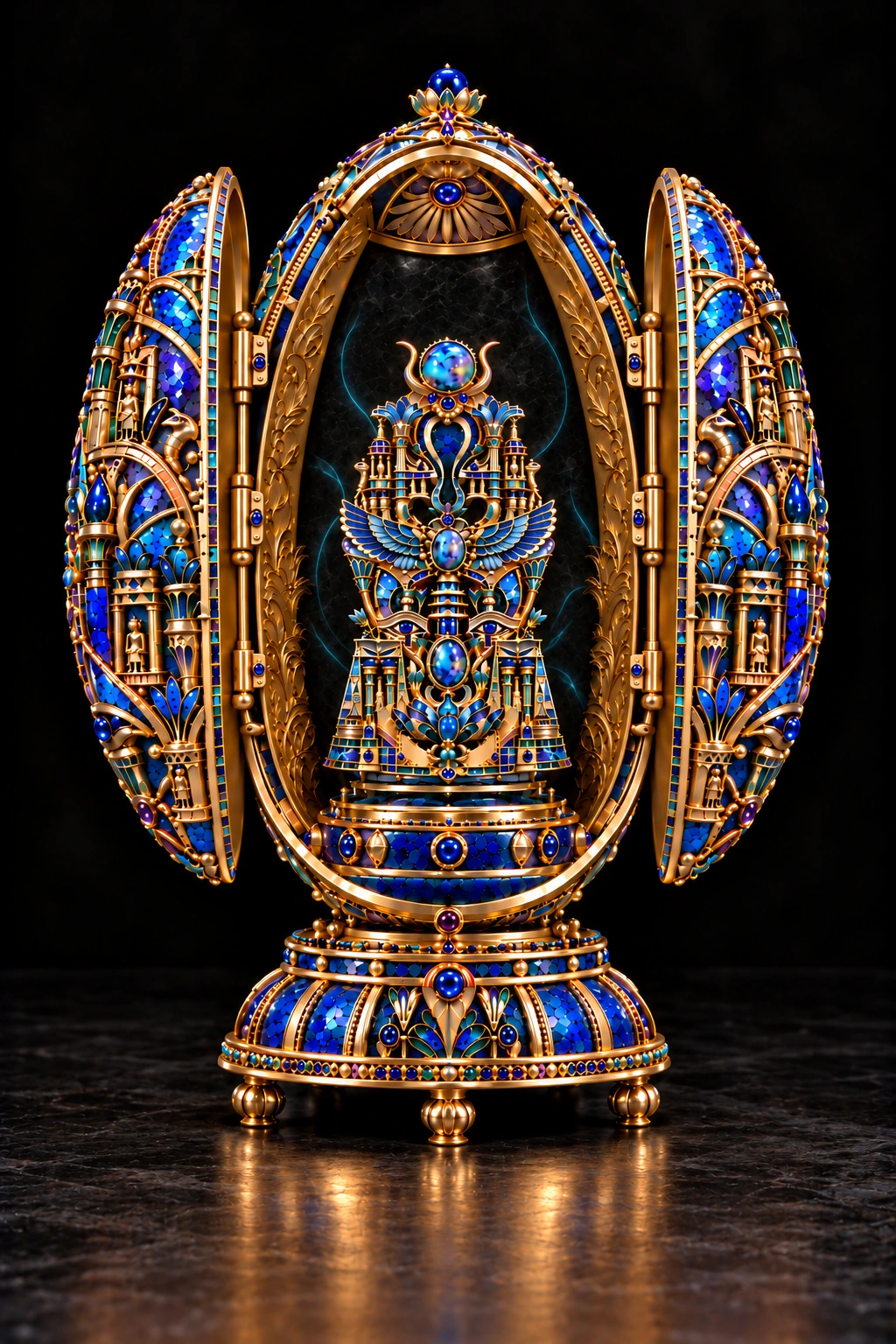
The reveal brought the original sculpture back into focus. Within the open shell, the miniature could stand independently, with the ankh, wings, paired eyes and lotus still visible. I wanted it to reward close inspection even though its apparent scale had changed.
Its size needed adjustment. An interior filled too tightly by the miniature would make the surrounding space difficult to appreciate. Reducing it slightly gave the goldwork room to register and allowed more of the interior backdrop to remain visible.
That breathing space became part of the reveal. The shell framed the sculpture, and the sculpture retained its own silhouette within that frame. The miniature's detail could then invite attention without competing with every passage around it.
The complete egg also needed room within the image. Pulling the viewpoint back gave the open doors and base a clearer relationship to the background. It helped me judge the overall proportions as well as the miniature inside.
Making the opening understandable
The opening mechanism became a significant part of the visual refinement. Two curved front doors were intended to swing to the sides, leaving a fixed rear section around the interior. The early appearance did not make that arrangement sufficiently clear.
Defining the hinge lines, gaps and stops helped explain the movement. A small clasp contributed to the closed arrangement. These details had to belong to the decoration while remaining recognisable as parts with a purpose.
Because this is a visual concept, those refinements suggest how the object might operate. They do not establish that the mechanism would function in a physical build. Their role in the image is to give the opening a coherent visual account, allowing the reveal to feel more convincing.
The base carried a related responsibility. Its connection to the shell, curved inlays, feet and contact shadows needed to make the object appear grounded. Its apparent stability mattered to how I read the whole egg, especially with the doors open.
A quieter background within the richness
For the interior, I explored a dark marble appearance. It gave the miniature a different setting from the original black background, while preserving enough darkness for the gold and gemstone colours to remain visible.
The veining needed restraint. Strong gold passages in the marble could compete with the miniature's finer goldwork. Reducing those accents made the backdrop quieter and kept the sculpture prominent.
That decision connects the egg to the earliest intention behind Axis of Harmony. Richness needs room to be understood. The right background can strengthen an intricate form by giving its edges and colours a clear place to appear.
The interior becomes another layer of that judgement: decorated shell, enclosing frame, dark backdrop and miniature jewel. Each contributes to the reveal through its relationship to the others.
Carrying the work forward
Across these developments, the artwork's identity rests in recurring relationships. The central line holds the composition together. Wings introduce lateral movement. Gemstone colour travels through gold settings. Architecture offers passages to explore, and the lotus gathers the lower forms.
The formats change what those relationships do. The upright jewel offers a silhouette against darkness. The expanded artwork surrounds the centre with an edge-to-edge field. The egg introduces an exterior, an opening and an interior, making discovery part of the imagined object.
This series has followed individual symbols, materials and refinements back towards the complete work. The final experiment brings those concerns into another form while leaving the original available to return to.
For me, that is the value of taking a jewel into a larger world. A settled design can become the starting point for another question. Axis of Harmony now offers several encounters with the same visual language, each shaped by the balance between what is immediately visible and what closer attention reveals.
Studio source note
This article draws on the recorded development of Axis of Harmony, its expanded full-bleed artwork and its closed and open jewelled-egg concepts. These are digital artworks and visual mock-ups, rather than documentation of manufactured jewellery or verified mechanical designs.