INSIDE AXIS OF HARMONY · ARTICLE THREE
Two Eyes, One Balance
By Jabbi Delahaye · 10 October 2026
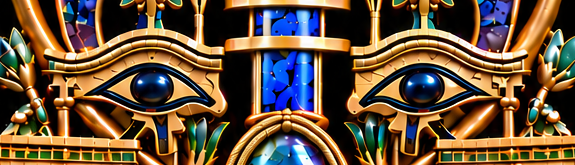
The paired eyes in Axis of Harmony change the way I encounter the whole image. Until I reach them, I can follow the goldwork, gemstones and miniature architecture as an imagined object. At the eyes, the experience becomes more direct. I am looking at the work, and something within its design appears to look back.
Their placement matters. They sit on either side of the central line, above the gateways and below the spreading wings. Each has a deep blue, rounded centre held within a dark outline and a gold surround. Together, they create a place where my attention settles before travelling through the lower part of the composition.
I wanted this pairing to belong to the wider sense of balance in the work. Its meaning develops through the relationship between two forms, the space separating them and the structure they share. Looking closely at the eyes also brings me back to the Egyptian imagery that informed the design, and to the care needed when history and personal interpretation meet.
The eye that was restored
The wedjat eye offers an important historical starting point. The Metropolitan Museum of Art describes it as the restored eye of Horus, combining human and falcon features. In the account given in its collection record, Seth injures or takes the eye and Thoth restores it. The museum connects the symbol with healing and rebirth, and explains that amulets in its form were believed to protect their wearers. [1]
That history gives the eye more depth than a general idea of watchfulness. It carries a story in which damage is followed by restoration. The association with protection sits beside an association with becoming sound again.
I find that distinction useful when approaching my own artwork. Protection can suggest a guarded boundary; restoration suggests care for what has already been disturbed. Together, those ideas allow me to consider the eyes as part of a composition concerned with connection and continuity.
These are meanings I am responding to through an image. The digital work makes no promise of healing or protection. Its spiritual depth comes from engaging with symbolism and giving the viewer room to consider it.
The left eye, the right eye and their meanings
The British Museum's record for a composite wedjat amulet associates Horus's right eye with the sun and his left with the moon. It connects the restored eye with the moon's waning and waxing, placing recovery within a recurring celestial cycle. [2]
The left, lunar eye is associated with the Eye of Horus, known as the wedjat, the restored or sound eye. This association gives me a historical foundation for considering restoration and renewal. The restored Eye of Horus also carries the protective associations discussed above. These meanings belong to the symbol's religious context; they are not claims about what the eyes in my digital artwork can do.
The solar eye tradition is associated with the name Eye of Ra, also written Eye of Re. It connects the eye with the sun god's power and forceful protection. Naming it alongside the lunar Eye of Horus gives me a clearer historical framework, while recognising that Horus's own right eye also has a solar association. [3]
That example helps explain why the distinction involves more than two mirrored outlines. The restored eye foregrounds recovery and wholeness; the Eye of Ra introduces divine solar power and forceful defence. Those emphases help me understand the imagery. The two traditions are related, and I do not treat the shorthand of a lunar Eye of Horus and a solar Eye of Ra as a rule that identifies every eye-shaped object by direction alone.
In Axis of Harmony, I interpret the pairing through day and night, outward energy and inward restoration. These are my artistic responses to the historical associations. The mirrored eyes share blue colour and gold surroundings, so their relationship matters more to my composition than dividing them into rigid roles.
Right and left here refer to the deity's eyes, rather than automatically to the viewer's sides of the image. I am not assigning one of my visible eye forms definitively to Ra and the other to Horus. I am bringing the solar and lunar associations into a contemporary pairing whose purpose is balance.
What the two forms do
From a distance, the eyes form a horizontal pause within a strongly vertical work. The crown draws attention upwards, the gemstones mark points along the centre, and the lower stairs invite the eye towards the base. Against those movements, the paired eyes hold a line across the composition.
That line helps connect the two sides. Their curved upper surrounds echo one another, while the central column and oval setting occupy the space between them. Each eye belongs to its own architectural area, but both participate in the same structure.
This is where balance becomes visible as a relationship between parts. Similar forms carry attention on either side of the centre. The viewer can move from one to the other and recognise the wider arrangement without having to inspect every small detail first.
Close looking reveals a different level of activity. Rounded blue surfaces catch small highlights. The dark eye outlines sit against warm gold. Narrow vertical elements descend beneath them, connecting the eye shapes with the structures below. The pairing remains clear while those smaller features give each side something to discover.
A blue centre within gold
The blue centres interest me because they gather light into a compact form. Their rounded appearance gives them a different character from the larger fantasy gemstones, whose fragmented interiors contain many changes of colour.
Here, the surface feels more contained. The bright reflections sit within dark blue, making the centre appear polished and curved. That small area of light gives the eye an intensity without requiring a large expanse of ornament.
Around it, the dark contour makes the shape legible. Gold provides the next boundary, then leads into surrounding architectural details. The material changes organise the view: blue centre, dark edge, warm surround, wider structure.
This is imagined jewellery, rendered digitally. What matters visually is whether the surfaces appear to belong together. The rounded centre needs a convincing place within its outline. The outline needs to remain distinct from the gold. Each transition contributes to the feeling that the detail has been considered.
Watchfulness without a face
There is no complete human face behind these eyes. They sit within an object that combines plant forms, architecture, wings and stones. That makes their presence unusual. They suggest attention while remaining part of an ornamental structure.
For me, this allows watchfulness to become an atmosphere within the work. It can be encountered as a sense of care around the lower sanctuary, where gateways and small figures suggest a world on a miniature scale.
I also want that encounter to stay open. Someone may first notice the polished blue centres and respond to their material appearance. Another viewer may recognise the Egyptian-inspired eye forms and bring knowledge of their symbolism. Both routes can lead towards a closer engagement with the image.
What a macro study can reveal
The paired-eyes close-up brings the material relationships into clearer view. It allows me to examine the contour of each eye, the placement of highlights and the transitions between dark outlines and gold surrounds.
The full image remains necessary. A close-up can make the eyes seem like the principal subject, while the complete work shows them participating in a much larger arrangement. Returning to that wider view restores their scale and their relationship to the wings, lotus and gateways.
Holding two kinds of attention
The pairing gives me a way to think about attention moving in different directions. Outward awareness takes in what surrounds us. Inward reflection makes space to consider what we have encountered. In my interpretation, both have a place within the work's balance.
The solar and lunar associations offer a starting point for that thought, while the visual arrangement gives it a form. Two related eyes share a structure. Neither has to disappear for the other to remain present.
What I value here is the connection between recognition and discovery. The eye shape is immediately readable, yet its setting invites a slower look. Historical meaning adds another layer, and personal interpretation allows me to continue working with what that meaning brings into the composition.
After exploring the ankh's open centre, the eyes offer a different encounter: a pair of concentrated forms that hold attention across the work. Their presence gives the viewer somewhere to pause, and perhaps a reason to look again.
Sources and further reading
[1] The Metropolitan Museum of Art, “Wedjat Eye Amulet,” object 11.215.141, New Kingdom, ca. 1386–1347 BCE. Collection record describing the restored eye of Horus, its human and falcon features, and its protective and regenerative associations. https://www.metmuseum.org/art/collection/search/551476
[2] The British Museum, “Amulet,” museum number EA29222. Collection record discussing a composite wedjat design and the solar and lunar associations of Horus's eyes. https://www.britishmuseum.org/collection/object/Y_EA29222
[3] The Metropolitan Museum of Art, collection record for object 30.8.100, Late Period, 664–525 BCE. Historical context for the Eye of Re and its connection with the sun god's power. https://www.metmuseum.org/art/collection/search/552833
The readings of outward energy, inward restoration and compositional balance are my artistic interpretations. Axis of Harmony is a digital artwork depicting imagined jewellery, rather than a reconstruction of the museum objects.