INSIDE AXIS OF HARMONY · ARTICLE TWO
The Ankh: Giving Life a Shape
By Jabbi Delahaye · 10 October 2026
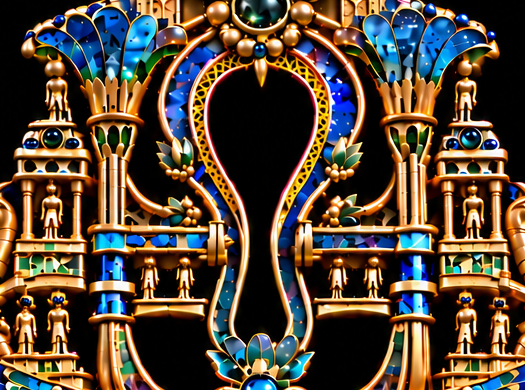
The first thing I want to look at more closely in Axis of Harmony is something the image leaves open. There is gold around it, blue and turquoise along its edges, and an elaborate world on either side. Yet the dark space near the centre holds its own. It gives the surrounding detail a shape and offers the eye a place to pause.
In the introductory article, I described wanting a quiet centre that the other elements could belong to. The ankh became part of that question. Its presence in this work depends on the relationship between the outlined form and the space it contains. To understand that relationship, I need to look at both the inherited symbol and the decisions visible in my own composition.
A meaning to begin with
The historical starting point is clear. The Metropolitan Museum of Art explains that the ankh was a hieroglyph used for words associated with living and life. Its collection includes a wooden model dated to the Middle Kingdom and a faience ceremonial implement from the New Kingdom. These objects show the sign taking material form across different periods. [1, 2]
That gives me a foundation for approaching it. A familiar outline carries a specific history. Its meaning does not begin with the associations I might attach to it today, and the richness of a contemporary image cannot substitute for understanding the source.
I find the connection between a written sign and a material object especially useful here. A meaning can be expressed through a mark, then encountered as a thing with an edge, a surface and a scale. My digital artwork takes another step in that relationship, giving an inherited form a place within an imagined jewel.
My interpretation needs to remain visible as an interpretation. When I speak about openness, continuity or breathing space in Axis of Harmony, I am describing how I read my own composition. The historical association with life is the point of departure.
An outline within a larger world
The conventional ankh has a loop above a crossbar and a descending stem. The form in my artwork is interpreted more freely. Its outline is stretched and woven into neighbouring structures, so the viewer encounters a suggestion of the symbol through several connected parts.
Near the upper centre, a gold-edged opening curves inward as it descends. Blue surrounds it, and small details follow its perimeter. Horizontal architectural connections extend towards either side. Lower down, the central line continues through other stones and structures.
I would describe this as an ankh-inspired arrangement rather than a direct reproduction of an ancient object. That distinction helps explain what the image is doing. Its central form belongs to a composition filled with wings, miniature buildings, eyes and flowers. Each changes how the others appear.
The connections matter because a shape can be recognisable without being isolated. Here, the surrounding work participates in its presence. Follow a gold edge, and the eye begins to read a contour. Follow a horizontal connection, and the central form becomes part of the architecture. The image asks the viewer to assemble those relationships through looking.
What the open space contributes
The dark interior makes the contour easier to see. Gold is especially legible against it, while the blue border gives the opening another layer. There is a difference between looking into a gemstone, where colour and internal fragments suggest depth, and looking into this space, where the background remains visible.
That contrast creates a useful change of pace. The larger stones are visually active. Their blues, violets and small warm accents ask the eye to keep searching. The open area allows attention to rest before returning to the more densely worked sections.
For me, this is where the central form begins to contribute to harmony. The work has enough ornament to sustain prolonged inspection, but the viewer also needs places from which to understand that ornament. The opening gives the neighbouring details a boundary.
I read that openness as a way of making room within abundance. This is a personal artistic association. It grows from the experience of looking at a composition where a space can carry as much visual weight as a stone.
Gold as a boundary
The goldwork gives the opening its definition. Its curves need to remain readable through changes in width, direction and surface detail. Where the line narrows, the shape becomes more delicate. Where the surrounding structures broaden, the centre appears to gather support from them.
The inner decorative edge adds intricacy, but it also raises a practical visual question: can I still follow the main contour? If every small feature attracts equal attention, the larger shape becomes harder to read. The detail needs a place within the hierarchy.
Light is part of that hierarchy. A brighter passage along an edge suggests a rounded surface, while a darker transition can help distinguish it from the element beside it. In an imagined jewel, those changes make the goldwork feel more coherent.
My interest in craftsmanship therefore reaches beyond the number of details. The image needs to suggest care in the way parts meet. Around this central form, a convincing connection helps the viewer believe in the whole arrangement, even while recognising that it is a digital creation.
Looking close, then stepping back
Macro inspection offers one way to test those relationships. Enlarging the centre makes it possible to examine the outline, the small repeating details and the points where nearby structures approach it. At that scale, a slight interruption can become much more noticeable.
The full composition answers a different question. Does the central form still hold attention among the crown stone, wings and architectural base? Is it clear enough to orient the viewer? Does its openness remain useful when the small details are no longer individually visible?
Both views are necessary. An enlarged study can reveal an awkward edge, but it cannot tell me everything about balance. Returning to the complete image allows the result of a refinement to be judged in context.
That is also why I want the close-up to sit beside the full artwork in this series. A macro image gives access to the smaller decisions. The wider view explains what those decisions are serving.
Life within the composition
The ankh's association with life gives this part of the work a depth that deserves more than a decorative mention. I do not want to turn that association into a list of spiritual promises. I want to consider what it asks of the image.
Within Axis of Harmony, I connect it to the continuity of the composition: the way one form leads towards another, the movement between open and occupied space, and the sense that the different elements belong to a shared structure. These are the meanings I am developing through the work.
The central opening remains important because it allows that structure to breathe. Around it, the goldwork and colour can become intricate without entirely closing the image. The viewer can look through, around and along the form, finding different routes of attention.
Giving life a shape, for me, means holding that inherited association together with the experience of looking. The historical sign gives the work a starting point. The composition gives me a way to explore it. In the space between those two, the ankh becomes a question I can keep returning to.
Sources and further reading
[1] The Metropolitan Museum of Art, “Model ankh,” object 12.182.66, Middle Kingdom, ca. 1981–1802 BCE. Collection record explaining the sign's association with life and identifying the wooden object. https://www.metmuseum.org/art/collection/search/546309
[2] The Metropolitan Museum of Art, “Ceremonial Implement in the Shape of an Ankh,” object 30.8.29, New Kingdom, ca. 1396–1386 BCE. Collection record identifying the faience object and its historical context. https://www.metmuseum.org/art/collection/search/544840
The discussion of Axis of Harmony's composition and symbolic relationships is my artistic interpretation. The artwork depicts imagined jewellery; it is not a reconstruction of either historical object.