INSIDE AXIS OF HARMONY · ARTICLE FOUR
Wings of Renewal
By Jabbi Delahaye · 10 October 2026
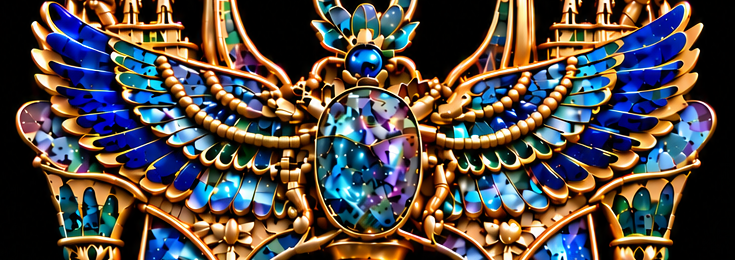
The wings give Axis of Harmony room to spread. In a composition that rises through gateways, gemstones and the open central form, they carry the eye sideways. Their outer feathers lift, while the inner rows curve back towards the body. The image remains still, but this part of it suggests an unfolding movement.
That movement matters to the balance of the work. The wings occupy a broad span around a concentrated centre, holding width and weight in relationship. When I look at them, I can follow individual feathers or take in the whole sweep. Both encounters lead back to the scarab-inspired form from which they extend.
I named this article Wings of Renewal because renewal gives me a way into both the inherited symbolism and the visual experience. The historical associations deserve a clear account. My own interpretation develops from the forms I have made: layered colour, outward movement and a centre that continues to hold.
The scarab and the returning sun
The scarab's association with renewal begins with an insect. The Metropolitan Museum of Art explains that ancient Egyptians connected the dung beetle's movement of a ball of dung with the sun being brought into the sky at dawn. Its account also relates the beetle to kheper, a word associated with becoming or coming into being. [1]
Khepri names the rising-sun deity associated with the scarab. In its discussion of another object, the museum identifies a winged beetle carrying a small sun disc as Khepri, distinguishing this rising-sun aspect from Re's broader solar presence. [2]
Those references give the idea of renewal a specific foundation. It belongs to a religious understanding of emergence and the solar cycle. The return of light offers an image of life continuing through change, with the scarab carrying that meaning into material forms.
For my artwork, this provides a starting point. I read the outward spread of the wings as a movement of renewal within the composition. That reading is personal; it responds to the history without turning my digital image into an ancient ritual object.
Why these wings have feathers
There is an important detail in the historical imagery: the wings of a winged scarab need not resemble the wings of an actual beetle. The Met's Late Period faience example consists of a scarab body and two separately made wings. Its record identifies those as bird wings, with individual feathers indicated. Small holes allowed the pieces to be fastened to mummy wrappings, within a funerary context concerned with rebirth. [3]
I find that combination useful to consider. A beetle form can belong to a larger symbolic image whose parts come from different kinds of living things. The feathered wings contribute to an arrangement that carries meaning beyond naturalistic anatomy.
Axis of Harmony also combines forms freely. The scarab-inspired centre is transformed through imagined stones and goldwork, while the wings spread into a richly decorated structure. I am approaching it as a contemporary interpretation, with the historical examples helping me understand the visual language I am working with.
The centre from which everything opens
In the close-up, the large oval gemstone gives the winged form a strong centre. Its blue, turquoise and violet fragments create a different kind of activity from the feathers beside it. Within the stone, the eye moves between small areas of light. Along the wings, it follows a sequence of elongated shapes.
The gold surround keeps the oval legible. Smaller gold forms meet it on either side, gathering the wing structures into the central area. Above, a rounded blue detail sits beneath a flower-like arrangement. Together, these features give the middle enough presence to hold the breadth of the wings.
That connection is essential to how I read the image. If the feathers seemed detached from the centre, their spread would feel less purposeful. Their movement needs somewhere to begin and somewhere to return.
For me, the gemstone brings a sense of contained energy to that position. This is an artistic impression created through colour and light. The wings give that impression an outward direction.
A rhythm made from feathers
The feathers form several visible rows. Darker blue areas sit beside turquoise and pale passages, with gold following the edges. Their repetition creates a rhythm, but changes in length and angle keep the wing from becoming a flat pattern.
Near the centre, the forms are smaller and more closely gathered. Further out, the longer feathers extend the sweep. Their rounded ends allow one shape to lead towards the next, while the fine boundaries help each remain distinct.
Curved bead-like rows add another movement across the wings. They introduce a sequence of small rounded highlights beside the broader feather surfaces. That difference in scale gives the eye another path to follow.
These details need to work together. The feathers establish the main sweep; the smaller rows add structure within it. When the hierarchy remains clear, intricacy can deepen the experience of the wing without obscuring its overall shape.
Blue, teal and the work of gold
Colour helps the wings belong to the rest of Axis of Harmony. Their blues connect with the larger stones and architectural inlays. Turquoise and teal create brighter transitions, while gold carries the outlines into surrounding forms.
I wanted those colours to remain rich enough for close looking. A dark feather can support a brighter neighbour, giving its surface more presence. A small pale reflection can suggest a change of plane. Variation helps the wing feel layered.
The gold is especially important where those layers meet. Its edges separate surfaces that might otherwise merge, and its warmer tone gives the blue more definition. A curve of gold can describe the end of a feather or connect a small detail to the larger structure.
This is a digital depiction of imagined jewellery. I describe what the surfaces suggest visually, rather than claiming a particular physical technique or identifying the blue passages as a specific gemstone. Their convincing appearance depends on how coherently light, boundaries and colour behave together.
Movement within symmetry
The two wings mirror the broad direction of one another. Their shared sweep helps the composition feel steady, yet their curves suggest lift. This is the tension I wanted to preserve: an orderly arrangement that still gives the eye something to follow.
The outer feathers draw attention towards the edges, then the curved rows bring it back towards the scarab. Below, the architectural forms carry the view further down. Above, the open centre provides another route through the work.
The wings therefore act as a crossing point between several movements. They connect the two sides while participating in the vertical structure. Their width expands the image at a place where its central line remains strong.
I read renewal here through that unfolding. The historical solar association informs the thought, while the visible arrangement gives me a contemporary way to explore it. The form seems to open without losing its connection to the whole.
What looking closer asks
The macro study makes it possible to examine where one feather overlaps another, where a gold edge turns and where a small connection meets the centre. These are useful places to judge whether the imagined object holds together.
An overlap needs enough definition to suggest depth. A highlight should help explain the surface it occupies. The smaller gold elements need clarity without becoming so prominent that they interrupt the sweep of the wing.
Returning to the full artwork changes the scale of those judgements. The wings have to contribute to the whole alongside the crown, eyes, lotus and gateways. Their detail matters because it supports that relationship.
This is where the title comes back into focus for me. Wings of Renewal describes an inherited association, but it also describes an encounter with the image: a centre opening into colour and form, held within a larger balance. The close-up lets us follow how that movement is made, one feather at a time.
Sources and further reading
[1] The Metropolitan Museum of Art, “Scarab,” object 04.2.790, New Kingdom, ca. 1166–1158 BCE. Historical explanation of the beetle, the rising sun and kheper. https://www.metmuseum.org/art/collection/search/549307
[2] The Metropolitan Museum of Art, collection record for object 10.130.701, New Kingdom, ca. 1300–1080 BCE. Identification of a winged scarab with a sun disc as Khepri. https://www.metmuseum.org/art/collection/search/558714
[3] The Metropolitan Museum of Art, “Winged Scarab,” object 30.8.1082a–c, Late Period, 664–332 BCE. Bird-wing forms, separate components and funerary use. https://www.metmuseum.org/art/collection/search/552844
The discussion of Axis of Harmony's colour, movement and renewal is my artistic interpretation. The work is a digital artwork depicting imagined jewellery.