INSIDE AXIS OF HARMONY · ARTICLE FIVE
A Sanctuary in Miniature
By Jabbi Delahaye · 10 October 2026
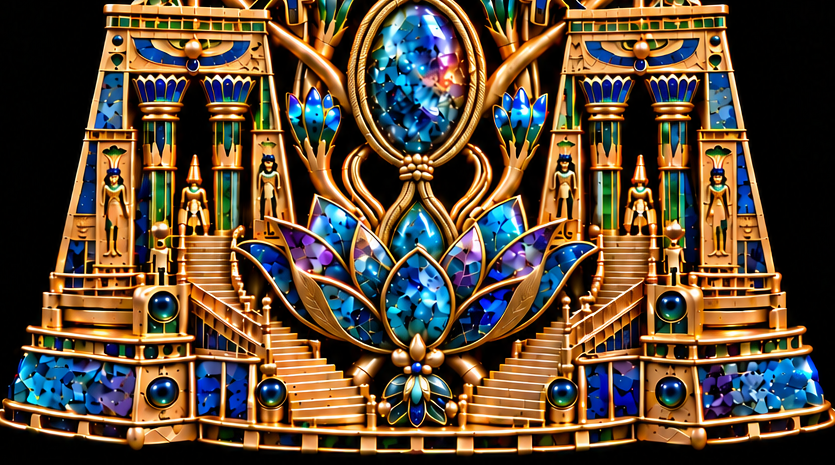
A staircase changes the way I look at a jewel. Before I notice the steps, I can follow a curve of gold as part of a setting. Once I see them, that same curve becomes a route. There is somewhere to stand, somewhere to climb, and an opening ahead. The image begins to offer a different kind of encounter.
In Axis of Harmony, the gateways, columns and small figures make that change possible. They occupy relatively little space within the whole composition, yet they alter its apparent scale. A stone that might fit within an imagined piece of jewellery begins to feel enormous beside a figure. A gold surround becomes a platform. Looking closer becomes a way of entering.
This is what I mean by a sanctuary in miniature: the sense of a place held within an object, with enough structure to invite the imagination beyond its surface.
When ornament becomes architecture
The lower part of the work brings several kinds of form together. The lotus opens between two architectural settings. Gold steps lead towards raised openings, while dark columns and small figures give those openings definition. Above and around them, the gemstone settings remain visible as settings. I can read this area as jewellery and as a small constructed world.
I like the moment when those readings overlap. The architecture does not require the rest of the image to stop being ornamental. A column can help organise a pattern while also suggesting something that bears weight. An opening can interrupt a band of colour while inviting me to imagine the space beyond it.
The gateways give this part of the composition a particular rhythm. Their uprights establish steadiness beneath the broader movement of the wings. Their horizontal tops create smaller resting points within the larger arrangement. Between them, the lotus keeps its own presence. The buildings frame that presence without enclosing it.
At a distance, these relationships help the base hold together. Closer in, the architecture begins to ask different questions. How would someone approach? What lies behind the figure? How far might the opening extend? The image offers enough information to begin imagining, while leaving those questions open.
A historical comparison
Research gives me a useful way to place these architectural associations alongside actual Egyptian structures. The Metropolitan Museum of Art's account of the Temple of Dendur describes a gateway, an open courtyard, an entrance hall, an offering hall and an inner sanctuary. Its discussion follows the movement of a cult image from the sanctuary towards the outer spaces. Architecture here had a role in religious activity, giving that movement a sequence and a setting. [1]
That context helps me appreciate the significance of thresholds. An entrance belongs to a relationship between spaces; its meaning extends beyond its outline.
My gateways are invented forms within a digital composition. They are not a reconstruction of Dendur, and the stairs do not illustrate a documented ritual route. The historical example gives me a comparison through which to think about the difference between depicting a doorway and suggesting a place.
The museum also explains how Dendur's decoration relates its architecture to the natural world, including plant forms at its base and in its columns. [2] That relationship interests me when I look at the lotus beside my own architectural details. In Axis of Harmony, flower and building share the same imagined material world. Their proximity lets organic curves and upright structures support one another.
The figure as a measure
The small figures make the architecture more legible. Without them, I might first see the openings as elaborate settings or dark interruptions in the gold. With them, I begin to judge height and distance. The figures give the surrounding forms a scale I can recognise through my own body.
They do not need to occupy much of the image to do that work. A head beneath a lintel, a body between columns, or feet meeting a platform can be enough to suggest a place that accommodates someone. Those relationships make the setting feel occupied.
I leave their identities open here. What interests me is their contribution to the experience of looking. They allow a viewer to imagine standing within the image, rather than observing every element from outside.
There is an illuminating comparison in the Met's Model of a Granary with Scribes, a Middle Kingdom object from the tomb of Meketre, dated approximately 1981–1975 BCE. Its modelled spaces contain figures carrying grain and attending to measuring and accounting. The museum explains that such models formed part of Meketre's funerary equipment, intended to provide for his afterlife. [3]
That object has a purpose and context very different from my artwork. I find it useful because it shows how figures make a miniature architectural setting readable through occupation and activity. In my composition, their presence similarly helps an arrangement of forms become somewhere.
Following the steps
The stairways give the eye a way to approach these small settings. Their repeated edges create a sequence across the curved gold base. Each step suggests another position, so the gaze can move through the detail gradually.
That movement matters within a symmetrical image. The overall arrangement can be understood quite quickly, but a staircase slows the encounter. I find myself following individual divisions, then looking up towards the opening they serve. The architecture introduces a local journey within the larger composition.
The steps also connect different kinds of surface. They emerge from an ornate base where gold and colour are already active, then lead towards darker, more enclosed spaces. The transition gives the gateways a sense of arrival.
Because this is an imagined object, those routes can remain suggestive. I want enough coherence for the viewer to follow them, without turning the image into an architectural plan. Their value lies in making movement imaginable.
Gold, shadow and an interior
An opening needs darkness as well as an edge. The gold can describe its boundary, but the darker space behind the columns helps it read as an interior. That difference in light gives the small architecture depth within a busy image.
The columns have a related task. Their dark surfaces remain distinct from neighbouring gold, while the details at their tops help mark the transition towards the lintels. Small changes of surface separate the parts so that the eye can understand how they meet.
Here, my attention returns to the discipline of digital refinement. A highlight may make a tiny edge clearer, but too much brightness can flatten the opening or draw attention away from the figure. A shadow can suggest depth, yet it still needs to leave the architecture readable.
The most useful changes are often modest. They help a step remain a step, a column remain distinct, or a figure hold its place. When those relationships work, the larger fantasy becomes easier to inhabit.
Looking through the close-up
The macro view brings these relationships forward. Details that contribute texture in the full image become the subject of attention: the stairs, the spaces between the supports, the figures beneath the openings, and the gold edges that connect everything to the base.
Returning to the full composition then changes what I see. I know those small passages are there even when I cannot inspect them individually. Their presence gives the larger work a depth that does not depend entirely on visibility at first glance.
This is one reason I value the close-up studies. They let a viewer spend time with a particular area and carry that discovery back into the whole. The architecture rewards that exchange because its scale is so easily overlooked.
A place within the object
The word sanctuary expresses my experience of these details. The gateways suggest shelter and an interior; the raised settings give the figures somewhere to belong. Around them, the work remains expansive, full of gemstones, wings, flowers and gold.
These small places make that abundance approachable. They offer points where I can imagine pausing, looking upwards, or following a path. Their scale brings a human measure into a composition whose other forms can feel immense.
For me, that is their contribution to harmony. They make room for an imagined encounter within the ornament. A viewer can admire the surface, then notice a stairway and begin to see the work differently.
A jewel holds a setting. A setting holds a figure. And that small figure opens a world.
References
[1] Dieter Arnold and Adela Oppenheim, “The Temple of Dendur: Architecture and Ritual,” The Metropolitan Museum of Art, 2 November 2018. https://www.metmuseum.org/essays/temple-of-dendur-architecture-and-ritual
[2] The Metropolitan Museum of Art, “The Temple of Dendur,” collection record, object 68.154. https://www.metmuseum.org/art/collection/search/547802
[3] The Metropolitan Museum of Art, “Model of a Granary with Scribes,” collection record, object 20.3.11. https://www.metmuseum.org/art/collection/search/545281