INSIDE AXIS OF HARMONY · ARTICLE SIX
The Lotus Beneath Everything
By Jabbi Delahaye · 10 October 2026
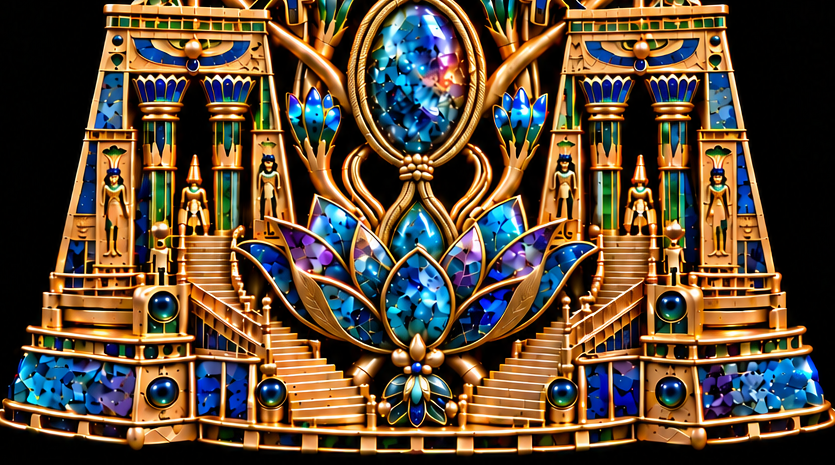
The lotus draws my attention downwards before it sends it back up through Axis of Harmony. Its petals spread between the stairways, opening around a bright blue centre. Above it, the oval stone and branching goldwork continue the central line. Around it, the gateways establish their own small worlds. The flower gives these different forms somewhere to meet.
That position interests me as much as the flower itself. In a composition with wings, eyes, architecture and gemstones, the base has a great deal to hold together. The lotus brings width and an upward movement into that lower area. Its outer petals reach towards the buildings; its central petals lead the gaze towards the stone above.
I think of it as a gathering point. It lets me recognise the relationship between the two sides before I begin following their smaller details.
An opening at the base
The flower has a clear silhouette, even though its interior is full of colour. Pointed petals rise and turn outwards, each enclosed by a gold edge. Some stand behind others. The overlaps suggest a flower opening in several directions, while the central petal keeps the axis visible.
Those overlaps do a lot of work. If every petal occupied the same plane, the flower would read more like a flat emblem. Here, the successive layers give it depth. A dark interval between neighbouring forms makes one seem to sit forward; a thin line of gold carries another edge through the surrounding colour.
The flower is also substantial beside the figures in the gateways. Their small scale makes its petals feel almost architectural. It belongs to the same imagined jewel, but it can be read as something much larger within that miniature world.
I enjoy that uncertainty of scale. The image allows a flower to remain recognisable while becoming a structure capable of organising the space around it.
The Egyptian lotus in the sources
The Metropolitan Museum of Art describes the plant commonly called the Egyptian lotus as a water lily. In its account of a Lotus Flower Inlay from Amarna, the museum connects the flower's opening cycle with the rising sun, creation, daily rebirth and rejuvenation. [1]
That association gives this part of the work a historical depth beyond its appearance. The symbol draws meaning from a natural event: a flower opening, and the return of light. Renewal is expressed through something that could be observed.
The inlay is made of faience and belongs to the New Kingdom's Amarna Period. [1] I find the object useful as an example of a plant form translated into a crafted material. The outline and colour could carry an association even when the flower itself was absent.
A second object, the Met's Middle Kingdom Model Lotus Flower, is made of painted and plastered wood. The museum notes that offering bearers were found in the same tomb and suggests that model flowers might have belonged to their offerings. [2] That possibility places the flower within an activity as well as an image.
These examples help me think about the movement from plant to symbol to object. My own lotus takes a different material direction, becoming gold-edged, gemstone-like petals within a digital artwork. I keep that interpretation distinct from the ancient objects and their purposes.
Colour held within a petal
The petals in Axis of Harmony contain blues, turquoise and violet, with smaller flashes of lighter colour. Their interiors are fractured and irregular. Those changes make the surfaces active, but the surrounding gold keeps the individual forms legible.
I can follow a petal's outline before looking into it. Once inside, the eye encounters smaller divisions of colour, bright fragments and darker passages. The large shape stays steady while the surface offers further discoveries.
That relationship is especially useful at the base. The flower needs to register as one form within the complete image, yet it also needs to sustain the closer encounter. Its outline gives the first reading; the imagined stone gives the second.
I describe these as fantasy gemstone surfaces. Their colours do not establish a particular mineral, and I would not assign them a stone's traditional properties simply because they resemble it. Their contribution here comes through the image: depth, brightness and variation contained within recognisable petals.
The violet areas also help distinguish neighbouring layers. Against the stronger blues, they create changes that make the flower easier to explore. Looking across it, I encounter several related surfaces rather than one uninterrupted field.
What the gold makes clear
Gold gives the flower its structure. It marks the edges, traces the overlaps and gathers the pointed forms towards their lower junction. Without those divisions, the neighbouring colours could merge and make the bloom difficult to read.
The outline changes as it passes around each petal. It curves broadly along the outer forms, then tightens towards the points. That movement keeps the setting responsive to the flower's shape.
There are also quieter gold areas within the petals, where the surface interrupts the gemstone-like colour. These give the eye another kind of detail to follow. A broad reflective area behaves differently from a fractured blue interior, so the flower gains variety without requiring another motif.
This is where coherence matters to me. A rich surface still needs clear relationships between its parts. The edge must belong to the petal, the petal must remain distinct from its neighbour, and the lower junction must feel connected to the rest of the work.
The flower's apparent luxury depends on those relationships being readable. Colour can attract attention immediately; the setting gives that attention somewhere to go.
Between the two stairways
The stairways approach their gateways on either side of the lotus. Their repeated horizontal edges create a measured rhythm. The flower introduces longer curves and pointed forms between them, changing the pace of that lower section.
The architecture gives the petals something firm to answer. Steps and platforms establish levels, while the flower spreads across the centre with a different kind of movement. Each becomes clearer through its proximity to the other.
That meeting also connects this article to the previous one. In A Sanctuary in Miniature, I looked at how architecture and figures make the image feel inhabitable. Here, the lotus occupies the space between those places. It gives the imagined setting a large organic presence.
I do not read it as a literal garden within the jewel. Its scale is too fluid for that. I see a flower participating in the architecture of the whole composition, shaping the route the eye takes through it.
Renewal within this work
The historical association with rebirth gives me a starting point for a personal reading. In Axis of Harmony, I see renewal in the flower's unfolding form: the way the petals separate, extend and rise from a shared junction.
That reading comes from looking at this particular image. The ancient symbolism supplies context, while the composition gives the association its present shape.
There is a relationship with the scarab discussed earlier in the series. Both motifs have Egyptian associations with renewal, but they contribute differently to my work. The wings carry the gaze laterally across the upper area. The lotus gathers it lower down, then directs it upwards through the centre.
Together, they make that theme available at different points in the image. A viewer may notice the spread of the wings first, or begin with the flower. Either route can lead into the wider arrangement.
The close-up and the whole
In the macro study, the flower becomes large enough for its internal relationships to be examined individually. I can follow where one gold edge passes in front of another, where a dark interval separates two petals, and where a highlight gives an imagined stone its rounded depth.
Returning to the complete artwork tests those discoveries against the composition. A detail may be attractive on its own but still need restraint if it pulls attention too strongly. The flower has to keep its presence without disconnecting from the gateways or the central stone.
That exchange between scales is part of the way I understand the work. The close-up reveals how the flower is articulated; the whole shows what that articulation contributes.
Beneath everything, still opening
The title refers to the lotus's place in the image and to the role I see it performing. It gathers the lower forms, keeps the central line alive and gives the architecture a curve to sit beside.
For all the detail within its petals, its most immediate gesture remains simple: opening. I can recognise that gesture before I inspect the imagined materials.
At the base of Axis of Harmony, the flower holds that moment. The buildings stand on either side, the stone rises above, and the petals keep unfolding between them.
References
[1] The Metropolitan Museum of Art, “Lotus Flower Inlay,” New Kingdom, Amarna Period, collection record, object 26.7.967. https://www.metmuseum.org/art/collection/search/548302
[2] The Metropolitan Museum of Art, “Model Lotus Flower,” Middle Kingdom, collection record, object 25.3.283. https://www.metmuseum.org/art/collection/search/545285