INSIDE AXIS OF HARMONY · ARTICLE SEVEN
Imagining a Gemstone That Does Not Exist
By Jabbi Delahaye · 10 October 2026
My fantasy gemstones began with studying real ones. Rubies, lapis lazuli, emeralds and opals gave me different ways to think about colour, light and the presence a material can have. I was also interested in the meanings people have attached to stones: how a colour, a rarity or a history could become part of an artwork's story.
That study became a starting point for creating gemstones of my own. I began taking what I was learning about natural stones and bringing it into imagined materials, combining qualities that interested me into something new. These became my magical gemstones: a fantasy collection that I could draw on within my artwork.
Axis of Harmony brings that practice into an imagined jewel. Its stones carry the learning forward through colour, apparent depth, reflections and the goldwork around them. The oval stone is one example, but the idea reaches across the piece, into the wings, petals and smaller settings.
Learning from colour and meaning
Each real gemstone offers a different starting point. Ruby brings the intensity of red. Lapis lazuli offers a deep blue with a substantial, almost solid presence. Emerald gives me another direction through green, while opal invites attention to flashes of different colours within a single stone.
Their meanings add another layer to that looking. GIA's history of ruby describes traditions connecting its red colour with blood and the power of life, as well as its continuing association with passion. [1] Those are cultural associations built around a material's appearance and history.
Lapis offers a different kind of grounding. GIA records its appreciation by ancient civilisations including Egypt and Mesopotamia, and its use in carvings, inlays and amulets. [2] Its history extends beyond a stone set in jewellery. It has been shaped into objects that people carried, used and valued.
Studying these materials means paying attention to both their visual qualities and the stories around them. I want to understand where an association comes from before bringing it into my own work. A stone's meaning changes with its context; it is not a fixed definition that every culture shares.
That leaves room for my own interpretation. I can respond to the intensity of ruby or the depth of lapis, then consider what those qualities might contribute to an image.
From studying stones to inventing them
Creating my own gemstones lets that learning take another form. I can bring a deep blue together with turquoise, violet and a small warm flare. I can imagine a polished outer volume containing angular fragments, bright passages and darker spaces.
The result belongs to a fantasy collection. I use the word magical for the experience I want these stones to offer: the sense that a small material form contains more than the first glance reveals.
That experience needs a structure. Many colours placed together do not automatically make a convincing gemstone. The surface needs to suggest a volume; the interior needs enough variation to reward looking; the outline needs to hold those discoveries within a clear form.
The real stones remain sources of learning and inspiration. My imagined stones develop their own identities through the combinations I create. Their meaning grows through their use in an artwork, including the symbols, settings and other forms beside them.
Looking into the oval stone
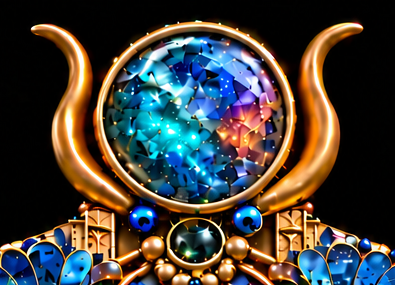
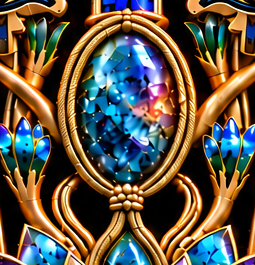
The oval stone in Axis of Harmony makes that approach visible. Blue fragments cross darker passages. Turquoise catches the light near the upper edge. Violet and a small warm flare concentrate towards one side. Bright reflections seem to sit over that activity, giving the whole form a polished outer surface.
Its gold setting gives it a definite boundary. Inside that boundary, the colour is much less settled. Some fragments appear near the surface; others seem to recede. I can recognise the form as a jewel while continuing to explore what kind of interior it might contain.
The darker divisions are essential to that impression. They separate the luminous areas and keep the stone from becoming one continuous glow. A pale fragment gains presence because the area beside it is quieter.
Where a reflection crosses several divisions, the oval can read as a continuous polished volume containing a more complicated interior. That relationship lets the stone feel whole despite its many internal shapes.
What gemstone research makes possible
Research gives this invented interior useful comparisons. In GIA's account of inclusions, mineral crystals and cavities containing fluid or gas can occur within a host gemstone. Studying them can help reveal a stone's identity, formation history, origin or treatment. The article also considers their visual interest through photographs taken under magnification. [3]
That helps me appreciate how much there can be to see within a real stone. An interior can be a subject in its own right.
My fragments are appearances within a digital image. They suggest an internal world, but they are not evidence of actual mineral inclusions or a geological history. The research sharpens my attention to real materials while giving me comparisons for the effects I imagine.
Opal offers another example. GIA explains that precious opal's play-of-colour results from light interacting with an ordered arrangement of microscopic spheres, producing diffraction. [4] That is a specific mechanism, belonging to a real material.
An opal-like quality in my fantasy stones is a visual association: flashes of varied colour within one form. Understanding the distinction helps me work with that inspiration more thoughtfully.
A collection within the composition
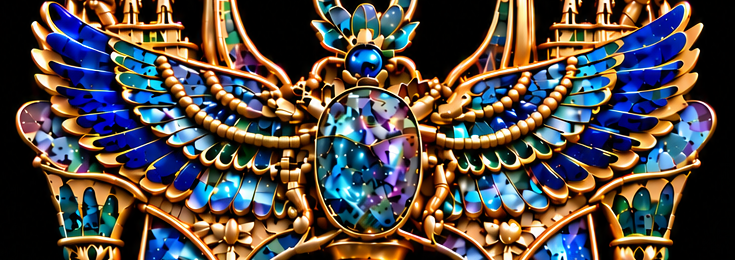
The gemstone language extends beyond the oval. In the lotus, related colours occupy pointed petals and participate in the flower's unfolding movement. In the wings, layered blue and teal forms carry the gaze across the composition. Along the architectural base, fractured colour becomes part of a broader band.
The smaller rounded stones offer another pace. Their compact reflections create short points of attention beside the larger areas of detail. They allow the imagined jewel to contain several kinds of encounter.
Together, these forms show how I can use my fantasy gemstones within an artwork. A material can belong to the same collection while changing its role according to its shape, scale and setting.
Where the meanings meet
The gemstones sit among symbols already discussed in this series: the ankh, the paired eyes, the scarab and the lotus. Their presence adds another layer to those encounters.
The lotus's historical association with renewal provides one context. The imagined material within its petals contributes colour, depth and brightness to the way I meet that flower now. The symbol and the gemstone surface work together within the composition.
This is how the study of gemstones and their meanings enters my practice. It informs the choices I can make, then the artwork gives those choices a particular relationship. I am creating a new setting for what I have learned.
The stones' magical quality belongs to that encounter. They invite the viewer to look further, moving from the recognisable shape towards the less familiar world inside it.
The gold gives the invention a place
The gold settings help those worlds feel contained. Around the oval, an inner rim and textured surround follow its shape. Below it, rounded gold details meet the curved branches, connecting the stone to the larger object.
The setting gives the eye something continuous to follow beside the irregular interior. Its clear boundary lets the gemstone remain visually active without losing its outline.
That relationship matters throughout the work. The petal edges, wing divisions and smaller settings each give the invented materials a form they can occupy.
I judge their coherence through looking. Does the reflection clarify the curve? Does the edge remain readable? Does the stone seem to belong within its surround? Those small questions help the fantasy hold together.
Returning to the whole
The macro study allows me to examine an individual fragment or reflection. Returning to the full image shows how that detail contributes to the composition. Both scales matter to the way I use these gemstones.
A stone can sustain close attention and still need restraint within the larger work. Its brightness, colour and setting have to remain in relation to everything around it.
That is the direction my gemstone study has taken: from looking at natural materials and exploring their meanings, towards developing a fantasy collection and bringing it into my art.
In Axis of Harmony, the oval stone holds one part of that journey. Its outline is clear, its interior remains open to discovery, and the learning that began with real gemstones continues inside an imagined one.
References
[1] GIA, “Ruby History and Lore.” https://www.gia.edu/ruby-history-lore
[2] GIA, “Lapis Lazuli History and Lore.” https://www.gia.edu/lapis-lazuli-history-lore
[3] GIA, “Inclusions in Gemstones,” Gems & Gemology, Summer 2022. https://www.gia.edu/gems-gemology/summer-2022-colored-stones-unearthed
[4] GIA, “Opal Description.” https://www.gia.edu/opal-description