EGYPTIAN SYMBOLS · HISTORICAL COMPANION · ARTICLE TWO
The Scarab: Becoming, Renewal and the Rising Sun
Research essay · 10 October 2026
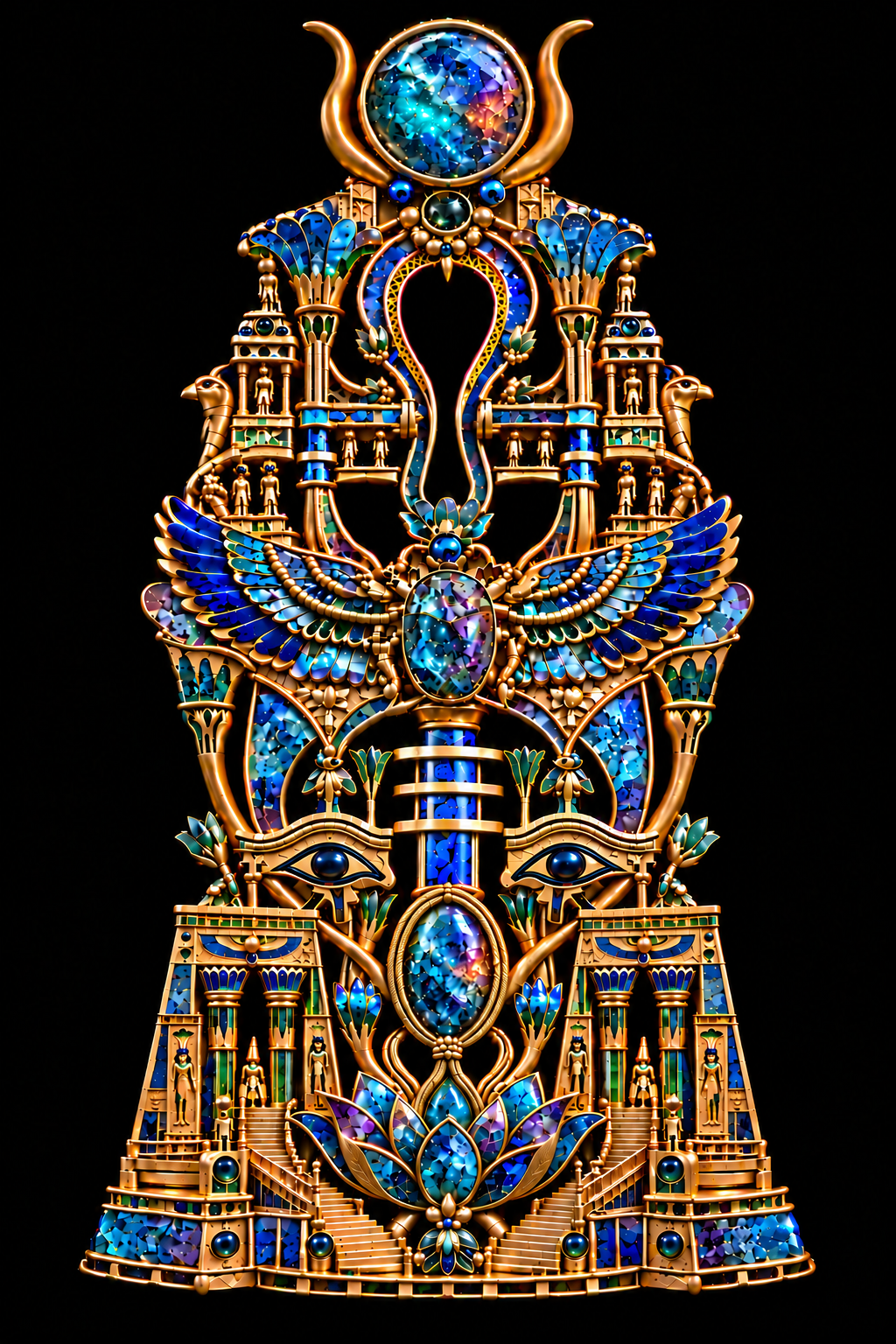
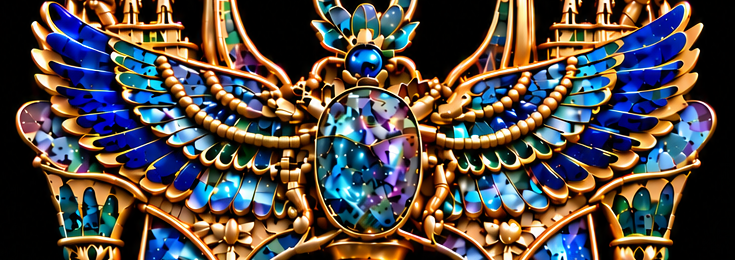
A beetle occupies the centre of Axis of Harmony. Its gemstone body is held within gold, while blue and turquoise wings spread across the composition. Seen first as jewellery, it offers colour, symmetry and a point of focus. Seen against its Egyptian background, it opens onto a more demanding subject: how life comes into being, how it might be renewed, and how a person hoped to survive death.
The scarab is often described simply as a symbol of rebirth. That description is useful, but incomplete. Surviving scarabs include small seals, personal ornaments, royal announcements and funerary amulets. Their meanings depend on their inscriptions, materials and settings. A beetle engraved with an official’s name and a large scarab placed within mummy wrappings belong to related traditions, yet performed different tasks.
This essay follows those differences before returning to the contemporary artwork. Ancient objects provide the historical evidence; the reading of Axis of Harmony is an interpretation of a modern digital composition.
1. The Beetle And The Morning Sun
The scarab’s solar associations grew from the behaviour of dung beetles. The movement of a rounded ball suggested the movement of the sun, while the beetle’s reproduction offered a model for renewed life. Kathlyn M. Cooney’s study in the UCLA Encyclopedia of Egyptology explains how this imagery expressed the sun god’s capacity for self-renewal. [1]
The relevant deity is Khepri, the morning manifestation of the sun god. The scarab sign participates in the writing of the Egyptian verb conventionally transliterated kheper, “to come into being”; Khepri’s name belongs to this same linguistic family. [1] The association therefore connects an animal, a written sign and a divine identity.
“Becoming” is a helpful word here. It directs attention to emergence and transformation rather than to a permanently finished condition. Dawn provides a recurring image of that process: the sun becomes visible again after its disappearance during the night. LACMA’s account of a heart scarab similarly connects beetle imagery with Khepri and solar regeneration. [2]
These are religious explanations of the world, not scientific descriptions of beetle reproduction. Calling the scarab self-creating describes the mythology attached to it. It does not mean that beetles reproduce without biological parents. Historical accuracy requires that distinction, even when a symbol’s imaginative force remains compelling.
2. A Small Object With An Inscribed Underside
Many scarabs are small enough to fit comfortably between finger and thumb. Their curved backs represent the insect; their flattened undersides provide room for an inscription or design. The contrast between these two surfaces is essential to understanding the object. The beetle form identifies a tradition, while the underside can identify an owner, invoke authority or carry a particular message.
UCL’s Digital Egypt resource places the use of scarab seals around the end of the First Intermediate Period, approximately 2050 BCE, and describes their larger-scale production in the late Middle Kingdom. It also records their circulation in Palestine and the development of local styles there, including features subsequently copied in Egypt. [3] The scarab’s history consequently includes exchange and adaptation beyond Egypt’s borders.
An early Thirteenth Dynasty example in the Petrie Museum makes the personal dimension visible. Its underside names the treasurer Senebsumai and records his titles. Made from steatite, it survives with its glaze lost and part of its inscribed surface abraded. [4] Here the beetle carries the identity of a particular official, rather than an anonymous statement about eternity.
UCL explains sealing as a means of signalling ownership. [5] This practical function should remain part of the story. Religious significance and administrative use could inhabit the same object; interpreting every scarab solely as an afterlife charm would erase part of its working life.
3. When The Scarab Carried Royal News
Under Amenhotep III in the Eighteenth Dynasty, large commemorative scarabs carried accounts of royal events. A blue-glazed steatite example at the Metropolitan Museum of Art, dated approximately 1386–1347 BCE, commemorates the king’s prowess as a lion hunter. It measures just over eight centimetres in length. [6]
Another Met example records an artificial lake constructed for Queen Tiye. At almost ten centimetres long, it provides a substantial surface for the royal announcement. [7] These objects show how far the scarab could move beyond a small personal seal.
The Walters Art Museum’s commemorative scarab, dated about 1380 BCE, carries a text concerned with Amenhotep III’s authority and Tiye’s royal status. The museum places these scarabs within a programme of official gifts, probably distributed to senior officials or offices in Egypt and abroad. Its interpretation allows political and amuletic purposes to coexist. [8]
This is a useful corrective to the familiar image of Egyptian symbolism as exclusively mystical. An object could express religious renewal while also promoting the ruler who commissioned it. Its inscription addressed power in the living world. Reading that inscription changes what the beetle means in that particular instance.
4. The Heart Scarab And The Question Of Judgement
Heart scarabs belong to a more intimate setting. Their purpose concerned the deceased person and the testimony of the heart in the afterlife.
The Egyptian heart was associated with thought, memory and moral character. In the judgement of the dead, it was weighed against maat, the principle of order and justice. Heart-scarab inscriptions commonly used spell 30B of the collection now called the Book of the Dead, asking the heart not to oppose its owner. [2]
The formula can feel unsettling to a modern reader. If the heart remembers a life, why ask it not to speak against that life? The ritual acknowledges vulnerability at judgement. It sought a favourable outcome through an address to the heart itself. Describing the object merely as a charm for good luck misses this specific relationship between memory, testimony and continued existence.
UCL explicitly corrects another common misunderstanding: heart scarabs did not replace the physical heart in a mummy. It describes them as funerary objects often suspended from a necklace and usually inscribed on the underside. [9]
Precise beginnings require care. UCL places their attestation in the mid-Thirteenth Dynasty; the Met dates a fragment of a human-headed heart scarab broadly to Dynasties 13–17, approximately 1802–1550 BCE. That fragment bears a version of spell 30B. [9, 10] These references support an early history without requiring an exact, universally agreed invention date.
5. Hatnefer And Gautsoshen: Two Named Lives
Hatnefer’s heart scarab brings together religious purpose and exceptional craftsmanship. Dated approximately 1491–1473 BCE, it is made from serpentinite and gold. Its carefully worked beetle is attached to a chain of plaited gold wire. The inscription uses spell 30A, a less common alternative to 30B, addressing Hatnefer’s own heart at judgement. [11]
Its documented findspot matters. The scarab came from Hatnefer’s mummy in the tomb excavated by the Met’s expedition in 1935–36. It can therefore be understood within a particular burial, rather than only through its appearance. [11]
Gautsoshen’s scarab, dated approximately 1080–945 BCE, was found within her mummy wrappings at the centre of her chest. Its spell 30B asks her heart not to testify against her before the afterlife tribunal. The Met also notes that her name was scratched over an erasure, and that the battered object had been reused. [12]
The contrast is revealing: refined serpentinite and gold in one case, a reused slate object in the other. Both participate in a funerary tradition, but they preserve different histories of making, ownership and use. The second object also reminds us that ancient religious equipment could have an earlier life before entering the burial in which it was discovered.
6. Why A Beetle Has Feathered Wings
The winged scarab provides the closest historical comparison with the central motif in Axis of Harmony.
A Late Period faience example at the Met, dated 664–332 BCE, consists of three separate pieces: the beetle and two wings. The museum identifies these as bird wings, with individual feathers indicated, rather than the anatomical wings of a beetle. Small holes allowed the pieces to be fastened to mummy wrappings. Their intended purpose was the deceased’s rebirth. [13]
This combination is deliberate religious imagery. It does not reproduce an insect exactly; it constructs a form suited to a funerary task. The feathered wings are therefore more than a modern decorative flourish.
The bead shroud of Tabakenkhonsu offers a surviving setting for related imagery. Dated approximately 721–664 BCE, during the Twenty-fifth Dynasty, its tubular faience beads form a net sewn to the outer mummy wrappings. A winged scarab occupies the breast, while other figures protect the abdomen. [14] Its placement connects the motif with the body it was meant to protect.
Heart scarabs and winged scarabs should nevertheless retain their separate descriptions. An inscribed heart scarab invoking a judgement spell and a three-part winged amulet expressing solar rebirth need not perform exactly the same function, even when both relate to funerary hopes.
7. Material, Colour And The Limits Of Certainty
The objects discussed here range from steatite and slate to serpentinite, gold and faience. The Met also holds an Eighteenth Dynasty lapis lazuli scarab, dated approximately 1550–1300 BCE, measuring only seven millimetres in length. [15] Scarab imagery could be expressed through very different materials and scales.
Material records do not automatically establish a complete symbolic code. Knowing that an object is blue or green does not, by itself, prove every meaning later assigned to those colours. An argument becomes stronger when material evidence is considered alongside inscriptions and archaeological context.
Cooney also cautions that royal names do not necessarily date scarabs to the named king’s lifetime: some were produced later, and heirlooms could enter later deposits. Missing findspots and modern forgeries further complicate dating. [1] Broad museum date ranges can therefore express responsible uncertainty rather than a failure to investigate.
8. The Scarab In Axis Of Harmony
In Jabbi Delahaye’s Axis of Harmony, the scarab becomes a central organising form. Its oval fantasy gemstone body gathers the surrounding detail into one focus. Gold divisions articulate the spreading blue and turquoise wings, which create a broad horizontal movement beneath the open ankh.
The comparison with ancient feather-winged scarabs is visually meaningful. It supplies a historical foundation for reading the motif through renewal and protection. The modern composition, however, combines these references within its own symmetrical arrangement, imagined gemstones and jewellery-like architecture. It is a contemporary digital artwork rather than a reconstruction of a particular funerary object.
The artwork’s balance suggests a further interpretation: renewal held within order. Its wings extend outward while the central body remains anchored to the vertical axis. This is a reading of the composition, not an ancient Egyptian explanation of its exact design. The invented gemstone can suggest a concentrated source of light or vitality without being presented as a historically documented sacred material.
Research gives the image greater depth by preserving these distinctions. Behind the shining form are seals handled by officials, announcements circulated by a royal court, and amulets placed against the bodies of named individuals. The scarab’s endurance rests partly in that range. It made the idea of becoming tangible in objects that could be held, worn, read and buried. Axis of Harmony returns that idea to the visible world through a new, imagined form.
References
Sources checked 10 October 2026. Dates follow the cited collection records and are approximate. Historical sections draw on scholarly and museum sources; the final section offers contemporary visual interpretation. This article has not undergone specialist peer review.
[1] Cooney, Kathlyn M. (2008). “Scarab.” In Willeke Wendrich (ed.), UCLA Encyclopedia of Egyptology. Especially solar symbolism and the difficulties of dating scarabs. https://escholarship.org/content/qt13v7v5gd/qt13v7v5gd_noSplash_15228783f0ef7f2e4ed839258b641b6b.pdf
[2] Los Angeles County Museum of Art. Heart Scarab, AC1999.116.1. Collection record and curatorial notes. https://collections.lacma.org/object/98288
[3] University College London, Digital Egypt for Universities. “Scarab UC 60992.” Scarab seals, chronology and circulation. https://www.ucl.ac.uk/museums-static/digitalegypt/main/uc60992.html
[4] Petrie Museum of Egyptian Archaeology, UCL. Scarab of Senebsumai, LDUCE-UC11485. Early Thirteenth Dynasty. https://collections.ucl.ac.uk/Details/petrie/15725
[5] University College London, Digital Egypt for Universities. “Seals and Sealing in Ancient Egypt.” https://www.ucl.ac.uk/museums-static/digitalegypt/seals/index.html
[6] Metropolitan Museum of Art. Commemorative Scarab of Amenhotep III Recording a Lion Hunt, 26.7.264. https://www.metmuseum.org/art/collection/search/547781
[7] Metropolitan Museum of Art. Scarab Commemorating the Construction of an Artificial Lake, 35.2.1. https://www.metmuseum.org/art/collection/search/544520
[8] Walters Art Museum. Commemorative Scarab of Amenhotep III, 42.206. Collection record and interpretation. https://art.thewalters.org/object/42.206/
[9] University College London, Digital Egypt for Universities. “Heart scarabs.” https://www.ucl.ac.uk/museums-static/digitalegypt/burialcustoms/heartscarabs.html
[10] Metropolitan Museum of Art. Fragment of a Human-Headed Heart Scarab, 41.160.135. https://www.metmuseum.org/art/collection/search/546147
[11] Metropolitan Museum of Art. Heart Scarab of Hatnefer, 36.3.2. Serpentinite and gold; approximately 1491–1473 BCE. https://www.metmuseum.org/art/collection/search/545146
[12] Metropolitan Museum of Art. Heart Scarab inscribed for Gautsoshen, 25.3.163. Slate; approximately 1080–945 BCE. https://www.metmuseum.org/art/collection/search/548252
[13] Metropolitan Museum of Art. Winged Scarab Amulet, 25.5.1a–c. Faience; 664–332 BCE. https://www.metmuseum.org/art/collection/search/552816
[14] Metropolitan Museum of Art. Bead Shroud of Tabakenkhonsu, 96.4.5. Faience; approximately 721–664 BCE. https://www.metmuseum.org/art/collection/search/550800
[15] Metropolitan Museum of Art. Scarab, 15.43.111. Lapis lazuli; approximately 1550–1300 BCE. https://www.metmuseum.org/art/collection/search/567841