EGYPTIAN SYMBOLS · HISTORICAL COMPANION · ARTICLE THREE
The Eye of Horus: Restoration, Protection and Wholeness
Research essay · 10 October 2026
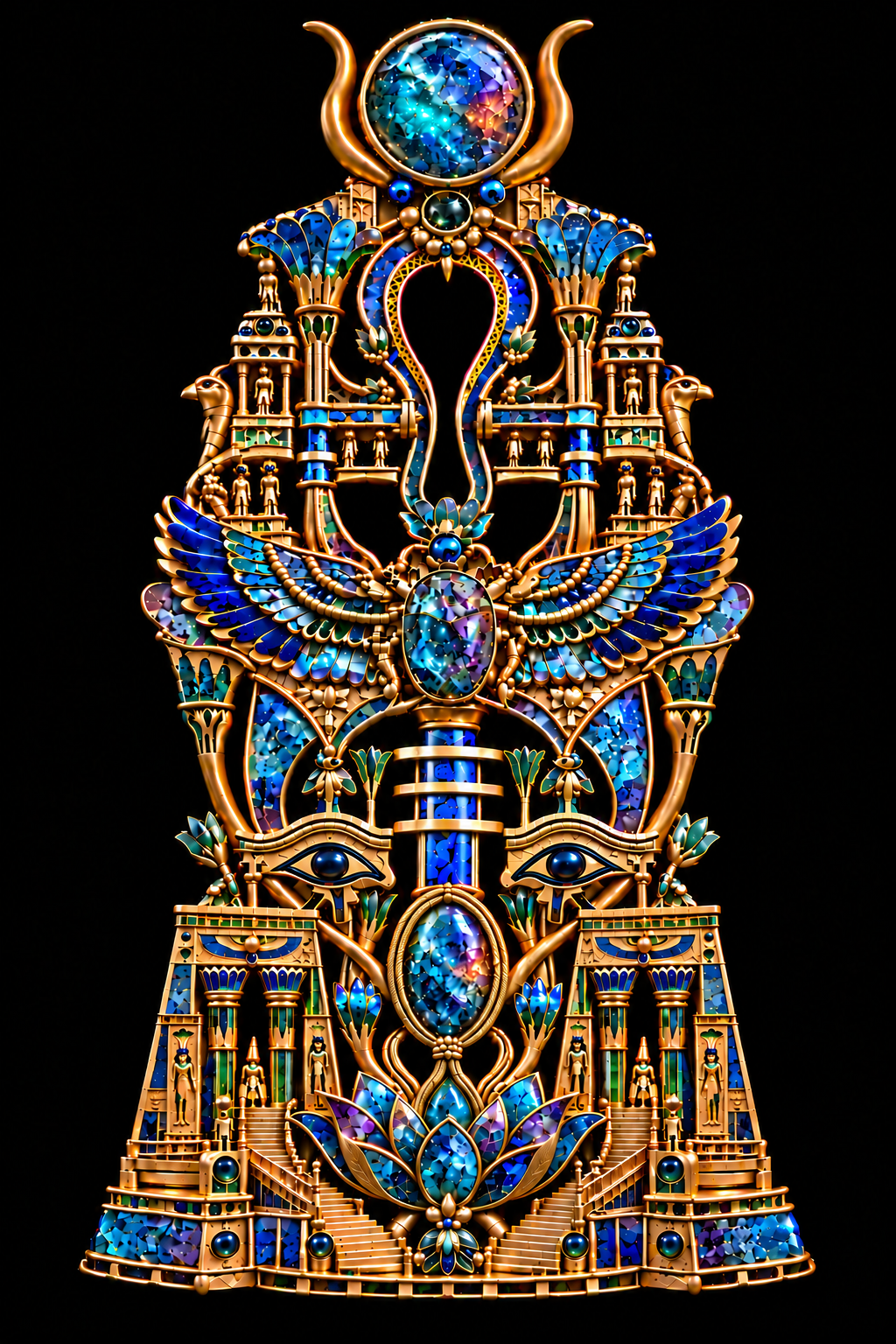
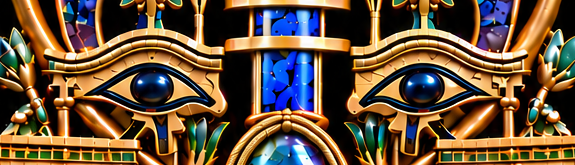
Two eyes look outward from the lower half of Axis of Harmony. Gold outlines surround dark, reflective centres, and the pair gives the intricate composition a sense of watchfulness. Their symmetry invites a reading through balance. Their Egyptian ancestry introduces something more specific: an eye that has suffered injury and become whole again.
The Eye of Horus is frequently described as a protective symbol. That description has substantial historical support, but protection is only one part of its meaning. Restoration, bodily integrity, renewed life and the capacity to see also belong to its history. Surviving objects show the eye worn as an ornament, placed with the dead and painted onto the walls of coffins.
Understanding that history requires care with three familiar claims: that the Eye of Horus is always the left eye; that any right eye must therefore be the Eye of Ra; and that the design was originally constructed from mathematical fractions. Each deserves examination rather than repetition.
1. An Eye Made Sound Again
The Egyptian name conventionally written wedjat refers to soundness or health. Museum translations include “the one that is sound” and “the whole or restored one.” The name places the emphasis on the eye’s condition: it possesses, or has recovered, its integrity. [1, 2]
The form is recognisable through its extended outline and markings below the eye. The Metropolitan Museum of Art describes a combination of human and falcon elements, appropriate to Horus’s association with the falcon. Its gold Ptolemaic amulet retains a human-looking eye, a horizontal cosmetic line and stylised falcon markings, including a vertical extension and a line ending in a spiral. [3]
This is a constructed sacred image rather than a straightforward anatomical drawing. Its identifying features allow a very small object to carry a recognisable religious meaning. For a contemporary artist, that economy of form is striking: a few lines can distinguish this eye from an ordinary representation of sight.
2. Injury, Conflict And Restoration
In the mythological account summarised by the Met, Seth injured or stole Horus’s eye, and Thoth restored it. The healed eye consequently embodied recovery and regeneration. An amulet could transfer those benefits to its wearer. [1]
Other museum accounts preserve the wider implications. The Walters Art Museum associates the theft with disorder and the recovery with the reestablishment of rightful order and legitimate kingship. [4] The damaged eye is therefore more than a private bodily injury: its restoration can also express the recovery of a rightful relationship within the world.
Egyptian mythology should not be reduced to one fixed narrative, identical in every source. LACMA’s account allows for the injury of one or both eyes and describes Horus offering his eye to his deceased father, Osiris, to sustain him in the afterlife. [5] The Smithsonian likewise connects the offering with Osiris’s renewed life. [2]
The movement from injury to restoration gives the symbol its particular force. Wholeness here does not require an untouched past. It can be a condition regained after damage. That is a modern way of expressing the pattern, but the pattern itself is grounded in the ancient accounts of an injured and restored divine eye.
3. The Moon And The Recovery Of Completeness
The moon supplied an observable rhythm through which the idea of restoration could be understood. Its visible shape diminishes and returns. The Smithsonian’s interpretation of a wedjat ring explicitly compares the eye’s healing with the lunar cycle. [2]
The Royal Ontario Museum places this within a broader account of Horus as a celestial deity: the right eye could correspond to the sun and the left to the moon. In its explanation, the moon’s waxing and waning allowed it to be imagined as an eye needing healing, while a solar wedjat could express the healthy eye. [6]
That distinction matters because the religious image exceeds the shorthand “moon equals Horus; sun equals Ra.” Horus himself could have both celestial eyes. The solar and lunar associations are historically meaningful, yet they do not establish two entirely separate visual systems with no overlap.
The lunar reading also changes how protection is understood. The emphasis falls on the possibility of recovering completeness through a recurring process. It gives the symbol a temporal dimension: something has happened to the eye, and something can happen again.
4. The Eye Of Ra: Divine Power With A Feminine Identity
Ra, also written Re, is the sun god. The Eye of Ra belongs to a network of divine relationships that cannot be explained solely by reversing the direction of an eye drawing.
In their Met essay on the Third Intermediate Period, James Allen and Marsha Hill discuss goddesses designated the Eye of Re, including Hathor, Tefnut, Wadjet and other deities. These goddesses act as powerful agents and counterparts of the sun god. [7] The Eye can thus have a feminine divine identity and a capacity to act.
The same essay describes the Tale of the Faraway Goddess: the wrathful Eye goddess departs to Nubia, Egypt suffers, and her eventual return restores prosperity. When appeased, these powerful goddesses can become protectors and benefactors. [7] Protection in this setting includes formidable force as well as beneficial presence.
An ivory furniture plaque from Nimrud supplies an instructive, qualified comparison. The Met interprets its lion-headed figure and accompanying monkey as possibly referring to the pacification of the Eye of Re. It also stresses that the imagery was adapted within a Phoenician context and that its precise meaning there is no longer fully understood. [8]
The distinction is useful: the restored Eye of Horus foregrounds soundness and recovery, while Eye of Ra traditions can foreground an active solar power embodied by goddesses. These are different emphases within a connected religious world. They should not be treated as an inflexible opposition between a gentle eye and a violent eye.
5. Left And Right: What The Objects Support
The Walters record explicitly identifies both right and left versions of the wedjat, with solar and lunar associations respectively. [4] It follows that a right wedjat can still be described as an Eye of Horus. Direction alone does not prove that an image represents the Eye of Ra.
There is also a practical difficulty in descriptions of paired eyes: “left” might mean the depicted being’s anatomical left or the viewer’s left side of the image. A precise account should state which is intended. Mirroring an image without considering that distinction can produce a confident but misleading label.
For Axis of Harmony, the historical sun–moon associations provide a basis for discussing complementarity. The artwork’s paired arrangement can carry the artist’s intention of balance. Assigning every feature a unique ancient identity, however, requires more evidence than the symmetry of the modern image supplies.
6. The Eye As Something To Wear
Two small faience eyes excavated at Amenhotep III’s palace at Malqata demonstrate how compact the motif could become. Both are dated approximately 1386–1347 BCE. One, measuring 1.2 centimetres, bears a nefer sign for goodness or beauty on its reverse; the other, measuring 1.5 centimetres, bears an ankh, the sign for life. [1, 9]
Their backs extend the message beyond the eye visible from the front. This combination is especially relevant to an artwork that brings the ankh and eyes into the same composition: ancient objects could also bring distinct signs into close relationship, although these amulets do not establish a direct prototype for Axis of Harmony.
The Smithsonian’s openwork faience ring, dated approximately 1539–1190 BCE, places the sacred eye in a wearable form. Its interpretation describes protection in life and rebirth after death. [2] The object reminds us that an amulet’s religious role could accompany a person’s bodily experience.
A much later gold eye at the Met, dated 332–30 BCE, shows the motif’s continued use during the Ptolemaic Period. [3] Another Ptolemaic collection record lists amethyst and gold in a string of beads with a wedjat pendant. [10] These examples demonstrate material variety without requiring a single symbolic meaning for every gemstone or metal.
7. Eyes Through Which The Dead Could See
On Hapiankhtifi’s Middle Kingdom outer coffin, dated approximately 1981–1802 BCE, a pair of wedjat eyes occupies the head end of one long side. The Met explains their purpose in relation to the mummy lying on its side: the painted eyes enabled the deceased to see out. The coffin came from a pit tomb at Meir and contained two smaller coffins. [11]
Ameny’s coffin, from the same broad period, offers a related arrangement. Its eyes appear above a depicted doorway. The museum connects them with protection, communication with the outside world and seeing the sun rise in the east. [12]
Here the eyes are part of an imagined opening. Their placement matters as much as their outline. A funerary object could surround and protect the deceased while also providing a symbolic means of contact beyond its enclosing surface.
Repetition could also give the motif a more elaborate form. LACMA holds a faience amulet combining four eyes, dated in its main record to the Late Period–Ptolemaic Period, 712–80 BCE. The museum suggests that the multiplication may have increased its efficacy. [5] That “may” preserves the difference between an observed design and an interpretation of its intended effect.
8. The Fractions Diagram: A Familiar But Disputed Explanation
A widely circulated diagram assigns six fractions to parts of the eye: 1/2, 1/4, 1/8, 1/16, 1/32 and 1/64. Their sum is 63/64. The arithmetic is correct. The historical claim that these measures originated as pieces of the sacred eye requires a separate argument.
Jim Ritter’s entry in The Encyclopedia of Ancient History traces the proposal to Georg Möller in 1911. Ritter explains that the six Egyptian signs represented subdivisions of the heqat, a measure of grain capacity, but challenges the proposed pictorial origin. His account argues that the early hieratic signs had no corresponding hieroglyphic pictures at their origin; later pictorial equivalents were variable. [13]
Consequently, the diagram should not be presented as proof that the eye was originally designed as a mathematical code. Nor does the sum, by itself, establish that a missing sixty-fourth was supplied by Thoth’s magic. An engaging explanatory story can become familiar without its historical foundation becoming stronger.
This distinction protects the achievements of Egyptian mathematics as well as the integrity of Egyptian religious imagery. The documented capacity measures deserve attention on their own terms. The restored eye also has a substantial history without needing an unqualified mathematical origin story.
9. Restoration And Balance In Axis Of Harmony
The paired eyes in Axis of Harmony sit beneath the winged scarab and alongside the central vertical structure. Their dark centres give weight to an otherwise luminous arrangement. Gold outlines and extended markings make them legible within the dense ornament, while their mirrored placement stabilises the lower composition.
Read through the wedjat tradition, they suggest watchfulness, protection and recovered integrity. Read within this particular artwork, they also support its concern with harmony: two forms held in relationship, neither visually overwhelming the other. These are contemporary artistic interpretations informed by history, rather than claims that an ancient text describes this design.
The distinction between the two eyes should therefore remain open enough to respect the evidence. Solar and lunar associations offer a meaningful interpretive framework. Calling the pair simply “Ra on one side and Horus on the other” risks making direction perform more historical work than it can support.
The fantasy gemstones, goldwork and architectural forms belong to Jabbi Delahaye’s contemporary digital practice. Their historical references give the composition depth, while their arrangement gives it a new purpose. The eye contributes something particular to that purpose: harmony can include repair. Its ancient story allows wholeness to emerge after injury, and the modern image gives that possibility a visible, balanced form.
References And Research Notes
Sources checked 10 October 2026. Dates follow the cited records and are approximate. Historical discussion is distinguished from the contemporary interpretation of Axis of Harmony. This essay has not undergone specialist peer review.
[1] Metropolitan Museum of Art. Wedjat Eye Amulet, 11.215.130. Faience; approximately 1386–1347 BCE. Myth, meaning, palace findspot and nefer sign on reverse. https://www.metmuseum.org/art/collection/search/551468
[2] Smithsonian, National Museum of Asian Art. Wedjat ring, F1907.388. Faience; Dynasties 18–19, approximately 1539–1190 BCE. Collection record and interpretive label. https://asia-archive.si.edu/object/F1907.388/
[3] Metropolitan Museum of Art. Wedjat Eye Amulet, 23.2.68. Gold; Ptolemaic Period, 332–30 BCE. Human and falcon elements and protective use. https://www.metmuseum.org/art/collection/search/547767
[4] Walters Art Museum. Sacred Eye Udjat, 47.265. Polychrome faience and glass; approximately 945–525 BCE. Restoration, royal order and right and left eyes. https://art.thewalters.org/object/47.265/
[5] Los Angeles County Museum of Art. Quadruple Eye of Horus Amulet, 45.23.66. Faience. The main record gives 712–80 BCE; an image caption retains a different range. This essay follows the main date field. The suggestion of increased efficacy is the museum’s interpretation. https://collections.lacma.org/object/10623
[6] Royal Ontario Museum. Amulet, wadjet eye, 986X2.21.4. Black faience; approximately 380–343 BCE. Solar and lunar interpretations and funerary use. https://collections.rom.on.ca/objects/188125/amulet-wadjet-eye
[7] Allen, James, and Marsha Hill. “Egypt in the Third Intermediate Period (ca. 1070–664 B.C.).” Metropolitan Museum of Art, originally 2004, revised March 2018. Eye of Re goddesses and the Faraway Goddess. https://www.metmuseum.org/essays/egypt-in-the-third-intermediate-period-1070-712-b-c
[8] Metropolitan Museum of Art. Furniture plaque carved in relief with lion-headed figure. Collection interpretation of Egyptian motifs adapted in a Phoenician context and found at Nimrud. The proposed connection with the Eye of Re remains qualified. https://www.metmuseum.org/art/collection/search/325355
[9] Metropolitan Museum of Art. Wedjat Eye Amulet, 11.215.127. Faience; approximately 1386–1347 BCE. Ankh on reverse. https://www.metmuseum.org/art/collection/search/551391
[10] Metropolitan Museum of Art. String of beads, wedjat pendant, 49.159.2. Amethyst and gold; 332–30 BCE. https://www.metmuseum.org/art/collection/search/546014
[11] Metropolitan Museum of Art. Outer coffin of Hapiankhtifi, 12.183.11a.1, .2. Approximately 1981–1802 BCE. Paired eyes and documented burial context. https://www.metmuseum.org/art/collection/search/545442
[12] Metropolitan Museum of Art. Coffin of Ameny, 11.150.39a, b. Approximately 1981–1802 BCE. Eyes, doorway imagery and seeing the rising sun. https://www.metmuseum.org/art/collection/search/557549
[13] Ritter, Jim (2012). “Horus-eye fractions.” The Encyclopedia of Ancient History. DOI: 10.1002/9781444338386.wbeah21178. Publisher abstract and full entry consulted. Ritter’s critique distinguishes genuine heqat subdivisions from the proposed origin of their signs as eye parts. https://onlinelibrary.wiley.com/doi/10.1002/9781444338386.wbeah21178 Full entry consulted: https://assets.super.so/e745dfd7-232e-47c1-a806-753f45b941ba/files/5682d6ef-2e08-4bbf-91d8-81f08143574f/ritter2012-2.pdf