EGYPTIAN SYMBOLS · HISTORICAL COMPANION · ARTICLE FOUR
The Egyptian Lotus: Creation, Renewal and the Return of Light
Research essay · 10 October 2026
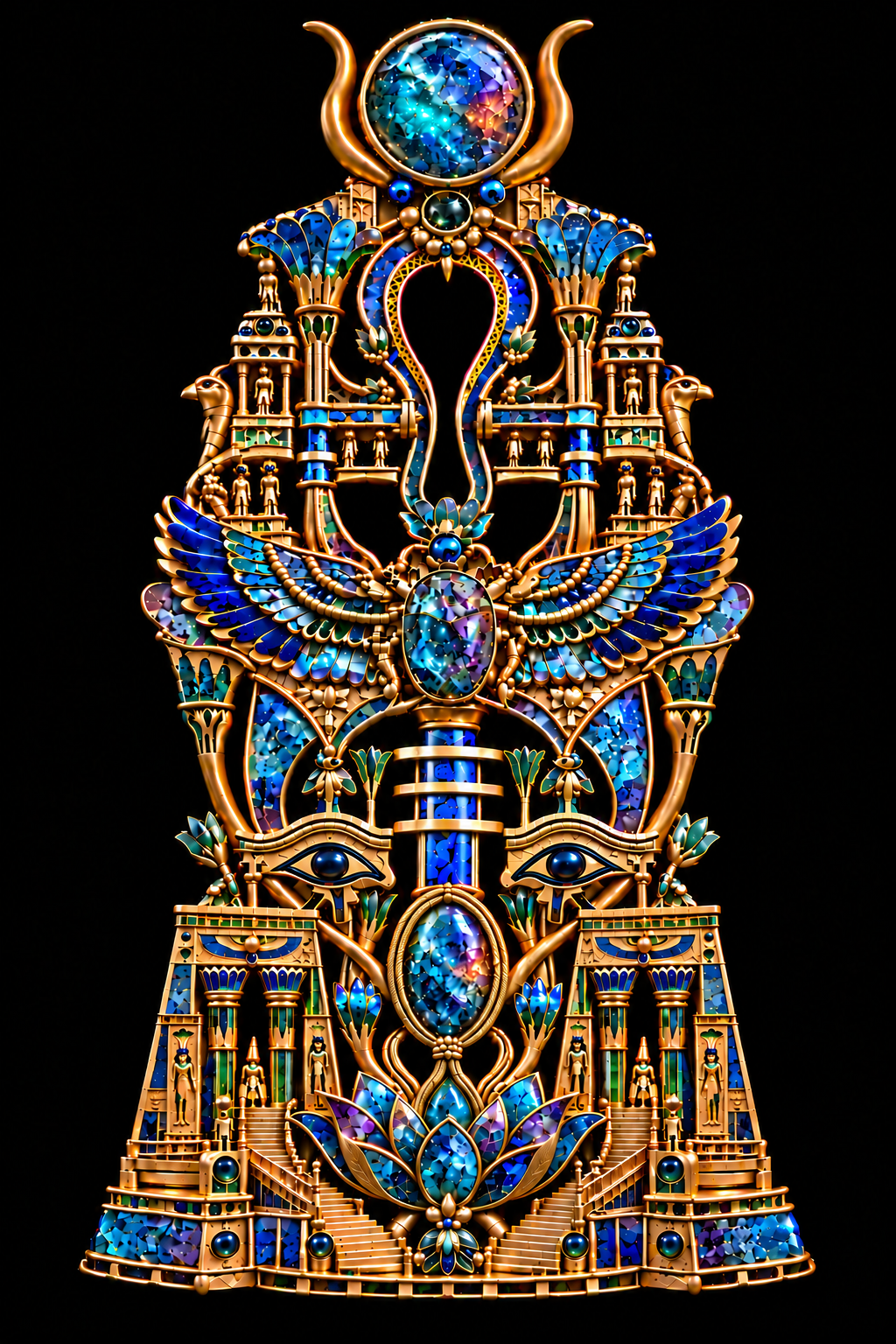
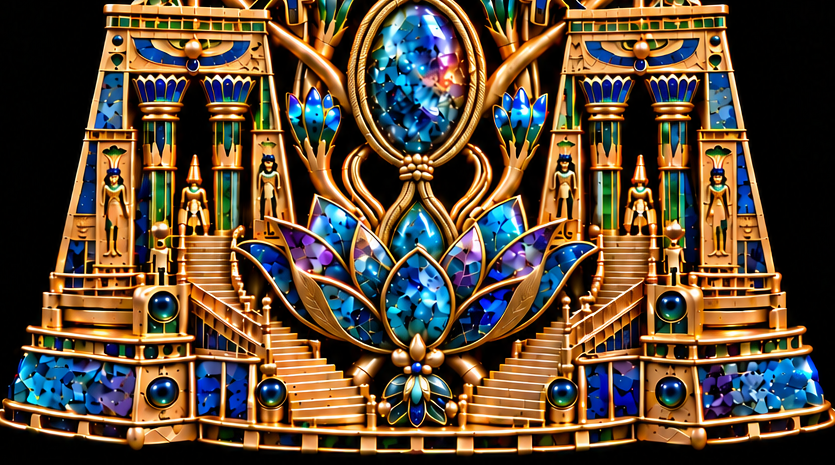
At the base of Axis of Harmony, a flower opens between two stairways. Its layered gemstone petals spread outward, while a central petal directs the eye back towards the vertical structure above. The lotus gives the composition a place from which to rise. In an artwork filled with gold, wings, eyes and miniature gateways, this floral form brings the imagined architecture into contact with growth.
Its Egyptian background makes that relationship especially suggestive. The flower commonly called the Egyptian lotus belonged to traditions of solar renewal, creation and renewed existence. It also belonged to the material world: plants gathered for burials, flowers translated into jewellery, and floral forms worked into vessels and buildings.
The historical subject begins with a botanical distinction. “Lotus” is a familiar name, but familiarity can conceal several different plants and several different cultural traditions.
1. Which Flower Are We Discussing?
The blue Egyptian lotus is a water lily. It belongs to the genus Nymphaea, rather than to Nelumbo, the genus containing the sacred lotus familiar from many Asian traditions. Kew’s plant account explicitly distinguishes sacred lotus from the water lilies, despite their outward resemblance. [1]
Older publications and museum records commonly use the name Nymphaea caerulea for the blue water lily. Kew’s current Plants of the World Online treats that name as a synonym of the accepted Nymphaea nouchali var. caerulea. Its native distribution includes Egypt. [2] The different scientific names can therefore refer to the same plant within different taxonomic treatments; they need not indicate contradictory identifications.
The white Egyptian water lily is generally identified as Nymphaea lotus, which Kew accepts as a species and records as native to Egypt and many other parts of Africa. [3]
This essay retains “lotus” as the established art-historical term, while specifying water lily where botanical accuracy matters. It does not assume that Egyptian lotus imagery carries the same meanings as lotus imagery in Buddhism or Hinduism. Similar flowers, or similar conventional names, do not establish a single universal symbolic history.
2. A Flower That Returns With The Light
The blue water lily’s opening during the day gave Egyptian religious imagery an observable point of departure. The Met’s account of a turquoise faience chalice fragment connects its closing at night and reopening in the morning with the sun and rebirth. The same record notes that the blue variety was represented more frequently in Egyptian art than its relative abundance in nature might suggest. [4]
The opening blossom could therefore be more than a pleasing natural shape. It provided an image through which the return of light could be understood. The centre revealed within the petals suggested emergence: something previously enclosed becomes visible.
This is an interpretation of a natural process within a religious framework. The botanical event and the cosmic meaning remain distinct. Nor should the blue lily’s flowering rhythm be generalised to every white water lily or to every unrelated plant called a lotus. Some museum summaries combine blue and white varieties into a single explanation; the present discussion keeps its daytime solar association focused on the blue water lily.
The motif’s value lies partly in the relationship between recurrence and beginning. Dawn happens repeatedly, yet religious imagery can present each return as a renewal of creation. The flower gives that large idea an intimate, visible form.
3. Nefertem And The First Emergence
Nefertem, also written Nefertum, personifies important aspects of this floral world. The Met describes him as born from a lotus on the mound of creation and associates him with the sun, creation and pleasant fragrance. It identifies him as the son of Ptah and Sekhmet, while also acknowledging alternative maternal associations. [5]
Those variations remind us that Egyptian religion contained connected traditions rather than one completely uniform account. A flower could take its place in different divine relationships without losing its association with emergence and renewal.
A Nefertem amulet at the Met, dated approximately 1080–332 BCE, presents the flower in the god’s headdress, accompanied by two tall feathers and counterpoises. Its interpretation links the deity with youthful power and the newborn sun. [6] The blossom becomes an identifying attribute, visible above a human-form figure.
LACMA’s gold amulet of Nefertem, dated in its main record to approximately 1295–1070 BCE, offers a wearable example. The small figure has a suspension loop on its back and a complex crown incorporating the blue lotus. The museum places him within the Memphite triad of Ptah, Sekhmet and Nefertem. [7]
Together, these examples show the lotus operating as more than an independent floral ornament. It could identify a deity whose presence brought creation imagery into the object.
4. Fragrance And The Experience Of The Flower
The flower’s religious associations were not purely visual. Nefertem’s connection with pleasant smells makes fragrance part of the discussion. [5]
The Rijksmuseum van Oudheden’s account of a silver Nefertem statue distinguishes the pointed petals of the blue flower from the rounder form of the white and emphasises the blue flower’s agreeable scent. It interprets the deity through the first sunlight emerging from the primeval flower. The museum also suggests that its statue may once have stood on a model solar boat, while keeping that reconstruction qualified. [8]
Fragrance gives the image a sensory dimension that photographs and digital reproductions cannot fully recover. A viewer can see a carved petal, but the living flower would also have been encountered through smell. An artist translating it into metal, faience or glass retained a visible form whose associations could reach beyond sight.
This evidence supports a discussion of fragrance and religious significance. It does not establish every modern claim about blue lotus intoxication, medicinal effects or ritual consumption. Those questions would require a separate examination of plant chemistry, ancient texts and archaeological residues. They should not be treated as proven simply because flowers appear in a scene.
5. A Flower Made To Last
A painted and plastered wooden Model Lotus Flower at the Met is dated approximately 2051–1981 BCE. Two large female offering-bearer figures were found in the same tomb, and the museum proposes that this flower and another may have belonged to the offerings they carried. [9]
The qualification matters. The surviving arrangement allows an informed suggestion, rather than certainty about every original attachment. Even so, the object provides a concrete example of a plant translated into a lasting manufactured form within a funerary setting.
An Amarna-period faience Lotus Flower Inlay, dated approximately 1347–1330 BCE, offers another transformation. [10] Here a floral shape becomes an element that could be set into a larger surface. The move from living plant to crafted component helps explain the motif’s flexibility: the blossom could retain its identity while acquiring a new material and purpose.
That flexibility is relevant to contemporary jewellery imagery. A gemstone flower need not imitate the softness of actual petals to remain recognisable as floral. Its makers can translate structure, opening and colour into a different material language.
6. Jewellery And The Concentration Of Colour
The Met’s New Kingdom Lotus pendant, dated approximately 1550–1080 BCE, combines gold, carnelian, blue glass and a pigmented calcareous bedding material. At 3.4 centimetres long, it condenses the floral motif into a small ornament. [11]
The material list is especially instructive. Ancient jewellery could combine gemstone, metal, manufactured glass and supporting substances. The presence of glass does not make the ornament’s colour or workmanship incidental. It shows that materials were selected and brought together to construct an effect.
The pendant supplies a historical comparison for the gold outlines and coloured petals in Axis of Harmony. It is a comparison between approaches to floral form and contrasting materials, rather than evidence that the modern work reproduces this particular pendant.
The distinction also protects the contemporary artwork’s invented gemstones. Their visual richness belongs to the digital composition. They can carry an artistic interpretation of renewal without being assigned a documented ancient Egyptian religious identity.
7. The Flower As A Vessel
Floral imagery could determine an object’s shape as well as decorate its surface. A reconstructed faience chalice at the Met, dated approximately 1080–664 BCE, takes the form of the blue lotus. Reassembled from eight fragments, it originally stood on a slender support imitating a stalk. The museum describes this vessel type as apparently used primarily in cult contexts. [12]
Its turquoise glaze and accompanying motifs connect the flower with a larger setting. Ducks in a papyrus marsh decorate the rim; tilapia fish and a cow suckling a calf appear below. The museum interprets the latter images through rebirth. [12]
A separate chalice fragment combines blue water lilies with papyrus umbels. Its Met interpretation identifies the lily with Upper Egypt and papyrus with Lower Egypt, explaining their intertwined forms as an image of unification. [4]
The lotus thus enters relationships as well as carrying associations of its own. Beside papyrus it can participate in a geographical and political statement. Shaped into a vessel, it can become part of a ritual action. A general label such as “rebirth” should not erase these more specific settings.
8. Plants In The Temple World
At the Temple of Dendur, plant imagery helps construct a model of the natural and cosmic world. Isabel Stünkel’s Met essay describes lotus and papyrus carvings along the lower exterior walls, with the Nile god Hapy between them. The columns rise like plants, while their capitals incorporate lily and papyrus forms. The essay relates this decoration to the renewal of creation within the temple. [13]
This context discourages casual identification of every Egyptian floral capital as a lotus. The particular plants and their relationships matter. Temple decoration can combine several natural forms within an organised architectural setting.
A scholarly study by Gabriele and Jochen Hallof supplies a more specific instance at Dendur. Their analysis of a displaced temple block identifies a scene of the ruler offering flowers to the local god Pedesi and translates the accompanying text as an offering of lotus flowers. [14] Here the floral subject belongs to an identifiable ritual scene, supported by an inscription.
The motif also appears at a much smaller architectural scale. A wooden furniture element in the Met, dated approximately 1981–1550 BCE, takes the form of a column with a lotus-bud capital and stands only 13.5 centimetres high. [15] Floral architecture could therefore enter portable furnishings as well as buildings.
9. The Actual Flower In A Burial
Representations should be considered alongside surviving plants. The Met records Five Lotus Buds from the Mummy of Prince Amenemhat, dated approximately 1080–945 BCE. Its find information places them on the mummy in the prince’s reburial near Deir el-Bahri; the material is identified as blue water lily. [16]
The record does not, by itself, explain every reason for their placement. It does establish that actual flowers accompanied a burial. This is a different kind of evidence from a carved blossom or a modern symbolic explanation.
Read together, the wooden model, jewellery, vessel and preserved buds show how widely the plant entered Egyptian material culture. Their different contexts should remain visible. A flower offered, worn, represented or placed with the dead did not necessarily perform an identical task in each setting.
10. The Gemstone Lotus In Axis Of Harmony
In Axis of Harmony, the lotus expands into a layered arrangement of blue, teal and violet fantasy gemstones outlined in gold. It sits low in the composition, where the stairways approach it from either side. Its outward spread gives breadth to the base, while the central petal continues the vertical movement towards the oval gemstone above.
This placement supports a contemporary reading of emergence. The flower appears to gather the surrounding forms and give them a starting point. Rather than balancing solely through columns and stepped structures, the artwork introduces an opening, growing form beneath them.
The Egyptian associations with renewed light and creation offer historical depth to that reading. They do not require us to identify the modern lotus as an exact botanical specimen or as Nefertem himself. The artwork’s jewel-like petals deliberately belong to an imagined material world.
The comparison with Dendur is likewise interpretive. Both place plant forms in relationship with architecture, but Axis of Harmony is a contemporary digital composition, not a reconstruction of a temple programme. Its stairways, gemstones and symmetry create their own relationships.
The lotus contributes a distinctive idea to those relationships: a foundation can also be a beginning. At the base of the artwork, the open flower gives stability a sense of potential. The historical tradition helps us recognise why that opening can suggest more than ornament. It recalls a visible emergence into light, translated across centuries into a new form.
References And Research Notes
Sources checked 10 October 2026. Dates follow the cited collection records and are approximate. Botanical nomenclature follows Kew’s current records where specified. Museum summaries sometimes generalise the flowering behaviour of blue and white water lilies; this essay limits the daytime solar explanation to the blue variety. The final section is a contemporary visual interpretation. This essay has not undergone specialist peer review.
[1] Royal Botanic Gardens, Kew. “Sacred lotus — Nelumbo nucifera.” Botanical distinction between Nelumbo and water lilies. Indexed text consulted; direct page retrieval was restricted. https://www.kew.org/plants/sacred-lotus
[2] Kew, Plants of the World Online. Nymphaea nouchali var. caerulea (Savigny) Verdc. Accepted name, synonyms and distribution. https://powo.science.kew.org/taxon/955147-1
[3] Kew, Plants of the World Online. Nymphaea lotus L. Accepted species and distribution. https://powo.science.kew.org/taxon/605604-1
[4] Metropolitan Museum of Art. Chalice fragment. Faience; approximately 1080–664 BCE. Blue lily, daily opening and closing, papyrus and unification. https://www.metmuseum.org/art/collection/search/553664
[5] Metropolitan Museum of Art. Nefertum, 89.2.519. Cupreous metal; 664–30 BCE. Creation, fragrance and divine relationships. https://www.metmuseum.org/art/collection/search/570648
[6] Metropolitan Museum of Art. Nefertum amulet. Approximately 1080–332 BCE. Floral headdress, youthful power and solar regeneration. https://www.metmuseum.org/art/collection/search/545568
[7] Los Angeles County Museum of Art. Amulet of Nefertem, AC1992.152.48. Gold. Main record: approximately 1295–1070 BCE; an image caption retains a different date range. Main record followed here. https://collections.lacma.org/object/62770
[8] Rijksmuseum van Oudheden. “Staand beeld van Nefertem,” AO 11b. Silver. Late Period; botanical form, fragrance, creation and a possible model-boat setting. Dutch text consulted and paraphrased in English. The page’s narrative and metadata give slightly different boundaries for the Late Period, so no precise numerical range is asserted here. https://www.rmo.nl/collectie/topstukken/staand-beeld-van-nefertem-3/
[9] Metropolitan Museum of Art. Model Lotus Flower. Painted and plastered wood; approximately 2051–1981 BCE. Association with offering-bearer figures remains qualified. https://www.metmuseum.org/art/collection/search/545284
[10] Metropolitan Museum of Art. Lotus Flower Inlay. Faience; Amarna Period, approximately 1347–1330 BCE. https://www.metmuseum.org/art/collection/search/548302
[11] Metropolitan Museum of Art. Lotus pendant, 43.2.4. Gold, carnelian, blue glass and pigmented calcareous bedding material; approximately 1550–1080 BCE. https://www.metmuseum.org/art/collection/search/546196
[12] Metropolitan Museum of Art. Reconstructed lotiform chalice, 26.7.979. Faience; approximately 1080–664 BCE. Form, reconstruction and proposed cult use. https://www.metmuseum.org/art/collection/search/553649
[13] Stünkel, Isabel. “The Temple’s Cult and Decoration.” Metropolitan Museum of Art. Plants, temple architecture and the renewal of creation. https://www.metmuseum.org/essays/temple-of-dendur-cult-and-decoration
[14] Hallof, Gabriele, and Jochen Hallof (1998). “Dendur: The Six-Hundred-Forty-Third Stone.” Metropolitan Museum Journal 33, pp. 103–108. Identification and interpretation of a temple block, especially the flower-offering scene, pp. 106–107. https://resources.metmuseum.org/resources/metpublications/pdf/Dendur_The_Six_Hundred_Forty_Third_Stone_The_Metropolitan_Museum_Journal_v_33_1998.pdf
[15] Metropolitan Museum of Art. Furniture element in the form of a column with lotus bud capital, 89.2.260. Wood; approximately 1981–1550 BCE. https://www.metmuseum.org/art/collection/search/556599
[16] Metropolitan Museum of Art. Five Lotus Buds from the Mummy of Prince Amenemhat, 25.3.146b. Blue water lily; approximately 1080–945 BCE. Excavation and reburial information. https://www.metmuseum.org/art/collection/search/552542