EGYPTIAN SYMBOLS · HISTORICAL COMPANION · ARTICLE FIVE
The Horned Sun Disc: Hathor, Divine Light and Renewal
Research essay · 10 October 2026
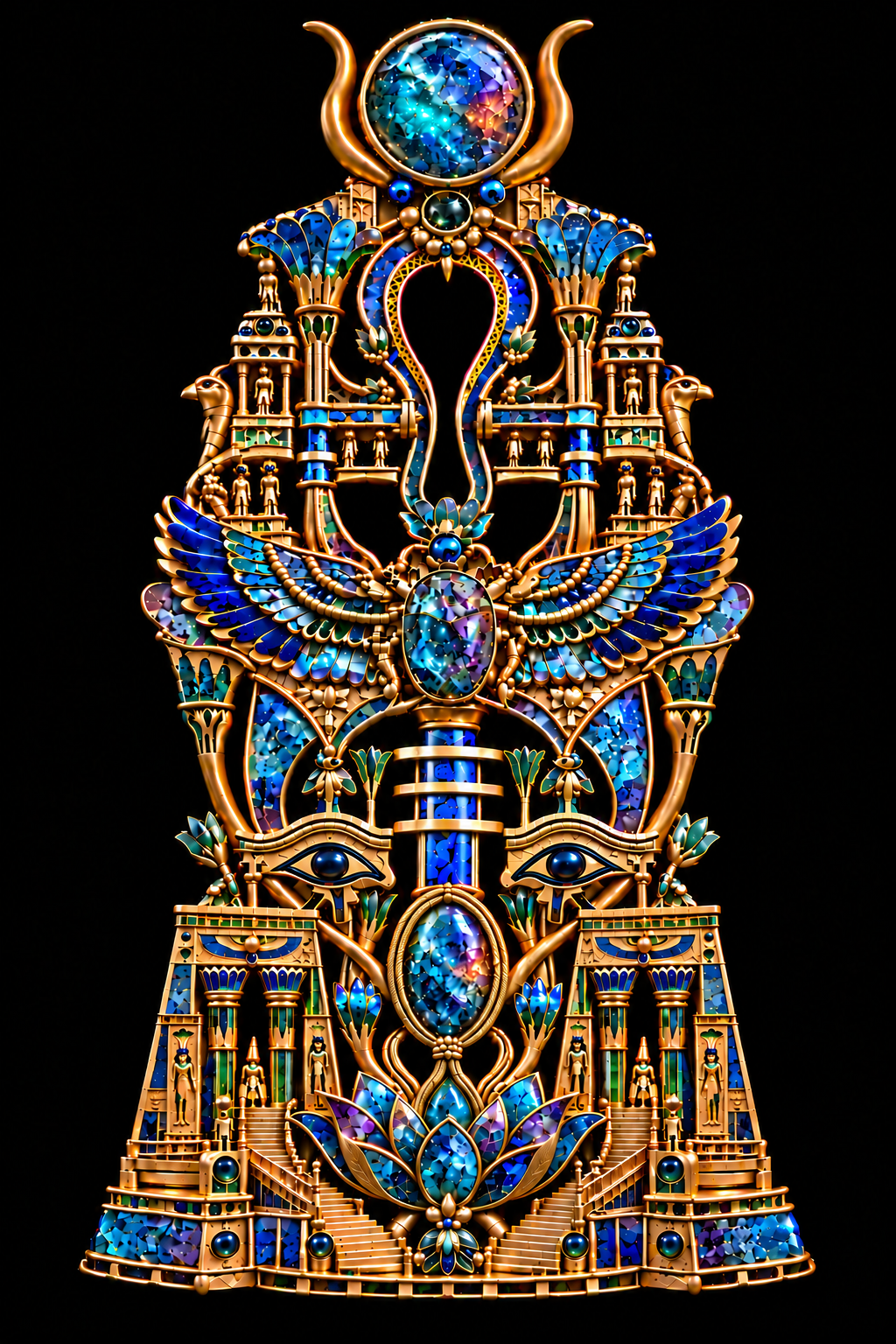
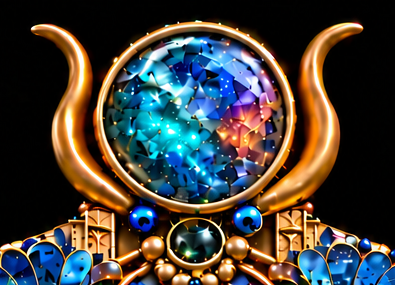
At the summit of Axis of Harmony, two golden horns curve around a luminous, circular gemstone. The disc gathers blue, turquoise and violet into a single field, while the horns give it a distinct place above the intricate structure below. It is both a crown and a point of concentration: the composition rises towards it, and its light seems to gather the whole work into one image.
The form recalls the horned solar crown associated with Hathor and also worn by Isis. Understanding that association adds depth to the artwork, but it requires more than matching a shape to a goddess. The crown belonged to changing religious relationships, royal settings, ritual objects and images of protection. Its meanings emerge through those contexts.
This fifth article considers the ancient headdress before returning to its contemporary transformation in Axis of Harmony.
1. Recognising The Crown
The basic arrangement is a solar disc set between cow horns. It can appear above a goddess’s human head, sometimes resting on an additional crown element, rather than requiring the deity to be represented as a complete cow. Egyptian divine imagery allowed human, animal and combined forms to express different aspects of a deity. Hathor’s horned disc belongs within that flexible visual language. [1]
The curve can look like a crescent to a modern viewer. That resemblance should not automatically turn it into a lunar symbol. In the headdress discussed here, museum identifications describe cow horns surrounding a sun disc. Reading the shape begins with that specific iconography, rather than with an assumed opposition between moon and sun.
A limestone relief at the Metropolitan Museum of Art, dated to the reign of Seti II, around 1214–1208 BCE, shows the crown above a female deity. The museum notes that both Hathor and Isis wore this headdress, although Hathor appears more frequently in New Kingdom temple contexts. The relief is a useful starting point precisely because recognition of the crown does not settle every question of identity. [2]
It provides a visual clue whose meaning must be tested against the surrounding evidence.
2. Hathor’S Many Relationships
Hathor’s associations reach beyond a single domain. A Garstang Museum account of its painted and gilded cult image connects her bovine character with fertility and abundance, alongside her relationship with song and dance. The same account describes her protection of the king and her role as a symbolic royal mother. [3]
These relationships help explain why the crown’s animal element matters. The horns are not merely an ornamental enclosure. They retain a connection with Hathor’s bovine form even when the rest of the image is human.
Her relationships with other gods also resist a simple family diagram. In discussing the Seti II relief, the Met explains that Hathor could be understood as a mother of Horus and as mother, wife or daughter of Re. In temple imagery she could support, escort or receive the king. [2]
The varied relationships should be read in their particular settings. They show how religious images could articulate different connections without reducing the goddess to one fixed function. The crown participates in that network of relationships; it does not supply a complete account of them by itself.
3. A Goddess With Solar Power
It is tempting to organise ancient imagery around a universal formula: the feminine belongs to the moon, the masculine to the sun. Hathor’s solar associations show why that formula is inadequate here.
The Met’s account of the Third Intermediate Period places Hathor among the goddesses associated with the Eye of Re. These deities could embody active divine power in relationship with the sun god. The account also discusses the dangerous, distant goddess whose return brings renewed prosperity. Appeasement and protection belong within this religious world as closely as warmth and nourishment. [4]
Solar imagery therefore need not imply only a gentle glow. It can involve potency, distance, return and the restoration of favourable conditions. Nor does Hathor’s connection with joy make her an uncomplicated emblem of happiness.
For a contemporary artist, these distinctions open a richer field of interpretation. Light can be understood as something that sustains, concentrates or transforms. Those are possible responses to the imagery, rather than a claim that every ancient wearer of the crown expressed the same philosophical idea.
4. Music As Ritual Action
Hathor’s connection with music survives in objects that place her image directly on an instrument. The sistrum is a rattle used in religious settings. A small faience plaque at the Met, dated around 1550–1300 BCE, depicts a Hathor sistrum whose handle incorporates a human face with cow ears. The museum associates it with music and joy. [5]
Here the goddess is not encountered only through a crown. Her face becomes part of an object made to act through sound.
A larger faience sistrum bearing the names of King Amasis, dated 570–526 BCE, has a shrine-shaped upper section with holes for sounding bars. The Met explains that the instrument’s rattling could soothe and pacify. It also cautions that this fragile faience example may have served as a gift to the deity rather than an instrument frequently played. [6]
That distinction matters. An object’s form may refer to a ritual action even when its particular material makes regular performance uncertain. Sound, offering and representation can meet in one object without becoming interchangeable.
The connection also gives Hathor’s imagery a dimension that a still photograph cannot convey: movement and sound were part of the religious environment in which such forms operated.
5. The Crown Enters Architecture
Hathor’s imagery could shape buildings as well as portable objects. A Met essay on a Hathor column explains how the goddess’s head and the form of the sistrum informed architectural supports. The relationship between instrument and column was established by the Eighteenth Dynasty. At Dendera, monumental sistrum columns give that association an architectural scale. [7]
The essay also connects Hathor columns with birth houses associated with the king’s divine birth, and discusses rooftop chapels where exposure to sunlight renewed cult images. [7]
These settings bring different kinds of renewal into proximity: birth, royal continuity and the revitalisation of a sacred image. They should not be collapsed into one undifferentiated meaning, but their coexistence helps explain the breadth of Hathor’s visual world.
In Axis of Harmony, the horned disc crowns a structure filled with miniature columns, stairways and gateways. The artwork does not reproduce a specific Egyptian temple. Its architectural character nevertheless makes this historical movement between intimate object and monumental setting especially relevant. A crown can mark the summit of an imagined sanctuary as well as the head of a figure.
6. Nourishment Beyond Life
Hathor’s relationship with renewal also extends into funerary contexts. The Garstang Museum’s cult image from Esna retains traces of paint and gold foil. Its accompanying imagery shows the deceased receiving water from Hathor in bovine form, while an inscription invokes nourishment. The museum connects her with protection of the dead and with the sycamore’s provision of shade, food and water. [3]
A pylon-shaped limestone stela of Ramesses II at the Met likewise invokes Hathor through titles associated with the West and the southern sycamore. The museum dates it around 1290–1224 BCE. [8]
These examples give renewal a practical vocabulary. Water, sustenance and shelter make continued existence imaginable through things that living bodies need. The religious setting changes, but the images remain close to material experience.
The disc between horns is not, by itself, a full statement about the afterlife. Such readings become more secure when the crown appears with a relevant inscription, figure or setting. That principle applies throughout this series: the wider object gives a symbol its historical specificity.
7. When Isis Wears The Same Headdress
The crown cannot always distinguish Hathor from Isis. A bronze statuette at the Met, dated 610–595 BCE, represents Isis nursing Horus, although much of the child is now missing. The museum explains that Isis had adopted Hathor’s headdress by the Late Period. An inscription invokes Isis on behalf of an official named Hor, providing evidence beyond the crown itself. [9]
This example makes the difference between resemblance and identification unusually clear. The horns and disc establish a shared visual form; the inscription supports the particular divine identity.
Another Met figure of Isis and Horus, dated 664–30 BCE, links the nursing image with Isis’s role as mother of Horus and symbolic mother of the pharaoh. The child’s royal crown contributes to the image’s association with legitimate kingship. Such figures were dedicated in temples and shrines in connection with the goddess’s protection of life. [10]
Shared imagery does not mean that Hathor and Isis were identical in every context. It shows that divine forms and attributes could move between closely related religious roles. A modern description should preserve that complexity rather than attaching a single name to every horned disc.
8. Metal, Colour And Separate Components
The surviving objects also reveal how these images were made. The inscribed Isis statuette incorporates bronze, gilded silver and electrum. The Met describes gilded silver bands fitted into recesses between the horns and disc. The crown’s appearance depended on material contrasts as well as its outline. [9]
A separate copper-alloy crown fragment recorded by the British Museum’s Naukratis project is held by the Museum of Fine Arts, Boston. Dated broadly to 664–31 BCE, it preserves a disc between horns and may once have crowned a figure made from another material. Its identification remains qualified: Hathor is possible, while Isis is considered more likely. [11]
A larger metal aegis at the Met, dated around 945–600 BCE, combines a goddess’s head with an elaborate collar. Its crown includes a disc between lyre-shaped horns, alongside other headdress elements. The record associates the image with Isis or Hathor and suggests that attachment features connect it with a ritual necklace and counterpoise. [12]
Such examples invite close attention to joins, inlays and supporting structures. The sacred image was also a crafted object, assembled through decisions about scale, surface and use.
9. An Image That Could Be Worn
Hathor’s imagery also appears at a much smaller scale. A faience Hathor-head amulet at the Met, dated 664–332 BCE, measures only a little over three centimetres in height. Its headdress combines several elements, while four vertical piercings suggest use as a spacer in a strung arrangement. [13]
The piercings change how we imagine the object. It belonged to an arrangement of other components, rather than necessarily hanging alone as a pendant. Its meaning and appearance were experienced through placement, proximity and wearing.
For an artwork conceived through the visual language of jewellery, this matters. Ancient divine imagery could move between temple walls, instruments, collars and small faience components. Scale altered the way an image was encountered, while its recognisable features allowed it to remain legible.
10. The Gemstone Disc In Axis Of Harmony
The summit of Axis of Harmony transforms the ancient arrangement into a contemporary digital image. Its circular centre has the fractured colour and changing reflections of an imagined gemstone. The golden horns create a clear boundary around that complexity.
The historical crown supplies a point of reference: cow horns enclosing a solar disc, associated with Hathor and also adopted by Isis. The gemstone treatment belongs to this artwork. It should not be presented as evidence for an ancient Egyptian gemstone sun or as a reconstruction of a surviving object.
Within the composition, the disc answers the opening flower below. The lotus spreads outward at the base; the crown gathers attention at the summit. Between them, eyes, wings and architectural details sustain the vertical movement. That relationship is a reading of Axis of Harmony’s structure, rather than a documented ancient scheme connecting every motif in this exact arrangement.
The crown gives the work a strong conclusion without exhausting its meanings. Its solar reference carries associations of divine presence and renewal, while its gemstone surface makes light appear multiple and changeable. The ancient form remains recognisable, and the contemporary image gives it a new material imagination.
Research Notes
This essay distinguishes museum identifications from interpretations of Axis of Harmony. Broad dates, uncertain attributions and qualified accounts of an object’s use have been retained where relevant. The cited objects come from different periods and settings; they do not establish an unchanging meaning for the crown throughout Egyptian history.
Axis of Harmony is a contemporary digital artwork by Jabbi Delahaye. Descriptions of its gold and gemstones concern its visual treatment and imagined materials. This essay is an accessible research companion, not a specialist peer-reviewed Egyptological study.
References
[1] The Metropolitan Museum of Art. “Divine Egypt: Inside the Exhibition.” Discussion of divine forms and Hathor’s imagery. https://www.metmuseum.org/pt/exhibitions/divine-egypt/inside-the-exhibition
[2] The Metropolitan Museum of Art. “Relief of a Female Deity’s Head.” Accession 48.149.6; limestone; reign of Seti II, ca. 1214–1208 BCE. https://www.metmuseum.org/art/collection/search/544755
[3] Garstang Museum of Archaeology, University of Liverpool. “Aspects of a Goddess: The Cult Image of Hathor in the Garstang Museum (E.66).” 20 July 2018. https://garstangmuseum.wordpress.com/2018/07/20/aspects-of-a-goddess-the-cult-image-of-hathor-in-the-garstang-museum-e-66/
[4] James Allen and Marsha Hill. “Egypt in the Third Intermediate Period (ca. 1070–664 B.C.).” The Metropolitan Museum of Art, Heilbrunn Timeline of Art History; originally published 2004, revised 2018. https://www.metmuseum.org/essays/egypt-in-the-third-intermediate-period-1070-712-b-c
[5] The Metropolitan Museum of Art. “Plaque with Hathor Sistrum and Blessing of Bastet.” Accession 10.130.850; faience; ca. 1550–1300 BCE. https://www.metmuseum.org/art/collection/search/553466
[6] The Metropolitan Museum of Art. “Sistrum with the Name of King Amasis.” Accession 07.228.77; faience; 570–526 BCE. https://www.metmuseum.org/art/collection/search/553063
[7] The Metropolitan Museum of Art. “Petrified Sound and Digital Color: A Hathor Column in the New Ptolemaic Galleries.” 12 August 2016. https://www.metmuseum.org/perspectives/hathor-column
[8] The Metropolitan Museum of Art. “Pylon-shaped Stela of Ramesses II.” Limestone; ca. 1290–1224 BCE. https://www.metmuseum.org/art/collection/search/549492
[9] The Metropolitan Museum of Art. “Statuette of Isis Nursing Horus, Inscribed for Hor, Son of Padihorresnet.” Accession 45.4.3a, b; 610–595 BCE. https://www.metmuseum.org/art/collection/search/545968
[10] The Metropolitan Museum of Art. “Isis and Horus.” Accession 23.6.9; cupreous metal; 664–30 BCE. https://www.metmuseum.org/art/collection/search/570700
[11] The British Museum, Naukratis project. “Figure-fitting,” record X__462. Copper-alloy crown fragment held by the Museum of Fine Arts, Boston; 664–31 BCE. https://www.britishmuseum.org/collection/object/X__462
[12] The Metropolitan Museum of Art. “Aegis with Head of a Goddess.” Accession 48.73; cupreous metal, stone and paint; ca. 945–600 BCE. https://www.metmuseum.org/art/collection/search/546000
[13] The Metropolitan Museum of Art. “Hathor Head Amulet.” Accession 26.7.1041; faience; 664–332 BCE. https://www.metmuseum.org/art/collection/search/550965
Museum records and institutional essays consulted 10 October 2026.