EGYPTIAN SYMBOLS · HISTORICAL COMPANION · ARTICLE ONE
The Ankh: Life, Breath and an Enduring Egyptian Symbol
Research essay · 10 October 2026
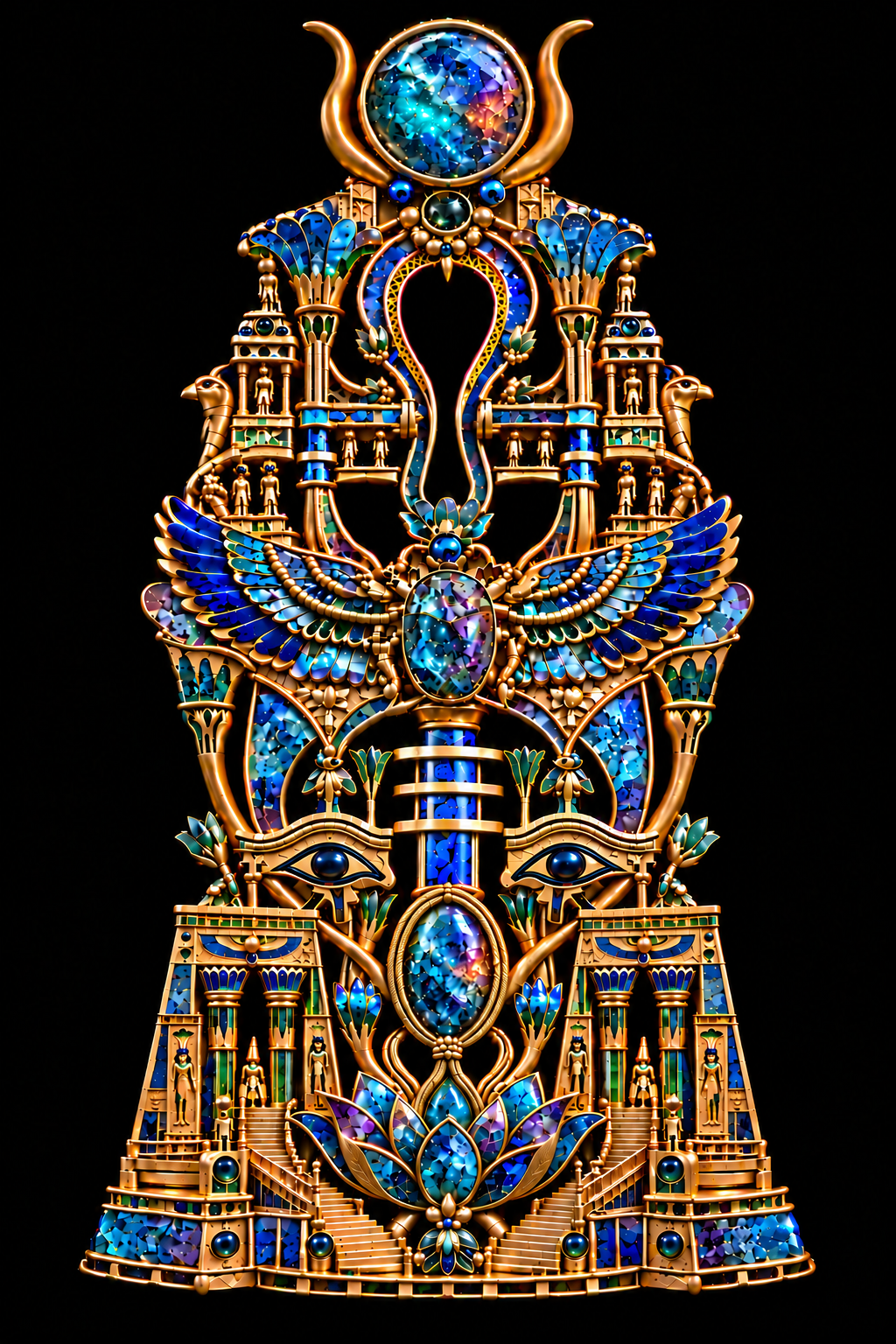
A loop, a crossbar and a descending stem: the ankh gives a remarkably compact form to an immense subject. In ancient Egypt it belonged to the language of life. It could be written in an inscription, held by a deity or made into an object. Understanding it requires attention to those different settings. A sign beside a royal name, an emblem in a divine hand and an amulet in a burial are related expressions, but they do different work.
This essay follows the ankh through selected archaeological examples and museum scholarship before considering its reinterpretation in Jabbi Delahaye’s Axis of Harmony. It separates documented ancient usage from proposals about the sign’s origin and from the meanings a contemporary artwork can create.
A Word Made Visible
The strongest starting point is linguistic. The Metropolitan Museum of Art identifies the ankh as a hieroglyph used for the words “live,” “alive” and “life.” Its symbolic associations developed around that linguistic meaning. The sign was therefore part of a writing system as well as a recognisable image. [1]
This distinction changes how we read it. Calling the ankh a symbol of eternal life can be appropriate in a particular context, but “eternal” is not automatically contained in every occurrence. The Met’s educational guide illustrates how the ankh could be combined with other signs to express the granting of life forever. Duration is supplied by the surrounding expression. An inscription has to be read, rather than reduced to an isolated emblem. [2]
The familiar outline also became an independent object. A wooden model in the Met, dated approximately 1981–1802 BCE, belongs to Dynasty 12 in the Middle Kingdom. Its recorded provenance places it at Meir, probably in the tomb of Ukhhotep or Hapiankhtifi. The qualification “probably” matters: the museum distinguishes a likely tomb association from a secure identification. Here, a written sign has acquired material presence. [3]
What Did Its Shape Originally Represent?
The meaning of the ankh is more securely established than the identification of whatever object its outline may originally have pictured. The Met’s guide offers a sandal strap or an elaborate bow as possibilities. Its wording is deliberately tentative. These are proposals about the sign’s visual origin, not alternative translations of the word for life. [2]
The two questions should remain separate. Scholars can read a sign reliably while debating the history of its shape. Recognising that difference gives readers a more accurate understanding of Egyptology: evidence can settle one aspect of an object while leaving another open.
The Feminine And Masculine Reading
Another interpretation sees the ankh as joining feminine and masculine elements: the upper oval is read as feminine, while the lower stem and cross-form are read as masculine. The suggestion connects the sign for life with the union through which new life is generated. It deserves consideration, together with an account of the evidence supporting it.
A documented example occurs in Thomas Inman’s nineteenth-century Ancient Pagan and Modern Christian Symbolism. In his discussion of Figure 43, Inman interprets the handled cross as combining male and female elements and associates it with fruitful union. Elsewhere he explicitly treats an oval as a female principle. His work is primary evidence that a nineteenth-century writer advanced this reading; it is not an ancient Egyptian explanation of the sign. [8]
The US National Park Service’s account also lists interlinking male and female symbols among theories about the ankh. Crucially, it introduces these as theories and acknowledges uncertainty about the sign’s origins. It supplies no ancient text establishing the specific equation of upper loop with feminine and lower portion with masculine. [9]
The research consulted for this essay therefore supports discussing the interpretation, but does not establish it as a securely documented ancient Egyptian explanation. The linguistic meaning of life and the proposed anatomical meaning of the outline have different evidential foundations.
A Comparison With Yin And Yang
This reading invites comparison with yin and yang. Philosopher Robin R. Wang describes yinyang in terms of interaction, change and the harmonisation of complementary aspects of existence. Its applications include gendered associations, but its scope is much wider than male and female: it encompasses relationships such as light and shade, movement and rest, and changing natural cycles. [10]
The useful point of comparison is the possibility of life or harmony emerging through relationship. That is an interpretive analogy between distinct traditions. The sources consulted here do not demonstrate that the ankh encoded Chinese yinyang philosophy or that one symbol developed from the other.
For Axis of Harmony, the comparison offers a contemporary way to consider complementary forms and balance. Historical accuracy strengthens that discussion by making clear which associations are documented ancient usage, which are later interpretations, and which belong to the encounter with the artwork today.
Life As A Divine Gift
The ankh takes on a particularly vivid role when it appears in a scene of divine action. The Met’s guide describes gods holding the sign and offering it towards the king’s face. Life becomes something that can be shown passing between divine and human figures. [2]
One relief discussed in that guide depicts Akhenaten making an offering beneath the Aten, the solar disc. The sun’s rays terminate in small hands, one of which presents an ankh towards the king’s nose. The arrangement gives the abstract idea a bodily location: the place where breath enters. [2]
There is a difference between identifying that gesture and claiming that an image demonstrates a physical mechanism. The scene is evidence for a religious understanding of life and divine support. Its precision lies in the relationship it depicts—who gives, who receives and how the gift is represented.
The royal context is equally significant. A scene involving a king does not simply illustrate an individual’s wish to stay alive. It places royal existence within a divine relationship. Reading the figures and the ankh together reveals more than extracting a single symbol from the composition.
An Object From A King’S Tomb
A faience ceremonial implement from the tomb of Thutmose IV provides a concrete example of the ankh’s connection with kingship. The Met dates it to approximately 1396–1386 BCE and records its discovery in the Valley of the Kings during the Davis/Carter excavations of 1903. In its centre is a cartouche containing the king’s name. [1]
The combination brings a named ruler into the sign’s field of meaning. It also shows why material and archaeological context belong in a discussion of symbolism. This is a particular object from a particular burial, rather than a timeless diagram detached from its use.
Its survival does not mean that every ancient ankh had an identical purpose. Comparison with objects of other dates, materials and findspots helps establish both continuity and difference.
Beyond Royal Imagery
The ankh also appears in objects associated with people outside the royal family. A small faience amulet in the Met, shaped like a cowrie shell, carries the full spelling of ankh on its base. Dated approximately 1491–1473 BCE, it was found in the coffin of an unnamed woman in the tomb of Hatnefer and Ramose at Thebes. [4]
At only 1.4 centimetres long, it presents a striking contrast to monumental religious imagery. The reference to life is carried by an intimate object in a burial assemblage. The museum records other objects in the coffin, including mirrors, bowls and a wooden box. Those associations restore some of the physical setting in which the amulet was encountered. [4]
UCL’s Digital Egypt resource also cautions against treating the ankh amulet as equally common throughout Egyptian history. It records examples from the end of the Old Kingdom and First Intermediate Period, identifies particular popularity in Dynasty 18, and describes later examples as rare. That chronology concerns amulets; it should not be mistaken for a claim about the first appearance or disappearance of the hieroglyph itself. [5]
When Symbols Work Together
Ancient compositions could bring the ankh into relationship with other signs. A gilded faience example in the Met combines ankh, djed and was: life, stability and dominion. The museum catalogues it broadly within the Late Period–Ptolemaic Period, 664–30 BCE. [6]
Its catalogue title refers to a neb basket, but the explanatory discussion identifies the supporting element as a heb bowl, associated with festival. The museum proposes that this type may have continued a function as a New Year’s offering. That interpretation remains qualified, and the precise dating of such examples is uncertain. [6]
This small object illustrates both the possibilities and the discipline of historical interpretation. Signs can reinforce one another, yet their combination needs to be read from the actual object. A cluster of ancient motifs does not automatically form one fixed message in every setting.
The Ankh In Axis Of Harmony
In Axis of Harmony, the ankh provides a central organising form within a contemporary visionary jewellery composition. Its association with life supplies a historical point of connection. Its relationship with the artwork’s wings, gemstones and other Egyptian references belongs to Delahaye’s present-day artistic interpretation.
The distinction leaves room for a close visual reading. The ankh can be understood as an axis around which the surrounding forms gather, while its open loop provides space within the intricate composition. These are observations about the artwork’s design, not claims that an ancient Egyptian object carried precisely the same arrangement or intention.
Likewise, the represented gold and fantasy gemstones contribute to the artwork’s imagined material world. Their appearance does not establish an ancient recipe, ritual function or archaeological precedent. The piece brings a historically recognisable sign into a new setting, where balance and imaginative invention shape its role.
Recognition And Renewal
Contemporary engagement with Egyptian imagery has its own cultural history. The Met’s exhibition guide for Flight into Egypt documents how Black artists and other figures across the African diaspora have drawn on ancient Egypt in artistic, scholarly and religious work. Such encounters involve questions of heritage and identity as well as visual inspiration. [7]
Axis of Harmony can be approached as a contemporary artistic encounter with that ancient visual language, without assigning Delahaye an unstated religious belief or claiming an unbroken historical lineage for the design.
The ankh rewards this double attention: first to the words, objects and gestures that establish its ancient meanings, and then to the new relationships a living artist gives it. Historical specificity makes the encounter more interesting. The sign retains its association with life while inviting viewers to notice what has changed around it.
References And Research Notes
Historical claims are grounded in the museum and university sources below. The section on Axis of Harmony is contemporary visual interpretation based on the established design context. This is a research-led public essay, not a claim of authorship or review by a professional Egyptologist. Dates follow the cited catalogues and remain approximate where indicated.
[1] The Metropolitan Museum of Art. Ceremonial Implement in the Shape of an Ankh. Dynasty 18, reign of Thutmose IV, ca. 1396–1386 BCE. Faience. Accession 30.8.30. https://www.metmuseum.org/art/collection/search/548476
[2] The Metropolitan Museum of Art. The Art of Ancient Egypt: A Resource for Educators. See printed pages 49–50 for hieroglyphs and combinations; page 96 for Akhenaten and the Aten. https://resources.metmuseum.org/resources/metpublications/pdf/The_Art_of_Ancient_Egypt_A_Resource_for_Educators.pdf
[3] The Metropolitan Museum of Art. Model ankh. Dynasty 12, ca. 1981–1802 BCE. Wood. Accession 12.182.66. https://www.metmuseum.org/art/collection/search/546309
[4] The Metropolitan Museum of Art. Cowroid Inscribed with an Ankh. Early Dynasty 18, ca. 1491–1473 BCE. Faience. Accession 36.3.22. https://www.metmuseum.org/art/collection/search/548968
[5] University College London. Digital Egypt for Universities: Amulets, symbols of power. https://www.ucl.ac.uk/museums-static/digitalegypt/burialcustoms/amulets3.html
[6] The Metropolitan Museum of Art. Ankh, djed, was on neb basket. Late Period–Ptolemaic Period, 664–30 BCE. Faience and gilding. Accession 26.7.1043. Consult the discussion of the heb bowl and the qualified New Year interpretation. https://www.metmuseum.org/art/collection/search/570354
[7] The Metropolitan Museum of Art. Flight into Egypt: Black Artists and Ancient Egypt, 1876–Now. Exhibition guide, introduction and cultural context. https://www.metmuseum.org/exhibitions/flight-into-egypt-black-artists-and-ancient-egypt-1876-now/visiting-guide
[8] Thomas Inman. Ancient Pagan and Modern Christian Symbolism. Second edition, revised and enlarged; preface dated August 1874. See the discussion of Figure 43 and the passage following Figure 73. Historical evidence for Inman’s interpretation, not proof of ancient Egyptian intent. Digitised by Project Gutenberg. https://www.gutenberg.org/cache/epub/38485/pg38485-images.html
[9] US National Park Service. African Burial Ground National Monument: ANKH — Egyptian Symbol of Life. Updated 5 November 2015. Consult specifically the qualified discussion of proposed origins. https://www.nps.gov/afbg/learn/historyculture/ankh.htm
[10] Robin R. Wang. Yinyang (Yin-yang). Internet Encyclopedia of Philosophy. See the introduction and sections on origins and concrete substance for complementary relationships and gendered applications. https://iep.utm.edu/yinyang/
Online sources consulted 10 October 2026.