ARTICLE SEVEN · PORTRAIT CONSTRUCTION
The Living Face
How anatomy, light, asymmetry and restraint gave a digitally constructed Renaissance-inspired portrait its human presence.
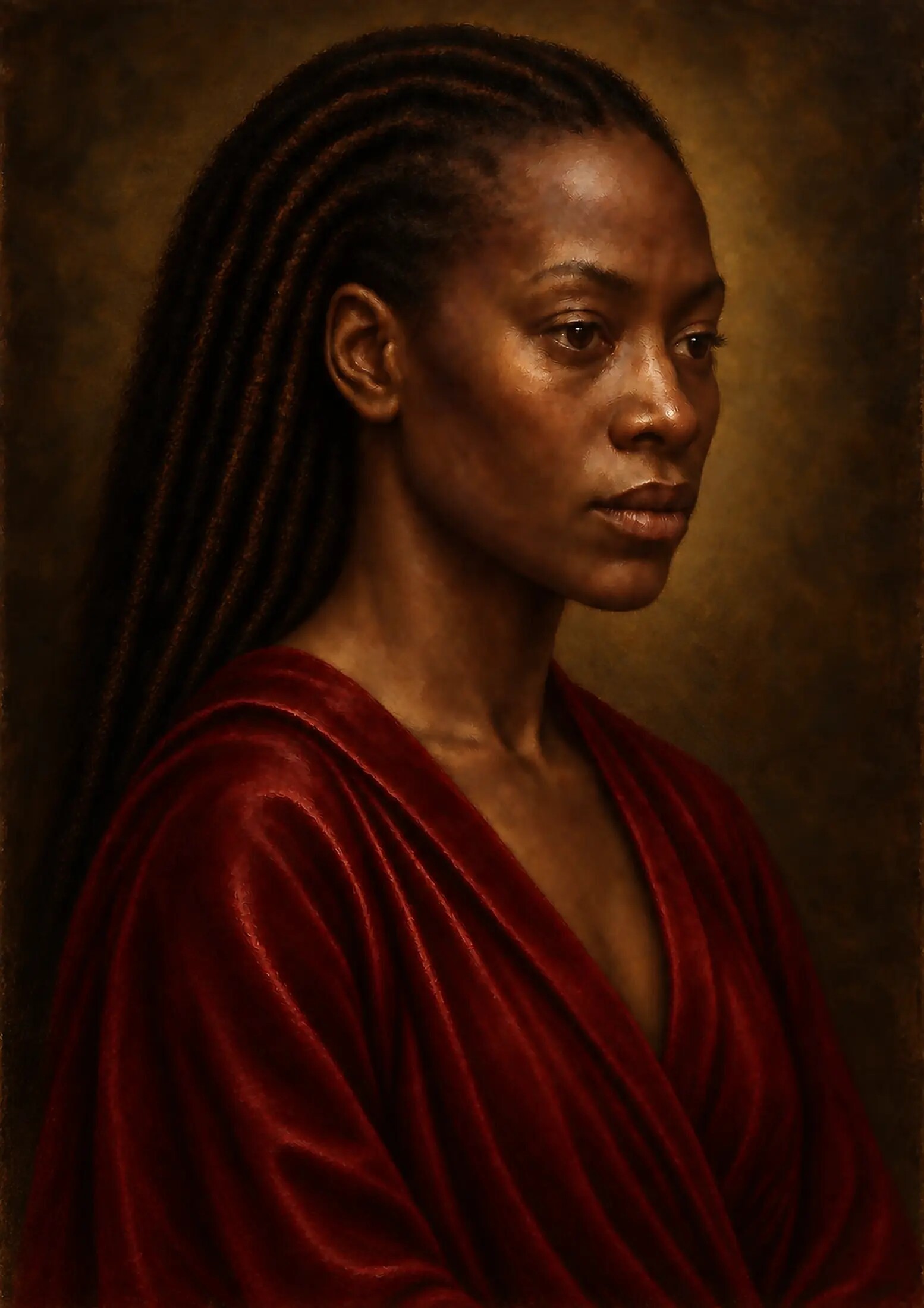
A face may be the smallest part of a full composition and still become the place where the entire image is judged.
In this seventh article accompanying Painting Without Wet Paint, I examine how anatomy, illumination, skin, gaze, moisture, asymmetry and subtraction were brought into one coherent presence.
A face is often the smallest part of a full composition and the place where the entire image is judged.
Viewers may admire the colour of a garment, the depth of the surrounding darkness or the apparent richness of the painted surface, but they return almost immediately to the eyes and mouth. We look for intention in the gaze. We read tension in the lips. We notice whether one side of the face carries slightly more weight than the other. Before we consciously examine technique, we ask a simpler question:
Is somebody present?
That question became central to the construction of this Renaissance-inspired digital painting. The task was not merely to produce a recognisable face or a collection of highly resolved features. It was to create the impression that bone, muscle, skin, moisture, light and thought occupied the same form.
This demanded a different approach from simply increasing detail. A face can contain pores, eyelashes and tiny reflections and still feel artificial. It can be anatomically tidy yet emotionally vacant. It can be symmetrical, polished and technically impressive while possessing none of the instability that makes a human expression feel alive.
The work therefore had to be developed at two levels simultaneously. At the structural level, the head needed convincing proportion, volume and illumination. At the psychological level, its features needed to suggest an interior life without being forced into a theatrical expression.
The resulting face emerged through repeated construction and correction: drawing beneath colour, tonal modelling beneath warmth, cool notes beneath flesh, transparency beside opacity, sharp edges beside dissolving ones. The eyes and mouth were repeatedly inspected at extreme magnification, but the final judgement was always made from the full composition.
The aim was not microscopic perfection. It was presence.
More Than a Likeness
Portraiture has never been concerned only with recording the arrangement of somebody’s features.
A successful portrait may communicate age, temperament, social position, vulnerability, authority, distance, intelligence or reserve. These qualities are not located in one isolated detail. They arise through relationships: the direction of the gaze, the tilt of the head, the pressure within the mouth, the posture of the body, the quality of the light and the amount of space the figure is allowed to occupy.
The Metropolitan Museum of Art’s account of portraiture in Renaissance and Baroque Europe notes that a portrait does more than record features; it attempts to convey the presence and identity of a particular person. That distinction is crucial. Resemblance can be measured comparatively. Presence cannot.
Presence is created when the parts of a portrait appear to belong to the same living system.
The eyes must sit within sockets rather than float on the surface. The nose must project from the planes of the face rather than read as a separate symbol. The mouth must curve around the dental arch and turn into the cheeks. The skin must reveal the structure beneath it without becoming a diagram of anatomy.
Most importantly, all these elements must exist under the same light.
When they do not, the illusion collapses. A perfectly rendered eye cannot rescue a poorly constructed skull. Delicate lips cannot remain convincing if they are pasted onto a face whose planes have not been established. Skin texture cannot create life when the underlying form is flat.
The living face begins beneath the visible face.
The Head as a Structure
The first responsibility was to treat the head as a three-dimensional form rather than an arrangement of familiar features.
Human beings are extremely sensitive to facial proportion. We may not consciously identify every error, but we recognise when an eye has been placed too high, when the distance between the nose and mouth has become compressed, or when the jaw no longer aligns with the turn of the skull.
In a digital image, these errors can become disguised by attractive colour and surface detail. They may survive at normal viewing size, only to become obvious when the portrait is enlarged. This is one reason why the construction process repeatedly moved between the whole image and close inspection.
The face was considered in broad masses before being treated as skin:
- the dome and side planes of the forehead;
- the brow ridge and the sockets beneath it;
- the projection of the cheekbones;
- the wedge of the nose;
- the rounded volume around the mouth;
- the turn of the jaw;
- the transition from chin to neck.
These forms determine how light moves across a head.
The forehead does not simply become brighter towards the light. It changes direction. The bridge of the nose catches illumination differently from its side plane. The cheek is not one continuous curve but a sequence of subtle turns: from the nose, across the cheekbone, into the softer lower cheek and finally towards the jaw.
If these transitions are ignored, the result may resemble a face covered by a smooth rubber mask. The colour can be beautiful and the texture sophisticated, yet the head will lack weight.
The solution was not to outline every anatomical plane. That would have made the portrait hard and diagrammatic. The structure needed to be felt through shifts in value, colour temperature and edge quality.
A fractionally cooler note could turn a plane away from the light. A softened boundary could allow the cheek to recede. A warmer reflected passage could reconnect the jaw with the neck. Structure became visible through controlled changes rather than drawn borders.
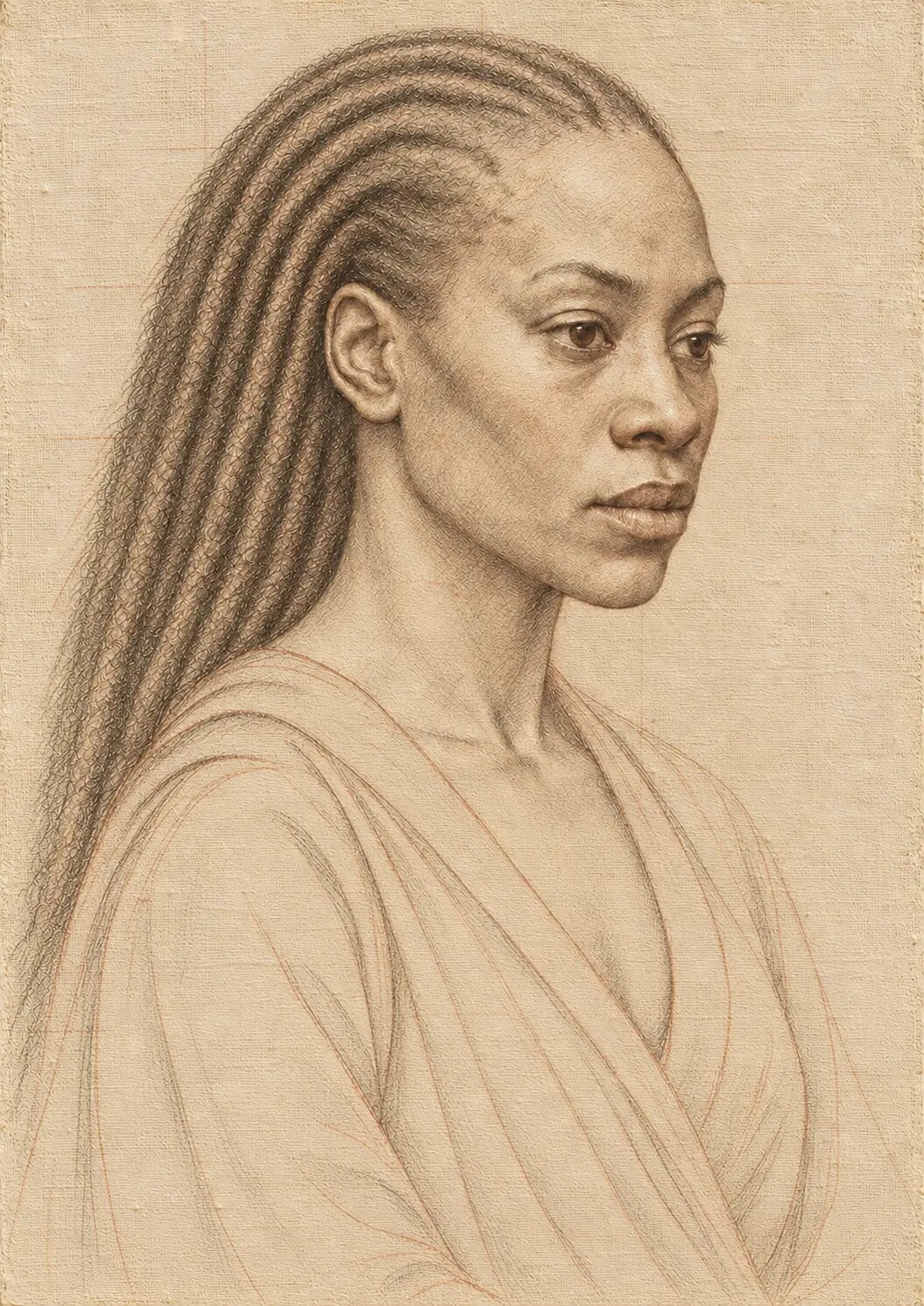
Anatomy as a Discipline, Not a Display
Anatomical knowledge is valuable because it explains why the visible surface behaves as it does. It becomes less useful when it announces itself too loudly.
The purpose of understanding the skull, muscles and soft tissues was not to make the portrait look clinically analysed. It was to prevent arbitrary decisions.
The brow follows the structure of the frontal bone and the rim of the eye socket. The eyelids wrap around a sphere. The corners of the mouth are influenced by surrounding muscles and by the curved dental structure beneath the lips. The jaw turns towards the ear before disappearing into the side of the head.
Knowing these relationships allows the artist to make quieter and more convincing adjustments.
It also helps when correcting digitally generated material. A passage may initially look plausible because it resembles a familiar photographic pattern. Under sustained inspection, however, it may contain a crease that does not correspond to any underlying structure, an eyelid that changes thickness without reason, or a highlight that implies a different surface angle from the one established by the rest of the face.
Anatomy provides a means of testing these passages.
Does this shadow describe the socket?
Does this edge turn around the cheek?
Does the upper lip project beyond the lower one in a way that agrees with the head’s position?
Does the neck support the skull convincingly?
Does a line represent actual structure, or is it merely decorative information?
These questions were more useful than asking whether a passage looked “realistic”. Realism is too broad a category. Structural plausibility is more precise.
At the same time, anatomical knowledge had to remain subordinate to the painting. A living face contains compression, softness, movement and variation. It cannot be reduced to a clean model of muscles laid over bone.
The anatomy had to disappear into life.
Modelling the Face Through Light
Light was not applied after the face had been completed. It was one of the principal means through which the face was constructed.
In the tonal underpainting, the head was organised into a hierarchy of light, halftone, shadow and accent. This established the direction of illumination before full colour complicated the image.
The light did not strike every part of the face equally. It gathered in selected planes, weakened across turning forms and dissolved into the surrounding darkness. The brightest passages were reserved for places where both form and meaning required them.
This restraint was essential.
If every visible plane received an equally strong highlight, the face became metallic. If all shadows were softened, the head lost structure. If every edge was sharpened, the figure appeared cut out from the background.
The illumination therefore moved across the face selectively. Certain areas were allowed to emerge fully; others remained partially withheld. A cheek might be clearly modelled while the far side of the jaw disappeared. One eye could carry a stronger point of reflected light while the other settled more deeply into shadow.
This variation did not imply two different light sources. It reflected the changing angles of the form, the relative exposure of each feature and the compositional need to direct attention.
The surrounding darkness also required careful construction. Black is not automatically shadow. A digitally empty black can erase the head instead of containing it.
Deep shadow needed internal variation: traces of warm reflected colour, cooler recesses, softened remnants of drawing and barely perceptible transitions into the background. These quiet differences allowed the darkness to remain active without becoming distractingly descriptive.
The face consequently appears to emerge from darkness rather than being placed in front of it.
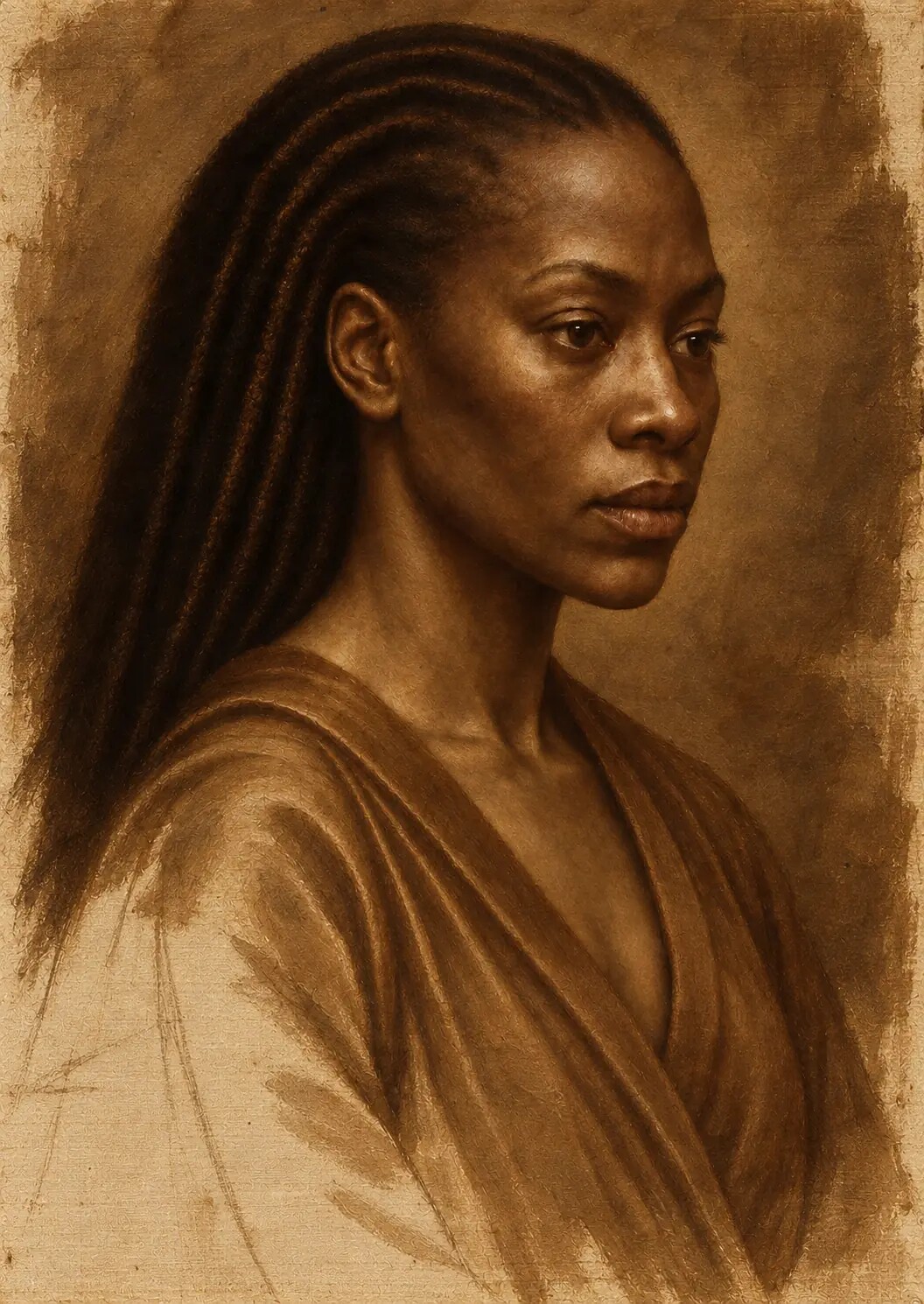
Flesh Is Not a Single Colour
One of the most persistent weaknesses in artificial portraiture is the treatment of skin as a local colour: a single flesh tone made lighter in highlights and darker in shadows.
Living skin does not behave so simply.
Its appearance is affected by blood flow, tissue thickness, underlying bone, reflected light, surface oil, age, environment and the colour of nearby materials. Some areas appear warmer; others cooler or more neutral. The skin around the eyes differs from the skin of the forehead. The lips belong to the face but have their own translucency. The ear may transmit light differently from the cheek.
The digitally constructed flesh was therefore organised through temperature as well as value.
Cooler or green-grey undertones remained beneath selected warm passages, reflecting the logic of verdaccio and related underpainting traditions. These cooler notes prevented the flesh from becoming uniformly pink or orange. They also allowed later warmth to feel embedded in the face rather than laid over it.
Warmth was used selectively:
- around the cheeks;
- at the lips;
- near the nostrils;
- along parts of the eyelids;
- in transitions affected by circulation;
- within reflected light.
Cooler notes helped describe:
- the temples;
- the lower face;
- the side planes turning from the light;
- the shadowed eye sockets;
- areas where bone lies close beneath the skin.
These distinctions remained subtle. If exaggerated, they would have divided the face into coloured zones. Their purpose was to create quiet internal movement.
The final flesh colour did not reside in any one layer. It emerged from the interaction of the simulated ground, tonal modelling, muted dead colour, warmer opaque passages, cooler corrections, transparent glazes and lighter scumbles.
This is one of the essential differences between choosing a colour and constructing a colour.
A sampled pink-beige value may approximate the visible appearance of skin at one point. It does not reproduce the sense that light has entered, crossed and returned through several optical layers. That sense of depth had to be suggested through the relationship between transparent and opaque passages.
Building Luminosity Without Plastic Skin
Digital smoothness is seductive. It can produce elegant gradients and flawless transitions with great speed. On a face, however, uninterrupted smoothness often creates an artificial surface.
Human skin is neither uniformly rough nor perfectly polished. At normal viewing distance, it reads as a coherent envelope around the form. At closer range, it reveals pores, small changes in reflectivity, fine lines, variations in colour and tiny interruptions.
The challenge was to include enough variation to make the surface credible without allowing texture to overpower structure.
Large facial forms were established first. Only after the forehead, cheeks, nose, jaw and mouth area were working as volumes could smaller surface differences be introduced.
This order matters because texture cannot repair form. Pores added to a flat cheek simply create a highly detailed flat cheek.
Surface variation was therefore kept subordinate to the larger modelling. It became more visible in selected focal regions and less insistent in transitional areas. It responded to the direction of the light and to the character of the depicted skin.
Highlights were similarly controlled. A broad, pale area may describe the main illumination, while a much smaller accent indicates moisture or surface oil. Treating every highlight as a brilliant point would have made the skin look wet, glazed or ceramic.
The intended effect was neither photographic pore-counting nor idealised porcelain. It was a painted surface capable of suggesting living tissue.
This required irregularity—but not random noise.
A mechanically repeated texture is quickly recognised as an overlay. Authentic variation changes with form, scale and focus. Pores compress as a plane turns away. Fine texture becomes less apparent in shadow. Softer areas do not carry the same surface definition as the bridge of the nose or the edge of the lips.
Texture had to belong to the face.
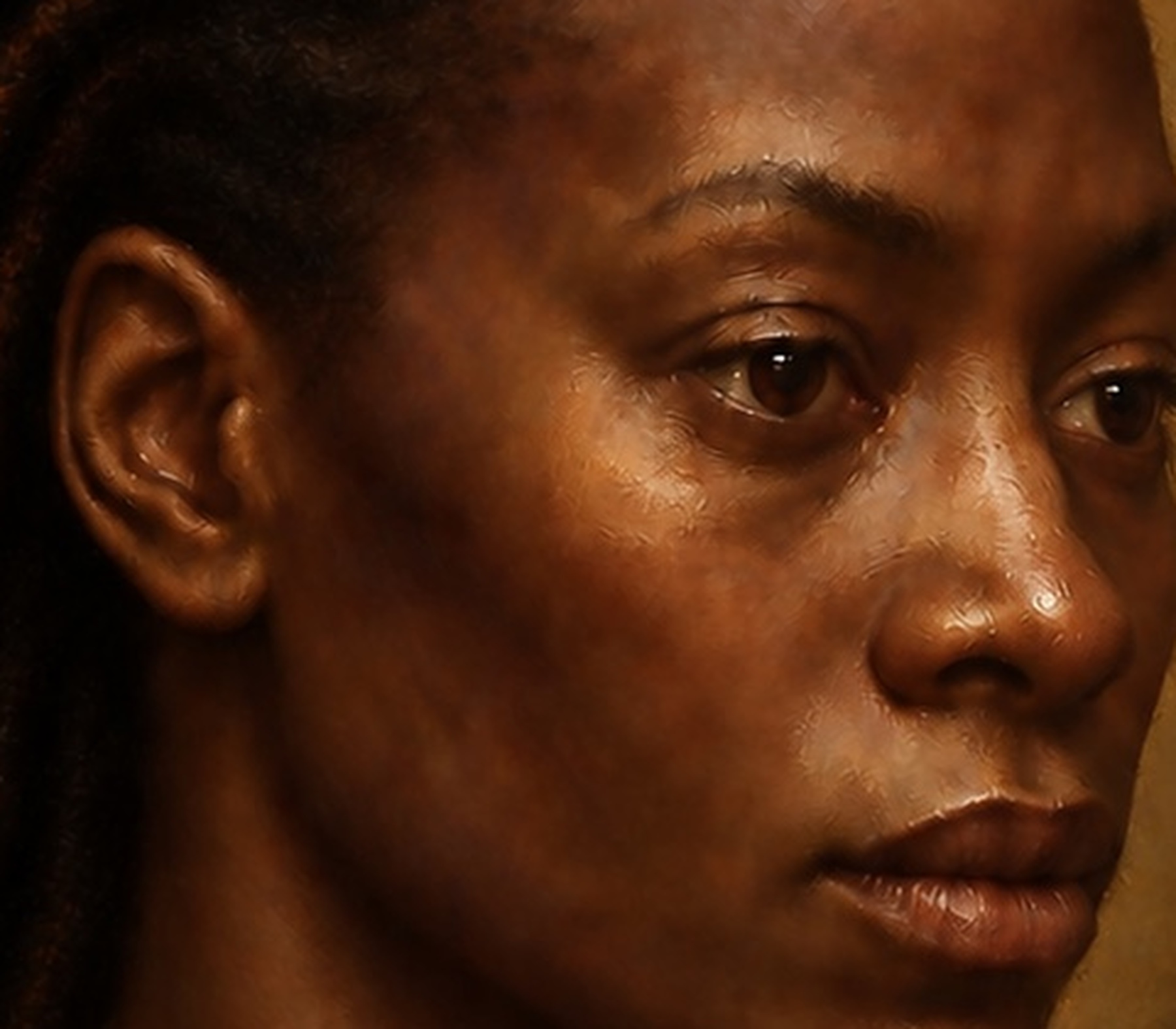
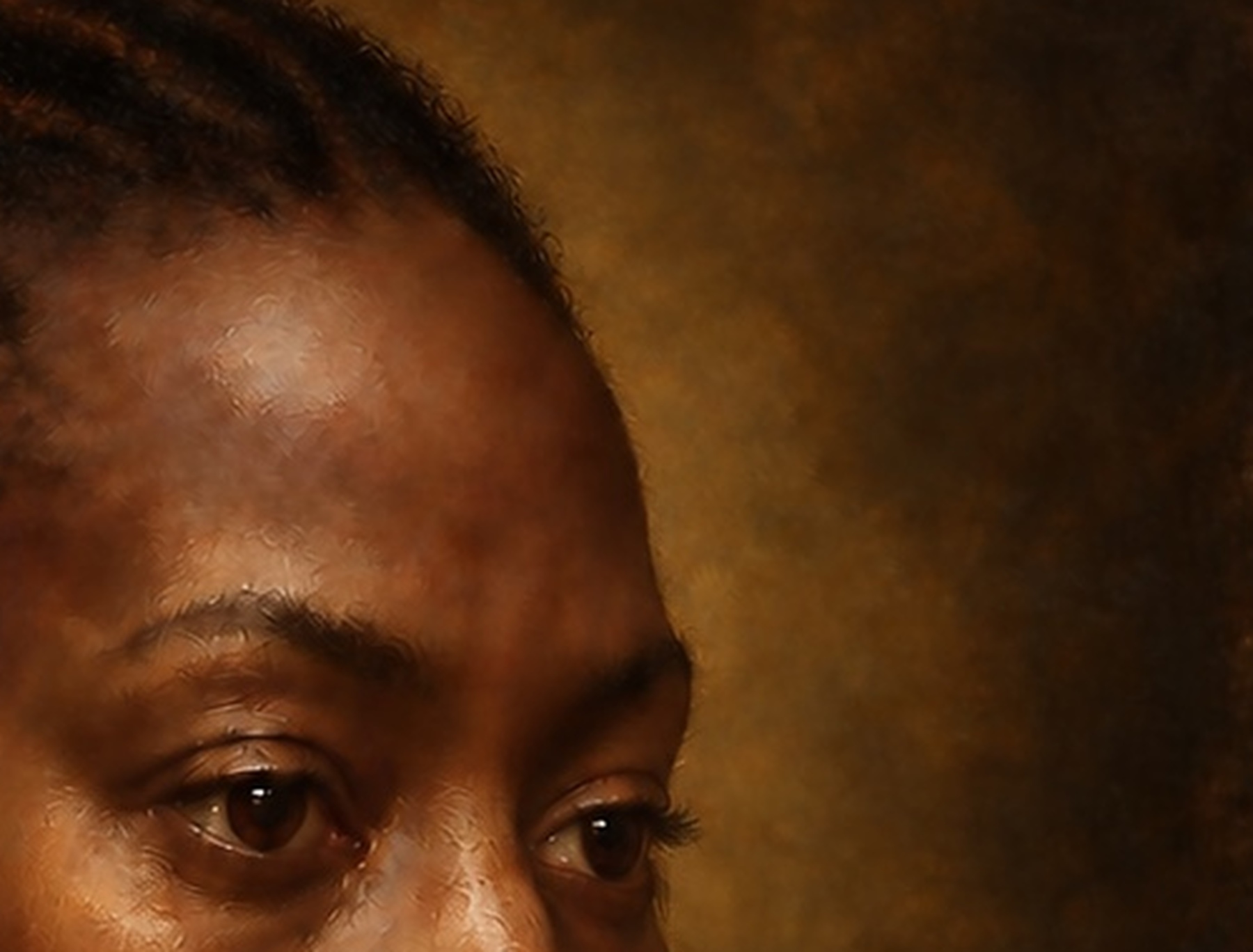
The Eyes as Constructed Forms
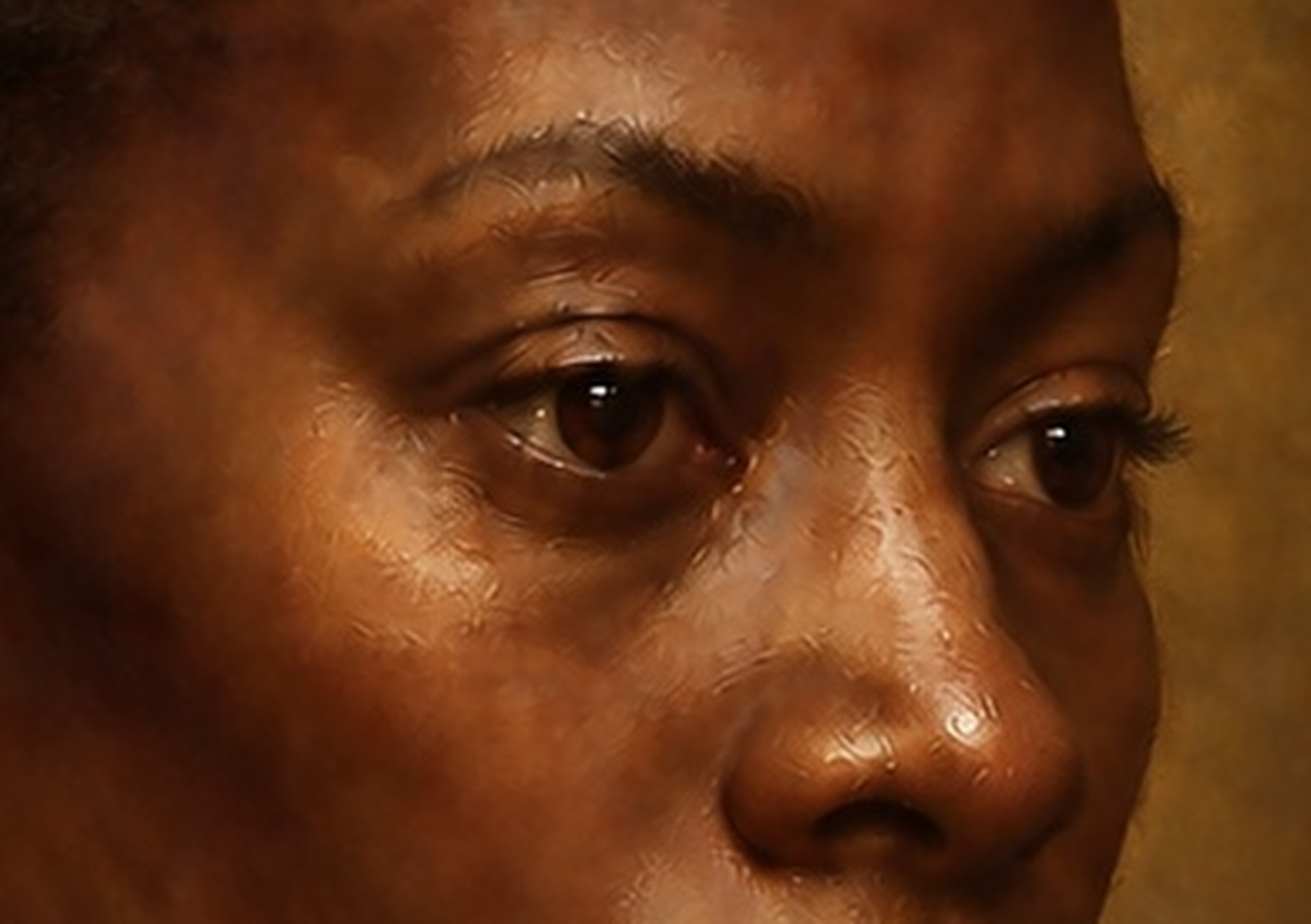
The eyes became the most closely examined part of the painting because they carry an extraordinary amount of psychological weight.
A minute alteration to the upper lid can make a gaze appear more alert or more guarded. A slight change in the position of the iris can shift attention. A highlight moved by only a few pixels may change the apparent direction of the light or give the eyes an unnatural glassiness.
Yet an eye cannot be painted convincingly by concentrating only on the iris and pupil.
The eye is a moist sphere held within a socket and partially covered by two lids. The clear cornea forms the curved front surface through which light enters. The iris controls the pupil, while tears maintain the surface of the eye. The National Eye Institute’s description of how eyes work offers a concise anatomical account, but for the painter the important point is visual: the eye has volume, depth, moisture and a transparent outer structure.
The lids must therefore appear to wrap around the eyeball. Their curvature changes from the inner corner to the outer corner. The upper lid generally carries more visual weight because of its thickness, shadow and relationship to the brow. The lower lid is not a matching line beneath it. It turns differently and often catches softer reflected light.
The visible “white” of the eye also required restraint. It is rarely a flat, brilliant white. It belongs to the lighting environment and is affected by the shadow of the lids, surrounding flesh, moisture and reflection.
Making it too white would separate it from the face. Darkening it excessively would remove clarity. The solution was a muted, responsive tone that could receive small shifts of warmth and coolness.
Iris, Pupil and Corneal Light
The iris was treated as depth rather than decoration.
It needed enough internal variation to avoid reading as a flat coloured disc, but not so much radial detail that it became a graphic pattern. The strongest structure remained near the pupil and outer iris, with softer modulation between them.
The pupil required equally careful handling. If it became too geometrically perfect or too sharply isolated, the eye looked designed rather than observed. Its darkness needed to connect naturally with the iris while remaining distinct enough to anchor the gaze.
The corneal highlight was one of the smallest and most consequential details in the image.
Because the cornea is curved and transparent, the highlight sits optically on the front of the eye rather than inside the iris. Its position must agree with the established light source. Highlights in both eyes also need to be related, although differences in head angle, lid coverage and shadow may alter their visibility.
A brilliant dot placed without structural logic can instantly produce an artificial “doll’s eye”. It may appear lively when viewed alone but false within the full face.
The highlights were therefore reduced to the minimum necessary. They were tested not only at macro scale but in the complete portrait. At the larger scale they needed to remain physically plausible; at normal viewing distance they needed to activate the gaze without announcing themselves.
The most successful highlight is rarely the one the viewer consciously notices.
The Tear Line and the Moist Edge
Moisture was another area where precision could easily become exaggeration.
The eye contains several reflective transitions: the wet margin of the lids, the small accumulation at the inner corner, the corneal reflection and subtle light along the lower tear line. If all of these were rendered at equal brightness and sharpness, the result would look artificial or overly emotional.
Instead, moisture was implied through differences in edge quality and value.
A narrow reflected passage along the lower lid could help describe its curvature. A small, restrained light at the inner corner could establish wetness. The corneal highlight could then remain the clearest reflective accent.
These details were not added as decoration. Each had to describe a surface with a particular physical character.
Skin scatters and absorbs light differently from the moist surface of the eye. The distinction between them may be communicated by only a tiny shift, but that shift is essential. Without it, the eye can appear dry and painted onto the face. With too much of it, the eye becomes glass or liquid.
Convincing moisture exists at the boundary between visibility and restraint.
Eyelashes, Brows and the Problem of Repetition
Eyelashes are small, but they reveal digital artificiality very quickly.
Uniform lashes—identical in length, spacing, curve and darkness—look manufactured. A heavy row can resemble eyeliner or wire. Lashes that ignore the curvature of the lid disconnect from the eye they are meant to belong to.
The final treatment relied on irregular grouping. Some lashes were visible; others merged into shadow. Their direction changed along the arc of the lid. A few carried enough contrast to register, while many remained only partly defined.
The same principle applied to the eyebrows.
Rather than treating the brow as a solid graphic shape, it was constructed as a mass containing directional hair. Individual strands were introduced selectively, particularly where they helped the brow turn around the forehead or dissolve into the temple.
The underlying shape remained more important than the number of hairs.
At extreme magnification, it is tempting to keep adding. More strands can feel like more realism. But once the portrait returns to normal viewing size, excess detail may harden the expression, darken the eye area or compete with the gaze.
The editing process therefore included subtraction. Repeated or overly regular lashes were softened. Unnecessary strands were removed. Sharp edges were broken. The feature was allowed to breathe.
Gaze and Psychological Presence
The direction of the eyes determines where the portrait’s psychological energy travels.
A direct gaze establishes a relationship with the viewer. An averted gaze can suggest thought, reserve, distraction or attention to something beyond the frame. Even when both eyes point in the same general direction, small inconsistencies may make the subject appear unfocused.
The gaze was evaluated as a unified action rather than two separately completed eyes.
This meant looking at the relative positions of the irises, the amount of visible sclera, the lid shapes and the turn of the head. It also meant considering how the gaze interacted with the mouth.
An intense eye combined with a fully relaxed mouth produces one emotional register. The same eye with compressed lips produces another. Expression does not belong to a single feature; it is distributed across the face.
The goal was to preserve ambiguity.
A portrait becomes less compelling when its emotional state is reduced to one obvious instruction: sadness, serenity, fear, authority. Human expressions frequently contain several possibilities at once. Reserve can resemble sorrow. Concentration can resemble suspicion. Calm can conceal tension.
The face was therefore allowed to remain open to interpretation. Its expression is not an illustration of a single emotion but a sustained psychological condition.
That ambiguity is part of what invites the viewer to keep looking.
Constructing the Mouth Around the Face
If the eyes are the most immediate psychological centre, the mouth is often the most sensitive indicator of tension.
A tiny change at one corner can alter the expression. A harder division between the lips can make the face appear severe. Too much upward curvature can produce an unintended smile. Too much symmetry can make the mouth feel designed rather than inhabited.
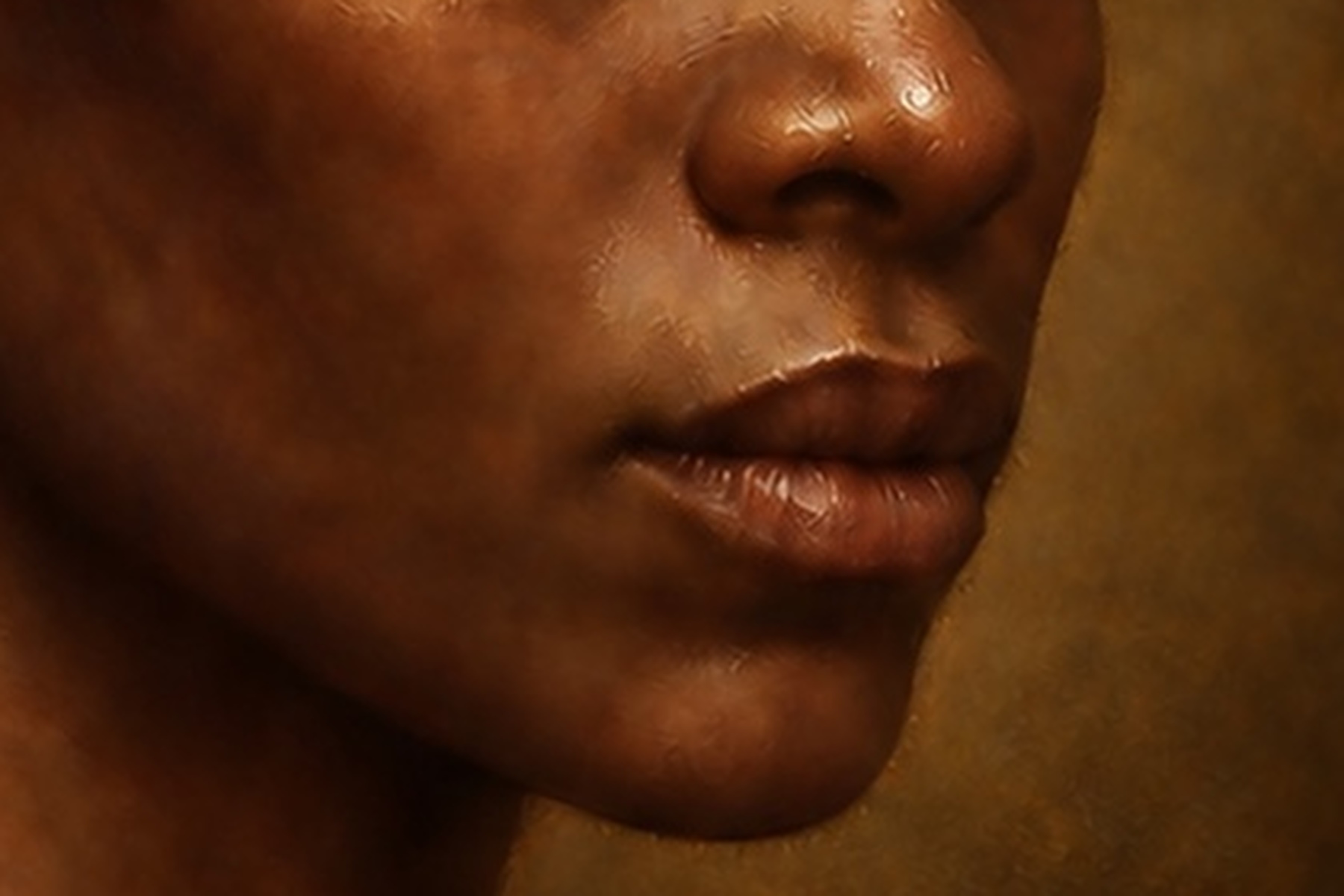
The mouth was first treated as a volume projecting from the lower face.
It curves around the dental arch and connects with the surrounding muzzle area—the complex of soft tissue between the nose, cheeks and chin. The lips cannot be convincingly painted as two enclosed shapes placed on top of the skin.
The upper lip generally turns away from overhead illumination more than the lower lip, but this is not a fixed formula. The direction of the head and light determines the actual pattern. What mattered was that the lips occupied space, turned around the face and shared its illumination.
The line where the lips meet was especially important. It was not drawn as an even dark contour. Its width, softness and darkness changed across the mouth.
Some sections were allowed to merge. Others became slightly firmer. At the corners, the meeting line turned into the surrounding flesh rather than ending abruptly.
This variability prevented the mouth from appearing cut out.
Colour and Translucency in the Lips
The lips required more than a stronger version of the skin colour.
They contain greater visible redness, but their appearance is still affected by the surrounding flesh, the lighting environment and their changing planes. A uniformly saturated red would have separated them from the face.
Their colour was constructed through restrained warm passages, cooler transitions and transparent red glazing. The upper and lower lips were related but not identical.
The upper lip carried deeper and often cooler colour where it turned from the light. The lower lip received a broader passage of illumination, with small reflective accents kept under control. The centre could hold greater warmth, while the edges gradually returned to facial skin.
This transition was crucial. A hard, continuous border creates the effect of lipstick or an applied graphic shape even when none is intended.
Instead, parts of the lip boundary were clearly defined while others dissolved. The viewer’s perception completes what the paint does not explicitly state.
Fine vertical structures were introduced sparingly. Real lips contain small folds and changes in direction, but drawing each one produces an engraved surface. A few broken indications were enough to interrupt digital smoothness.
As with the eyes, the detail was repeatedly tested at normal viewing distance. If a tiny feature contributed only at extreme magnification and damaged the mouth when reduced, it was removed.
Moisture Without Gloss
Moisture gives the lips life, but it can quickly become cosmetic gloss.
The brightest reflections were restricted to small areas where the form and light justified them. Broader light was carried by colour and value rather than by a row of white marks.
A moist highlight needed to sit on the surface without flattening the volume beneath it. It also needed to differ from the softer reflection of skin and from the sharper reflection in the eye.
These distinctions may occupy only a few pixels in the master image, yet they establish different material identities.
The eye is wet and curved.
The lip is moist, soft and finely textured.
The surrounding skin is comparatively matte and diffuse.
When the same highlight treatment is used for all three, the face becomes a single synthetic material. When their reflective behaviours are differentiated, the figure begins to feel physically coherent.
Asymmetry and the Evidence of Life
Perfect bilateral symmetry is rare in a living face and often undesirable in a portrait.
One eye may sit fractionally higher. One lid may open more fully. The brows may rise differently. The nostrils may not match exactly. The corners of the mouth may carry unequal tension. Light itself can increase these differences by revealing one side more strongly than the other.
Digital processes can easily erase such variation. Features may become mirrored, averaged or unconsciously regularised during correction. The result can appear elegant but lifeless.
Asymmetry was therefore treated as evidence of individual structure.
This did not mean adding arbitrary distortions. Invented irregularity is no more convincing than artificial perfection. Each difference needed to belong to the turn of the head, the anatomy, the illumination or the expression.
A slightly lower lid could support the gaze. A more compressed corner of the mouth could introduce psychological tension. A small difference in cheek volume could make the head feel naturally turned rather than mechanically centred.
The important distinction was between asymmetry and error.
An error breaks the internal logic of the face. Meaningful asymmetry strengthens it.
This required continuous comparison. Each eye had to work both independently and as part of the pair. Each side of the mouth had to remain connected through the curved form beneath it. The face needed difference without fragmentation.
Edge Control and the Hierarchy of Attention
A portrait does not become convincing when everything is equally clear.
Our attention is selective. We focus on one area while peripheral information becomes softer. Painters have long used edge control to organise this experience.
In the finished face, the sharpest edges were reserved for selected focal transitions: part of an eyelid, the meeting of the lips, a small accent near the nostril or the edge of a highlight. Other boundaries were deliberately softened.
The far side of the face could dissolve into shadow. Hair could merge with the background. Parts of the jaw could become difficult to locate precisely. A cheek transition could be described almost entirely through temperature rather than a visible line.
This pattern of lost and found edges prevented the portrait from appearing uniformly cut out.
It also strengthened the focal hierarchy. The viewer is guided towards the eyes and mouth not only because those areas contain detail, but because neighbouring areas become quieter.
The strategy is especially important in a high-resolution digital master. Resolution creates the capacity for sharpness everywhere. It does not create the artistic reason for using it.
Selective clarity makes the portrait feel observed. Universal clarity makes it feel processed.
Glazing the Face
Once the structural modelling and initial colour were established, simulated glazing was used to deepen and unify selected passages.
In physical oil painting, a glaze is a transparent or translucent layer applied over existing colour. As the National Gallery’s glossary explains, such a layer modifies the colour beneath without fully obscuring it; variations in thickness can contribute to tonal variation and the illusion of relief.
No physical glaze exists in the digital master. What was reconstructed was its visual logic.
Transparent colour was introduced in ways that allowed earlier modelling to remain active. Warmth could deepen the cheeks without repainting their structure. Red could enrich the lips while preserving tonal variation. A cooler transparent passage could settle part of the face into shadow without turning it into empty black.
These effects depended on unevenness.
A mechanically uniform veil would simply tint the entire region. A convincing simulated glaze needed to accumulate selectively, responding to form, shadow, edge and the imagined movement of a brush.
The darkest passages were not all glazed to the same intensity. Some retained more visible understructure; others became quieter. Saturation was concentrated where it contributed to depth and withdrawn where it would have become decorative.
Through this alternation, colour began to appear as though it resided within the face rather than on top of it.
Scumbling and the Return of Light
Glazing deepened colour. Scumbling helped recover light.
A scumble is lighter, semi-opaque colour passed over a darker or more established layer. In traditional painting it can catch the texture of the surface, producing broken illumination rather than a perfectly smooth highlight.
Digitally, this behaviour was suggested through pale, partially covering passages that allowed some of the darker structure beneath to remain visible.
Scumbling was useful in areas where the light needed atmosphere: the broader flesh lights, soft transitions near the cheek, subtle bloom on the skin and selected passages where opacity needed to interrupt transparency.
It was not the same as increasing brightness.
Simple digital brightening raises values. A convincing scumble changes the apparent material behaviour of the surface. It suggests that a lighter substance has passed over a darker one, catching some areas and missing others.
Used too strongly, it produces chalkiness. Used uniformly, it flattens the face. Its effectiveness depends upon restraint and placement.
In the finished portrait, transparent warmth and broken pale colour coexist. That alternation helps produce the impression of depth: light seems to enter some passages, sit upon others and disappear into shadow elsewhere.
The Macro-Inspection Cycle
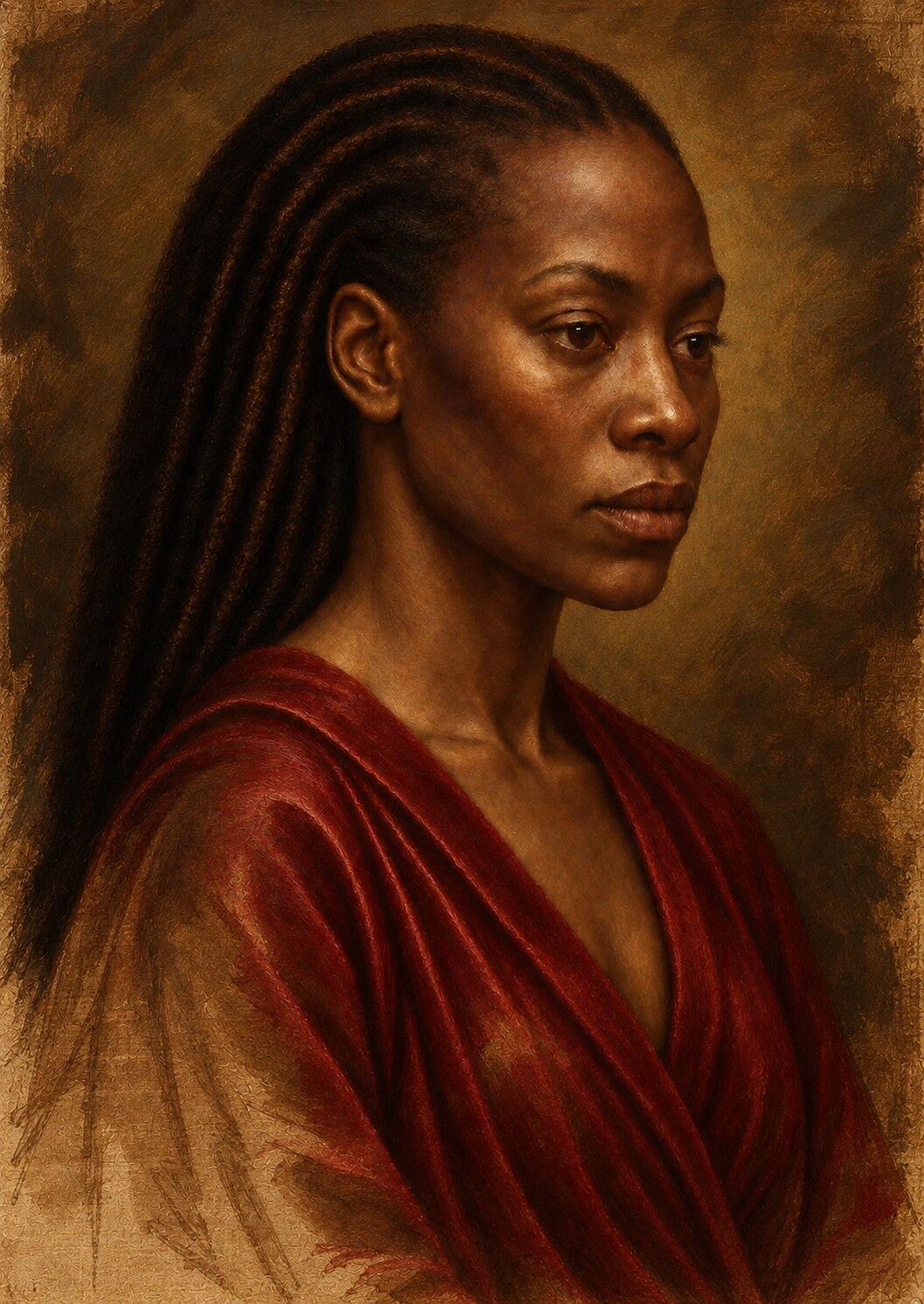
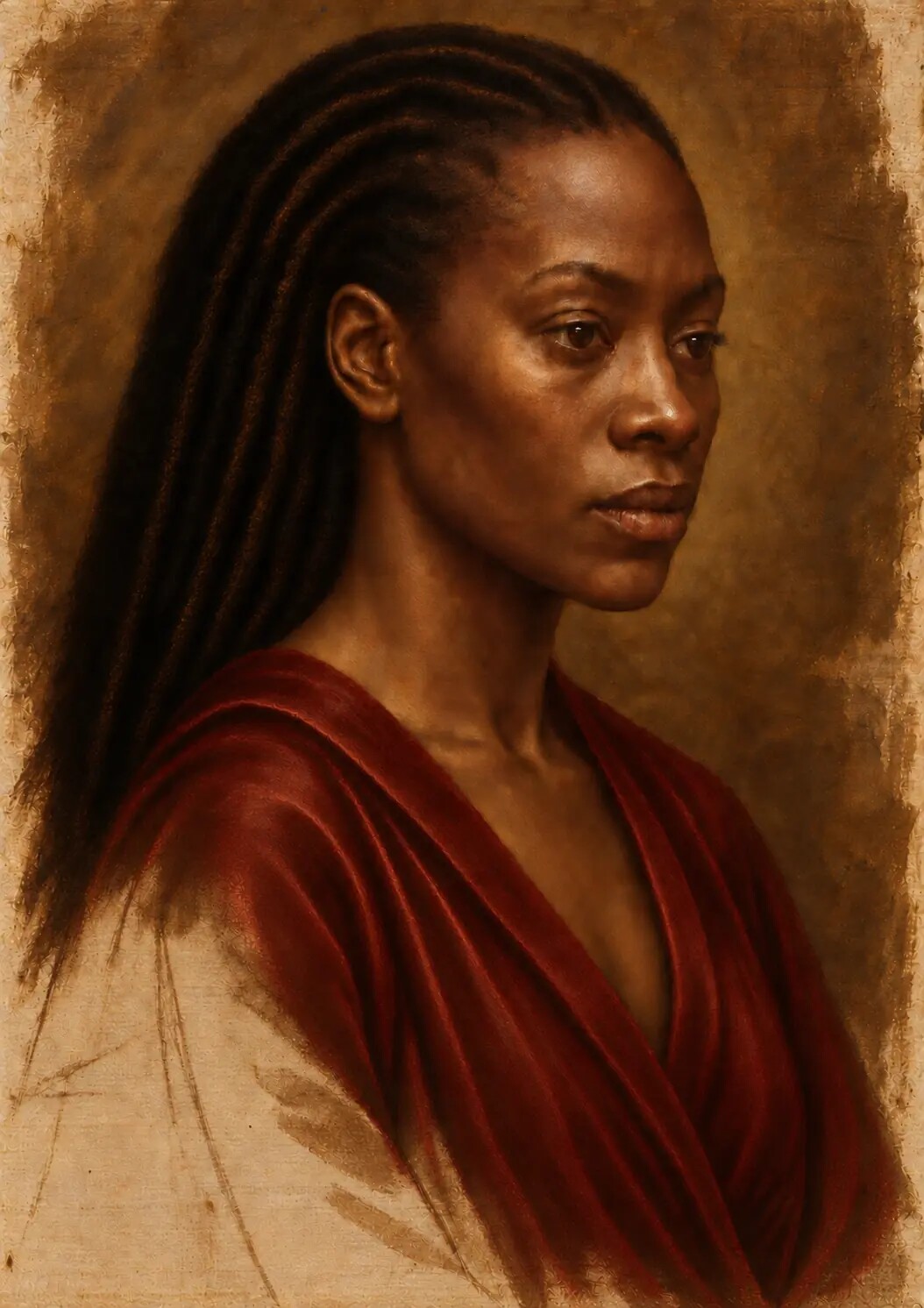
The face was repeatedly examined at five working scales:
- the complete composition;
- normal portrait-viewing distance;
- a close crop of the head;
- macro details of the eyes and mouth;
- micro-scale inspection of individual transitions and surface marks.
Each scale revealed a different category of problem.
At full-composition size, the main questions concerned presence and hierarchy. Did the face command attention without becoming disconnected from the body? Did its light belong to the composition? Did the expression remain readable?
At portrait scale, proportion and modelling became easier to judge. The turn of the head, relationship between features and integration of hair, neck and clothing could be assessed.
At macro scale, edge quality, eyelid construction, lip transitions and skin texture became visible.
At micro scale, mechanical repetition, false reflections, isolated pixels, broken contours and overly regular textures could be identified.
The process did not move in one direction from large to small. It cycled continuously.
After a micro-level correction, the image returned to normal scale. A revised eyelash might be anatomically better but too dark in the composition. A more complex lip texture might become distracting when reduced. A beautifully rendered highlight might pull attention away from the gaze.
Close inspection was therefore a diagnostic tool, not an invitation to keep adding information.
Often the correct response to magnification was subtraction.
False Detail and the Temptation of Magnification
Extreme resolution changes artistic behaviour.
When an image is enlarged on screen, empty areas can appear unfinished. The artist becomes aware of every smooth transition and may feel compelled to fill it with marks. Yet much of this new information will never function at the intended viewing distance.
This creates the danger of false detail: information that looks impressive in isolation but does not describe anatomy, material or light.
Examples include repeated pores, arbitrary scratches, rows of identical lashes, decorative lip lines and sharp flecks that do not correspond to the form beneath them.
False detail creates busyness without knowledge.
The correction process asked three questions of every small mark:
- What physical structure does it describe?
- What light or material behaviour explains it?
- Does it improve the face when the image returns to its intended scale?
If a mark could not answer at least one of these questions, it was weakened or removed.
This gave the finished surface greater quietness. It also allowed the genuinely important details to carry more force.
A restrained highlight becomes powerful when it is not surrounded by dozens of competing accents. A subtle break in the eyelid becomes expressive when the entire eye has not been outlined. A small temperature change becomes visible when the skin is not covered with uniform texture.
Detail needs silence around it.
Correcting Digital Artificiality
Several recurring problems can betray the digital or AI-assisted construction of a face.
The first is excessive smoothness. Skin gradients may be technically clean but disconnected from underlying form. This was corrected by strengthening structural transitions before introducing restrained surface variation.
The second is anatomical inconsistency. Eyelids, pupils, nostrils or lip corners may look plausible individually but fail to agree with the head’s perspective. These passages were compared against the skull and rebuilt where necessary.
The third is false reflection. Highlights may appear in locations that contradict the established light source or suggest an incorrect material. Reflections were reduced, moved or eliminated according to the surface being described.
The fourth is mechanical repetition. Pores, lashes, hairs and texture marks may recur at regular intervals. Repetition was broken through selective removal, changes in scale and variation in visibility.
The fifth is excessive local sharpness. Digital tools can produce edges that are far crisper than the rest of the painting. Sharpness was limited to focal accents and softened where the form turned or receded.
The sixth is symmetrical perfection. Mirrored or overly balanced features were adjusted to restore natural difference without introducing arbitrary distortion.
The seventh is expressive overstatement. Eyes may become too brilliant, lips too defined and facial tension too obvious. These passages were quietened so that the expression could remain complex.
The aim was not to hide the digital origin of the work. It was to prevent unconsidered digital habits from replacing observation and judgement.
The Face and the Surrounding Painting
No face exists independently of its environment.
The darkness behind the figure affects the apparent brightness of the skin. The colour of the garment alters nearby flesh through contrast and reflected light. Jewellery can introduce small points of brilliance that compete with the eyes. Hair frames the face and determines where its edges are found or lost.
For this reason, the portrait could not be completed as an isolated head and inserted into the composition afterwards.
The face and its surroundings were repeatedly balanced against one another.
If the background became too empty, the head appeared cut out. If the costume carried too much sharp ornament, it distracted from the expression. If the hair contained too many bright strands, the facial modelling lost authority.
Secondary materials were therefore subordinated without becoming generic. Their textures remained distinct, but their strongest contrasts were controlled.
The face retained primacy because the rest of the painting supported its light.
This relationship was also important emotionally. Darkness could provide gravity and concentration, but only if it remained articulated. Precious colour and ornament could suggest status or symbolic meaning, but only if they did not turn the portrait into a display of surfaces.
The figure needed an atmosphere, not a backdrop.
Expression Without Theatricality
The most difficult stage was deciding when to stop refining the expression.
Facial features invite interpretation, and every adjustment introduces psychological consequences. Raising a lid increases alertness. Deepening the line between the lips can imply restraint. Softening the brow may reduce tension. Brightening an eye may create openness—or artificial sentiment.
It is possible to over-direct a face until it performs an emotion instead of containing one.
The final expression was therefore judged by its capacity to sustain different readings. It needed enough specificity to feel intentional but enough openness to remain human.
This is where technical restraint became inseparable from emotional restraint.
A softened edge could make the gaze less literal. An asymmetrical mouth could suggest thought without declaring it. A partially shadowed eye could introduce distance while preserving connection.
The portrait’s emotional atmosphere emerged from accumulated small decisions rather than one exaggerated gesture.
It does not instruct the viewer what to feel. It creates the conditions in which feeling can arise.
The Ethics of an Invented Face
A digitally constructed face also raises questions that do not arise in quite the same way when painting a known sitter from life.
When a face is generated, reconstructed or assembled through computational processes, it may initially contain the appearance of a person without the history of a particular individual. It can seem intensely specific while belonging to no documented biography.
This creates both possibility and responsibility.
The artist must decide whether the figure functions as an individual, an archetype, a symbolic presence or some combination of these. Cultural references, costume, physiognomy and historical atmosphere cannot be treated as neutral decorations. They contribute to how viewers imagine identity.
The portrait must also avoid suggesting a false documentary claim. A convincing historical atmosphere does not make the figure an authenticated person from the past. The work is contemporary and digitally constructed, even when it draws upon the visual language of Renaissance and Flemish painting.
Accuracy of description is therefore part of the artwork’s integrity.
The face may evoke the authority of an Old Master portrait, but it does not claim to be an unearthed historical object. Its presence is artistic, not archival.
The Artist’s Role in an AI-Assisted Portrait
The creation of the face did not consist of asking a system to produce “realistic eyes” or “Renaissance skin”.
Those phrases describe broad appearances. They do not resolve the actual visual problems.
The work required a repeated cycle of direction and judgement:
- establish the intended emotional register;
- define the head’s structure and position;
- construct the light;
- evaluate the anatomy;
- identify implausible or generic passages;
- reconstruct individual features;
- compare those features with the whole face;
- remove false detail;
- integrate the surface;
- decide when further refinement would weaken the image.
Technology could generate possibilities, accelerate variations and assist with reconstruction. It could not determine which expression belonged to the painting.
It could not decide how much of the far eye should remain in shadow, whether a highlight had become sentimental, whether an asymmetry felt human or merely incorrect, or whether a beautifully detailed mouth was stealing attention from the gaze.
Those decisions belonged to the artistic process.
Authorship resided in the sustained sequence of intention, selection, rejection, correction and integration. The final face was not accepted because it was complex. It was accepted when its complexity became coherent.
Preparing the Face for Print
The screen was not the final destination.
A digitally constructed face may appear luminous on a backlit display because the screen emits light. A physical print depends upon reflected light, paper colour, ink density, surface texture and the conditions in which it is viewed.
This transition changes the face.
Deep shadows may close. Small red shifts may become too dominant in the lips or cheeks. Delicate highlights may lose separation. Fine texture may sharpen or disappear depending upon the paper and print process.
Critical-detail proofs were therefore essential.
The eyes, lips, cheek, forehead and deepest facial shadows needed to be printed at final size. These crops allowed judgements that could not be made reliably on screen:
- whether the gaze retained clarity;
- whether the eye highlights remained restrained;
- whether the lips appeared too saturated;
- whether the skin texture looked painted or digitally embossed;
- whether shadow transitions survived;
- whether sharpening created hard halos around the lids or mouth;
- whether the paper surface supported or competed with the simulated paint.
Different print surfaces could produce different interpretations.
A textured fine-art paper might strengthen the relationship with drawing, linen and dry paint, but it could soften the smallest facial details. A smoother baryta or photographic surface might preserve the eye and lip transitions more clearly while introducing a more contemporary tension.
Neither choice would physically recreate oil paint. The purpose of the print surface would be to translate the digital construction honestly and effectively.
The face had to live in reflected light as well as emitted light.
What Makes the Face Feel Alive?
The finished face does not depend on one spectacular detail.
Its presence comes from agreement.
The eyes agree with the skull.
The lids agree with the curvature of the eyes.
The highlights agree with the illumination.
The mouth agrees with the underlying volume of the lower face.
The skin agrees with the bone, flesh and temperature beneath it.
The texture agrees with the scale of the portrait.
The sharpness agrees with the hierarchy of attention.
The expression agrees with the atmosphere of the whole painting.
When these relationships hold, the viewer stops inspecting separate features and encounters a person-like presence.
That transition is the true objective of portrait construction. Technique withdraws sufficiently for attention to pass through it.
The paradox is that the face required extreme examination in order not to feel excessively worked. It required anatomical discipline so that the anatomy could disappear. It required detailed construction so that the viewer would not experience it as a collection of details.
The final effect is not perfection. It is coherence animated by difference.
A Face Discovered Through Revision
The face did not become alive when the last eyelash was added.
It became alive through the removal of certainty.
A hard boundary was softened. A mirrored relationship was broken. A highlight was reduced. A shadow was allowed to retain colour. A lip corner was permitted to remain ambiguous. A section of the jaw disappeared into darkness.
Each of these decisions made the portrait less diagrammatic and more perceptually active.
This is one of the enduring lessons of historical painting. Conviction does not require that everything be equally described. A painter can give the viewer more by withholding, dissolving and allowing one passage to remain dependent upon another.
The digital studio offers almost unlimited opportunities to add information. The deeper discipline is deciding what the image can live without.
In the completed work, the face carries the memory of every stage beneath it: drawing, tonal architecture, muted colour, warm and cool flesh, transparent depth, broken light and repeated correction. Much of that history is no longer directly visible, but it continues to govern the surface.
The result is not a physical oil-painted face. It is a digital reconstruction of the visual intelligence through which painted faces have traditionally acquired volume, atmosphere and psychological force.
Its life does not come from one prompt, one texture or one perfectly rendered feature.
It comes from relationships held in tension: symmetry and difference, clarity and disappearance, surface and structure, observation and invention, history and contemporary technology.
The face becomes convincing not when every part is completed, but when every part appears to belong to the same presence.
And presence, unlike detail, cannot simply be generated at the end.
SELECTED LINES
The discipline of presence
A face can contain pores, eyelashes and tiny reflections and still feel artificial.
The living face begins beneath the visible face.
Anatomy provided the discipline, but it had to disappear into life.
Selective clarity makes the portrait feel observed. Universal clarity makes it feel processed.
Close inspection was a diagnostic tool, not an invitation to keep adding information.
Detail needs silence around it.
The face became alive through relationships held in tension: symmetry and difference, clarity and disappearance, surface and structure.
SUGGESTED IMAGE SEQUENCE
A visual record for the continuing studio study
The published article uses the completed portrait, process stages and available macro studies. This sequence records the complete image programme for future proofs and diagrams.
- Opening image: Full view of the finished painting.
- Figure 1: Portrait crop showing the relationship between the illuminated face and surrounding darkness.
- Figure 2: Structural map of the head identifying the forehead, sockets, cheekbones, nose, jaw and chin.
- Figure 3: Comparison of the underdrawing, tonal underpainting, dead-colour stage, glaze stage and completed face.
- Figure 4: Eye progression from drawing to underpainting, colour, glaze and final detail.
- Figure 5: Macro comparison showing the eye before and after correction of highlights, lashes and lid structure.
- Figure 6: Mouth progression showing construction, initial colour, transparent reds and final edge control.
- Figure 7: Warm-and-cool temperature map of the face.
- Figure 8: Diagram of lost and found edges around the hairline, cheek, jaw and eyes.
- Figure 9: Skin detail at normal viewing scale, macro scale and print scale.
- Figure 10: Full-size printed proof crops of the eye, lips and deepest facial shadow.
MATERIALS AND PROCESS STATEMENT
A digital master informed by the visual intelligence of historical painting.
This artwork was created as a digital master through an artist-directed, AI-assisted process. Its construction was informed by historical drawing, underpainting, glazing, scumbling, edge control and portrait-modelling practices.
No physical oil pigment, linen, gesso, glaze or varnish is present in the digital master. These material behaviours were visually studied and digitally simulated. The completed work is intended for translation into a fine-art print through a separate process of colour management, proofing and surface selection.
REFERENCES AND FURTHER READING
Portrait presence, ocular anatomy and optical depth
Authoritative references supporting the historical, anatomical and material language used in this studio study.