ARTICLE THREE · STUDIO PROCESS
Drawing as Evidence of Thought
Why the hidden line matters in a digitally reconstructed Renaissance painting.
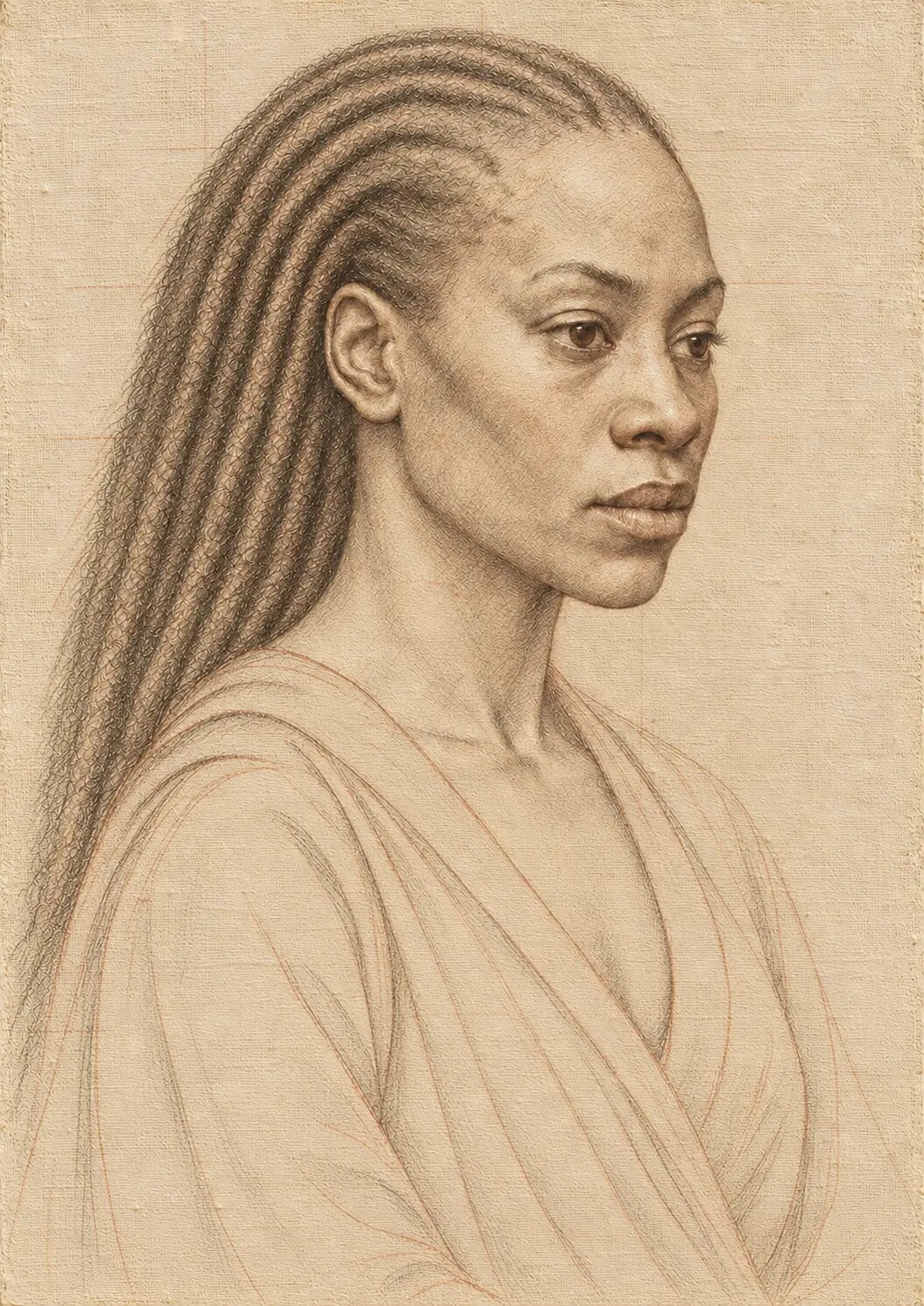
Before the portrait acquired colour, atmosphere or the illusion of oil paint, it existed as a problem of drawing.
In this third article accompanying Painting Without Wet Paint, I examine the underdrawing as a record of artistic thought—and explain why correction, uncertainty and revision were essential to creating a convincing final image.
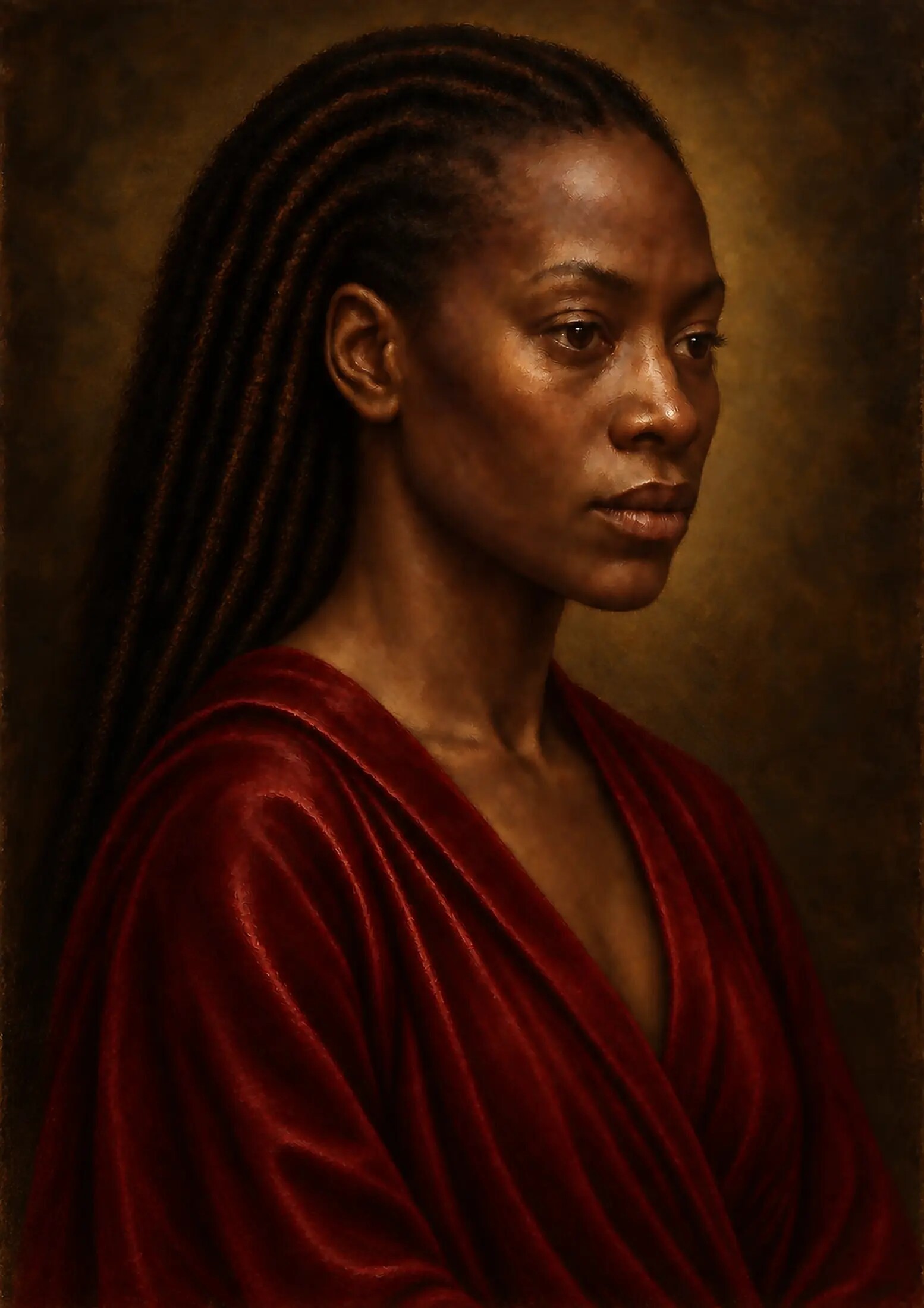
The finished portrait appears still.
The figure does not seem to be searching for a pose. The eyes appear settled within the face. The mouth belongs to the structure of the jaw. The illuminated skin emerges from darkness with an apparent inevitability, as though the image had always known what it would become.
Drawing tells a different story.
Beneath the finished surface lies a quieter image made from placement, measurement and doubt. It contains the first attempt to establish the head, the adjustment of an eyelid, the reconsidered angle of a cheek and the provisional line of a shoulder. Some decisions are confident. Others are tested more than once.
The underdrawing is not merely an outline waiting to be coloured in. It is the stage at which observation becomes structure.
In a traditional painting, much of this early work may eventually be concealed. Opaque paint covers the lines. Glazes redirect attention towards colour. Highlights give the surface its final animation. Yet the buried drawing continues to govern the image. It determines whether the face feels balanced, whether the body carries weight and whether the final expression remains psychologically coherent.
The line may disappear, but its decision remains.
That is why I think of drawing as evidence of thought.
The image before the image
An underdrawing is the preliminary design established on a prepared painting surface before the principal paint layers are applied. The National Gallery describes it as the initial outlining of a composition on a primed support, providing guidance during later painting.
That definition is accurate, but the function of an underdrawing can be much richer than the word outlining suggests.
A line can indicate the outer edge of a face, but it can also describe an internal axis, the direction of a form or the limit of a shadow. It can measure the distance between the eyes, locate the base of the nose or establish how the head sits above the shoulders. Hatching can suggest volume. Repeated marks can test a curve. A faint line may preserve a possibility that has not yet been accepted.
Different artists and workshops used different drawing materials and methods. Some transferred established designs from cartoons. Some worked with dry materials such as charcoal or chalk. Others used a brush and diluted pigment. Preparatory systems could be careful and extensive or economical and direct.
There was no single universal Renaissance underdrawing.
What connects these practices is not a fixed appearance but a shared function: the drawing made the developing composition available for judgement before colour complicated it.
That function became essential in reconstructing this portrait digitally.
The aim was not to generate a monochrome version of the finished painting and call it a drawing. The underdrawing needed to possess its own logic. It had to look as though the figure was being constructed rather than merely traced from an already resolved result.
Drawing is not the same as contour
One of the most persistent misunderstandings about drawing is that it consists mainly of lines around objects.
A face, however, is not a collection of enclosed shapes.
The nose does not end at a uniform boundary. One edge may be described by a shadow, another by reflected light and another may disappear almost entirely into the cheek. The mouth cannot be convincingly constructed as two outlined lips. Its shape depends upon the dental arch, the projection of the muzzle area, the compression where the lips meet and the transition into the surrounding flesh.
Even the apparent oval of the head is unstable. Hair interrupts it. Light dissolves it. The jaw changes direction. The cheek turns away.
A useful underdrawing must therefore do more than separate the subject from the background. It must organise relationships.
Where is the central axis of the face? How far does it turn from the viewer? Are the eyes positioned consistently across that turning plane? Does the nose project from the facial structure or sit on top of it? Does the neck support the head? Is the clothing responding to the body beneath it?
These questions cannot be solved through surface detail.
A beautifully rendered eyelash will not repair an incorrectly placed eye. A refined lip highlight cannot correct a mouth that has been attached to the face without understanding the jaw. Ornamental fabric cannot rescue a shoulder whose structure is implausible.
Drawing establishes the conditions under which detail can become meaningful.
The dignity of construction
This portrait participates in a visual language historically associated with status, memory and cultural authority. The stillness of the pose, the controlled lighting and the depth of the surrounding darkness all contribute to that language.
But authority cannot be created through styling alone.
To place a Black woman within a Renaissance-inspired visual field is not simply to dress a contemporary subject in historical atmosphere. The figure must receive the same structural attention that the tradition associated with its most valued sitters.
That means taking anatomy seriously. It means refusing to treat cultural representation as decoration. The face cannot be an interchangeable symbol placed beneath a layer of Old Master texture. Its particular proportions, presence and expression must organise the work.
The drawing stage became a form of respect.
It required the face to be constructed as architecture: forehead, orbital sockets, cheekbones, nose, jaw, mouth and chin held within one spatial system. It required the head to possess weight and direction. It required the clothing and ornament to support the presence of the figure rather than substitute for it.
Representation is weakened when recognition is superficial.
A subject can be visibly included while remaining structurally generic. The face may carry the signs of identity, yet lack the specificity that creates personhood and presence. Drawing helps resist that flattening because it asks what makes this face internally coherent rather than merely recognisable as a category.
The subject is not an addition to the composition.
She is the reason the composition exists.
Measuring the head
The first problem was placement.
How large should the head appear within the picture? How much darkness should surround it? Where should the eyes sit in relation to the complete image? How much of the torso was needed to give the portrait physical weight without weakening the intensity of the face?
These decisions created the initial geometry of the composition.
The head was considered not as a detached oval but as a volume positioned in space. A central axis helped establish its direction. Horizontal guides suggested the levels of the eyes, nose and mouth, but these could not remain mechanically parallel. They had to respond to the turning and tilting of the head.
Proportion provided a framework rather than a formula.
General anatomical relationships are useful, but applying them rigidly can make a face generic. The purpose of measurement is not to force every sitter into an ideal template. It is to make deviations legible. Once a basic structure has been established, the artist can see where the actual or intended face differs: a longer space between nose and mouth, an uneven brow, a fuller lower lip, a stronger jaw or a slight asymmetry in the eyes.
Character often lives inside those differences.
The digital underdrawing therefore moved between two forms of judgement. It needed sufficient proportional discipline to make the head convincing, and sufficient flexibility to prevent discipline from becoming standardisation.
Anatomy beneath appearance
The visible surface of a face is shaped by structures beneath the skin.
The brow turns around the frontal bone. The eyes sit within sockets rather than floating on a flat plane. The cheek changes direction over the cheekbone. The mouth wraps around the dental arch. The jaw narrows, turns and meets the neck.
A convincing portrait does not need to display an anatomical diagram, but it must feel accountable to anatomy.
This is particularly important in an AI-assisted process because generated images can produce locally persuasive features that fail to belong to the same head. An individual eye may appear beautifully rendered while sitting at an incorrect angle. A mouth may look realistic as an isolated crop but project from the wrong facial plane. The two sides of the jaw may imply different head positions.
These failures can be difficult to notice when colour, texture and dramatic lighting are already present. The richness of the finished surface distracts from structural contradictions.
Reducing the image to drawing removes that protection.
Without jewel-like colour or luminous paint, the face has to survive through placement and relationship. The test becomes direct: if the details disappear, does the head remain convincing?
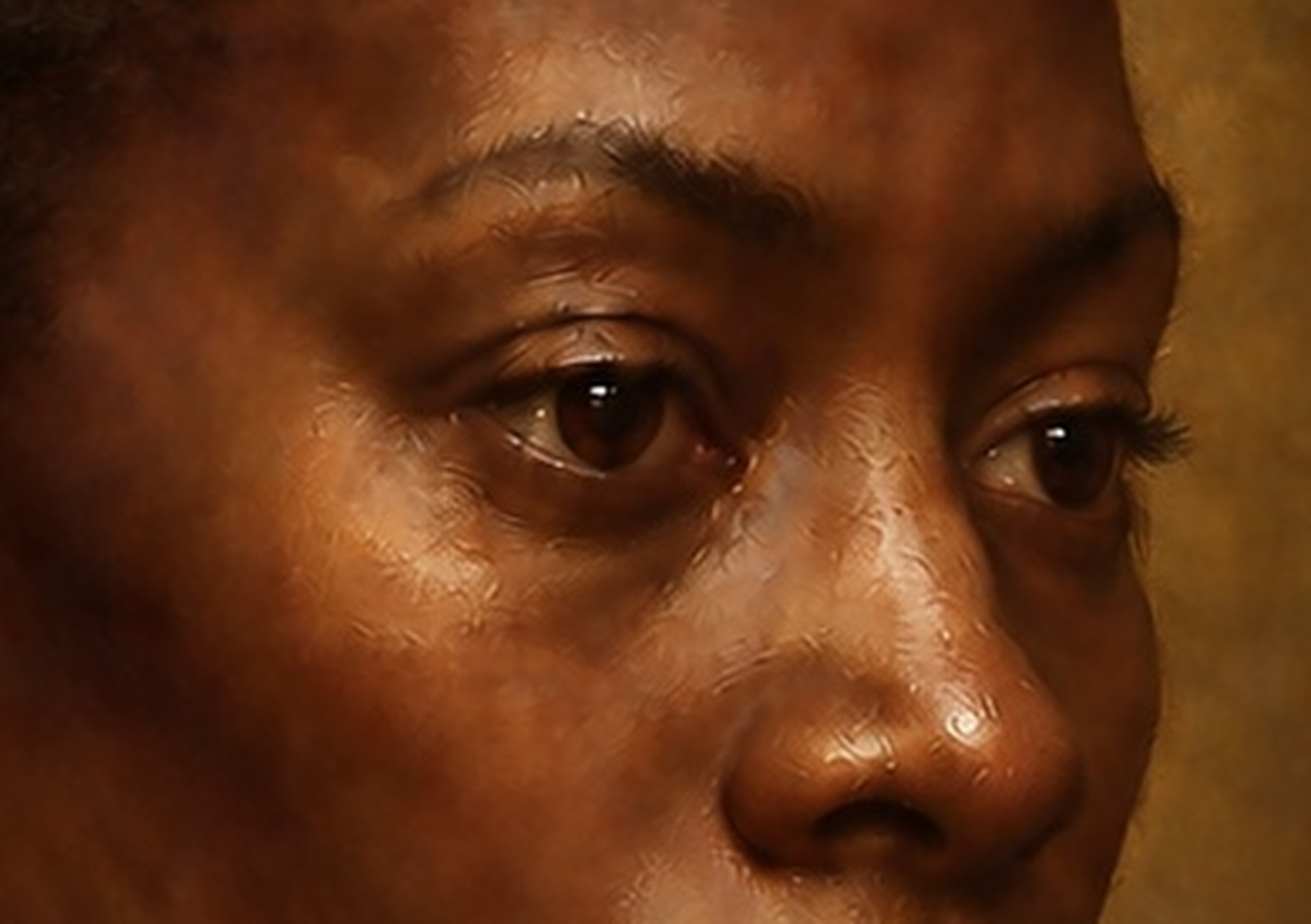
Constructing the eyes before painting them
The eyes eventually became the psychological centre of the finished portrait, but their expressive power began with relatively plain structural decisions.
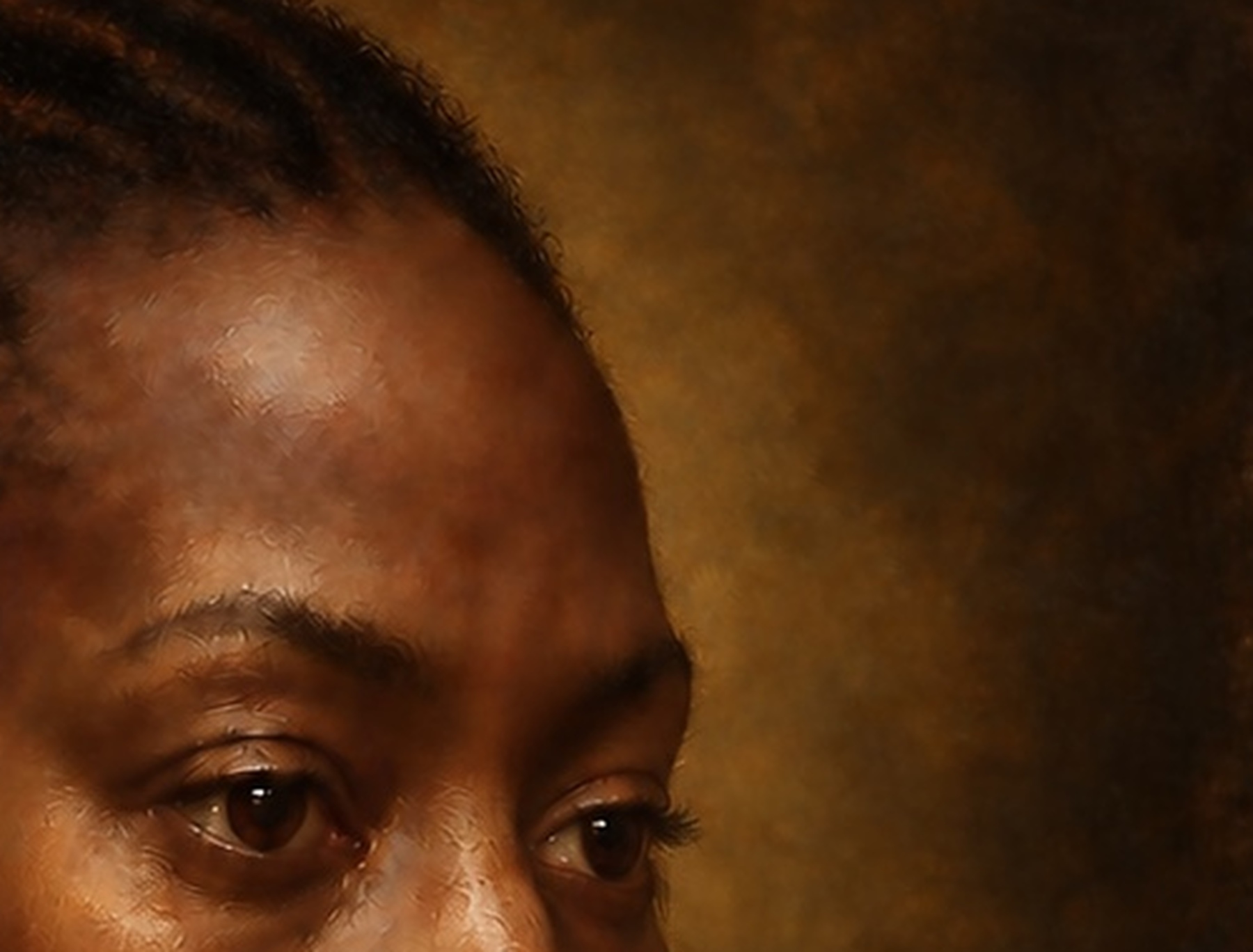
Each eye had to be understood as a moist sphere held within a socket and partially covered by upper and lower lids. The visible shape is not a symmetrical almond. The inner and outer corners are different. The upper lid generally carries greater visual weight. The lower lid turns into the cheek rather than forming a hard line around the eyeball.
The eyes also had to belong to one facial perspective.
If the head turns, the apparent widths of the eyes change. The bridge of the nose affects how much of the farther eye can be seen. Lid angles respond to the orientation of the head. The irises must sit in a coordinated direction if the gaze is to feel focused.
Small errors can alter the entire psychological reading.
Raise one upper lid and the figure may appear startled. Lower it and the expression can become guarded, calm or tired. Move an iris by a tiny amount and the sitter may cease to meet the viewer. Sharpen both eyes equally and the gaze can become unnaturally intense.
The underdrawing did not attempt to resolve corneal highlights, moisture or iris colour. Those belonged to later stages. Its task was more fundamental: to establish the physical conditions from which attention could emerge.
The mouth as structure
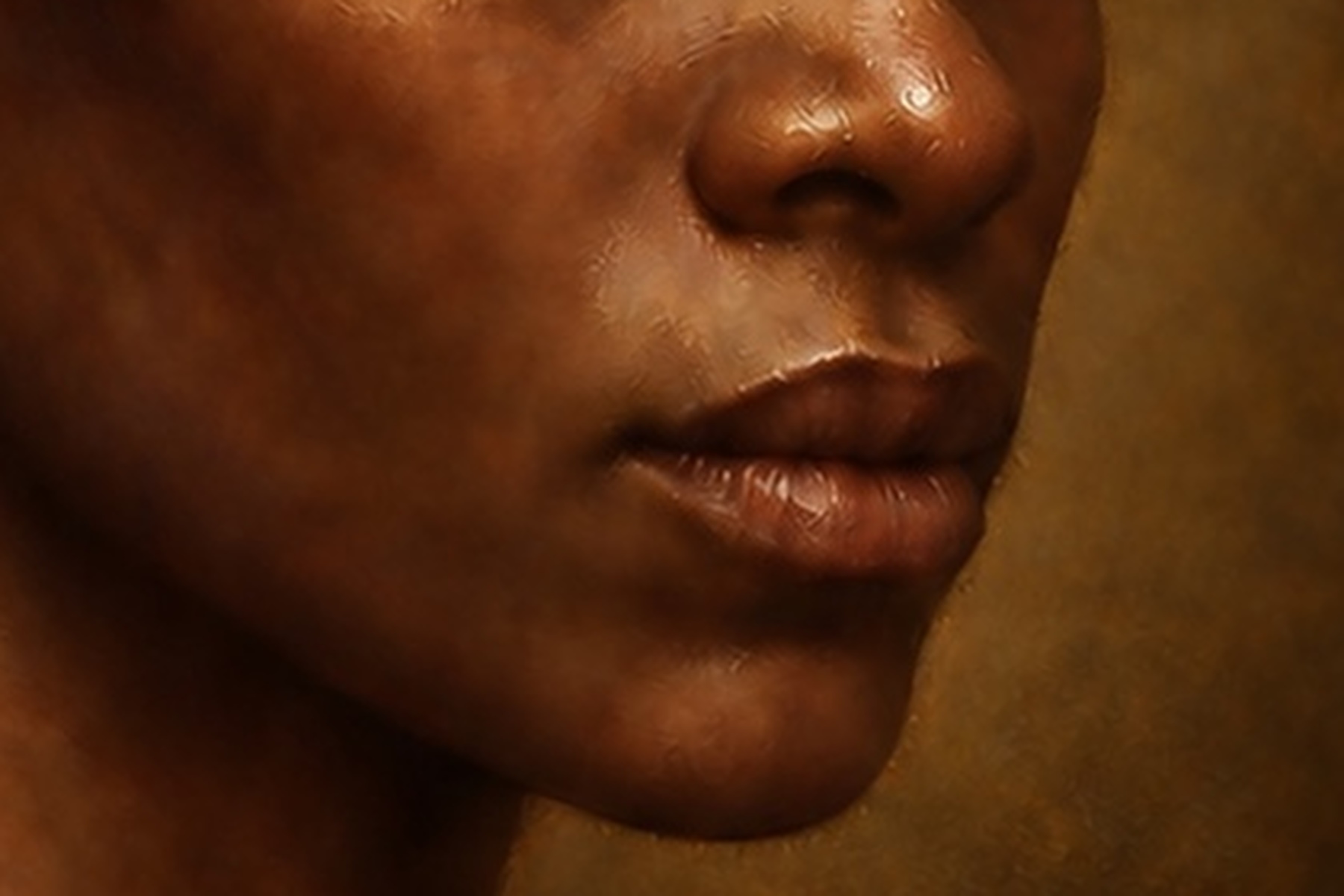
The mouth presented a different kind of difficulty.
Digital images often overstate lips. They may be given a hard enclosing line, a perfectly symmetrical shape and a central highlight that makes them appear detached from the face. Detail becomes a cosmetic addition rather than part of the anatomy.
The drawing had to begin beneath that appearance.
The mouth was constructed around the projection of the dental arch. The central meeting of the lips was treated as a compressed, changing edge—not a uniform dark stroke. The upper and lower lips turned into surrounding skin at different rates. The corners receded into the face rather than ending as sharp points.
Asymmetry was important.
Human mouths are rarely mirrored perfectly from one side to the other. One corner may sit fractionally higher. The upper lip may change thickness across the centre. The lower lip may catch more light on one side because of the direction of the head.
These differences had to be controlled. Arbitrary distortion would not create character. But eliminating every difference produced another kind of falsehood: a smooth, emblematic mouth that carried no evidence of living structure.
Repeated macro inspection allowed the mouth to be adjusted before its later colour and moisture effects were developed. What mattered at this stage was not beauty in isolation. It was whether the mouth belonged to the face and supported the intended emotional restraint.
The line of the jaw
The jaw is easy to underestimate because it is often partly concealed by shadow.
Yet it carries much of the head’s physical credibility.
The angle beneath the ear, the turn towards the chin and the transition into the neck establish how the head is supported. If that structure is uncertain, the face may appear to float. If the contour is too hard, the jaw can look cut out against the darkness. If it is too soft everywhere, the head loses weight.
The drawing therefore established a firmer structural path than the final painting would reveal.
Later paint could soften or lose sections of that path. Darkness could absorb part of the contour. Reflected light could recover another section. But those variations needed an underlying form to vary from.
A lost edge is not the absence of drawing.
It is drawing that has been deliberately withheld from the final surface.
Drapery, clothing and the concealed body
The visible garment also depended upon structures that would never be fully shown.
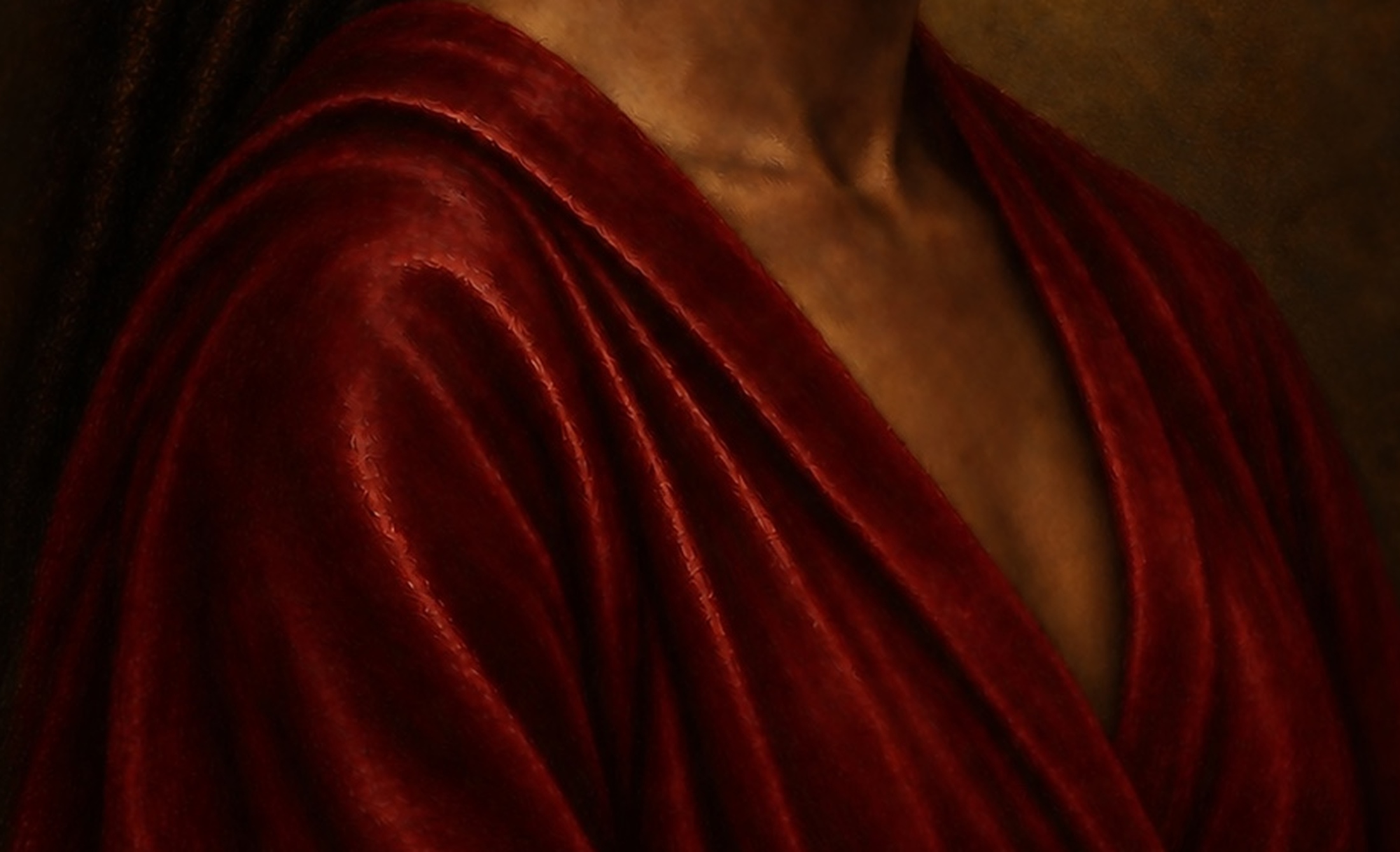
Fabric folds are not independent decorative lines. They respond to gravity, tension, compression and the body beneath them. A fold may radiate from a point of strain, collapse across a softer area or change direction as it crosses a shoulder.
The underdrawing first established the main mass of the torso and the location of the shoulders. Only then could the garment be organised around it.
This prevented the clothing from becoming a collection of attractive but unrelated ridges.
Large folds came before embroidery and ornament. Weight came before pattern. The direction of the cloth had to support the pose and guide the viewer towards the face.
The most detailed decoration was deliberately postponed. At the drawing stage, ornament was indicated only where it affected proportion, rhythm or the silhouette. This preserved the hierarchy of the image.
The figure needed to exist before the costume could enrich it.
Line weight as information
Not every underdrawing mark should carry the same force.
A dark, continuous line can indicate certainty, but if every contour is equally dark the drawing becomes flat. Near and far edges receive the same emphasis. Structural decisions and incidental details become visually indistinguishable.
Line weight was therefore varied according to function.
Major placements were established clearly enough to guide later painting. Internal modelling lines were lighter. Some contours were reinforced after adjustment. Others were allowed to fade where the final form would move into shadow.
Pressure variation also helped the drawing remain connected to the simulated ground. The line could catch more strongly on the raised tooth of the surface and become faint across a smoother passage. It did not sit above the ground as a perfectly uniform digital stroke.
This irregularity was not added merely to create an antique appearance. It communicated the action of drawing: contact, resistance, revision and changing confidence.
A clean outline would have been dishonest
A perfectly clean underdrawing would have created the wrong history for this painting.
It would have suggested that every decision had been made in advance and transferred without uncertainty. The final result might have looked elegant, but the process would have lacked evidence of discovery.
Historical underdrawings can vary from highly controlled transfers to visibly searching freehand work. The point is not that every Old Master drawing must look loose. The point is that this particular simulated process needed to record the development of its own design.
Some lines were therefore doubled. A cheek contour moved slightly before being accepted. The shoulder was adjusted to carry the head more convincingly. Parts of the garment were simplified. Certain early indications remained only as pale ghosts.
These revisions gave the drawing temporal depth.
One line belonged to an earlier decision. Another contradicted it. A later painted edge selected between them.
The image began to contain time.
Pentimento: the visible change of mind
The Italian word pentimento is related to changing one’s mind. In painting, it refers to an alteration made during the work’s development and subsequently covered by another passage. The National Gallery notes that pentimenti are valuable because they reveal how an artist’s design developed. Some eventually become visible as upper layers grow more transparent; others can be detected through infrared imaging or X-radiography.
A pentimento is sometimes treated as a charming imperfection—a sign that even a master made mistakes. I find it more useful to understand it as evidence of judgement.
The artist saw that a decision was not serving the work and changed it.
That action is not a failure of authorship. It is authorship in one of its clearest forms.
In an AI-assisted practice, this becomes especially significant. The generated proposal is not the final authority. A feature may arrive with apparent confidence, but confidence is not the same as correctness. The artist has to recognise when the image is wrong, determine why it is wrong and decide what should replace it.
Correction makes the judgement visible.
The simulated underdrawing included restrained evidence of this process. Earlier alternatives were not multiplied everywhere, because artificial indecision would become another decorative effect. Revision was concentrated where meaningful structural choices had occurred: the facial contour, features and garment.
The difference between an error and a trace
Not every imperfection deserves to remain.
This distinction matters.
A pentimento is meaningful because it shows the movement from one considered possibility to another. An unresolved anatomical error shows that the problem was not solved. A repeated digital artefact does not become valuable simply because it looks irregular.
The image was therefore assessed for two different kinds of deviation.
The first contained useful evidence: a changed contour, a partially buried construction line or an asymmetry that strengthened the individual character of the face.
The second weakened credibility: inconsistent perspective, an implausible eyelid, a broken jaw, doubled jewellery or a garment fold with no source of tension.
The first could remain. The second required correction.
This judgement prevented the celebration of “imperfection” from becoming an excuse for carelessness. Historical atmosphere cannot rescue structural failure.
Underdrawing as private architecture
Most viewers will never see the underdrawing of a completed painting.
That does not make it unnecessary.
Buildings contain structures that are not visible from the finished room. Music contains compositional relationships that may not be consciously identified by a listener. Language depends upon grammar even when a reader is absorbed in meaning.
The underdrawing performs a similar role.
It organises the painting privately.
It determines where the focal features sit, how the figure occupies the rectangle and where the principal transitions between light and shadow will occur. It gives the later painterly surface something to obey, resist or revise.
This private architecture becomes especially important in a dark composition. When much of the figure is absorbed into shadow, a small number of visible intervals must carry the whole form. The illuminated cheek, the bridge of the nose, the edge of a lip and the line of a collar must imply what remains unseen.
That implication begins in drawing.
Drawing the boundary of the light
Although the tonal underpainting would be developed in the next major stage, the underdrawing already needed to anticipate light.
This did not mean shading the whole portrait to completion. It meant identifying the major boundaries where illuminated form would turn into halftone and shadow.
The face was considered as a series of planes.
The forehead turned away from the principal light. The bridge and tip of the nose received different degrees of illumination. The cheek caught light before curving towards the ear. The lower lip projected, while the area beneath it receded. The jaw moved into the surrounding darkness.
These transitions were indicated selectively.
By planning them in the drawing, the later chiaroscuro could describe volume rather than merely darken one side of the image. The light would appear to encounter a body.
This is a critical distinction. Brightness alone does not create illumination. Light becomes believable when it reveals structure.
What infrared imaging teaches us
Many historical underdrawings are hidden beneath paint, but modern imaging can sometimes make them visible.
Infrared examination can penetrate certain paint layers and reveal underlying material that absorbs infrared radiation. Carbon-rich black drawing on a pale ground is often especially responsive. Infrared reflectography can therefore disclose lines, adjustments and compositional changes that cannot be seen by the naked eye.
These images have transformed the way paintings are studied.
The finished work no longer appears as a single, sealed statement. Beneath it we may discover abandoned placements, altered hands, moved contours or differences between an initial design and its final painted form.
Technical imaging does not reveal every underdrawing. Its success depends upon the materials used and the optical behaviour of the overlying paint. Nor does it automatically explain why a change was made. Interpretation remains necessary.
But it gives us access to a remarkable fact: many paintings remembered as images of control were built through revision.
Their authority did not depend upon avoiding uncertainty.
It depended upon working through it.
Simulating a process that digital tools usually hide
Digital tools are extremely good at concealing revision.
A line can be erased completely. A layer can be deleted. A face can be reconstructed without leaving a physical trace. Earlier versions may survive in file history, but they do not necessarily remain visible in the finished image.
This creates a different relationship to artistic time.
In physical painting, correction can leave a ridge, a change in texture or a buried form. As paint ages, some changes may become more visible. The object keeps a material record of decisions.
A digital master does not do this automatically.
If evidence of process is important, it must be preserved deliberately—not falsified as theatrical wear, but retained through the relationship between stages. The drawing should genuinely guide later decisions. Its marks should not be invented only after the painting is finished.
For this work, the underdrawing was treated as an active stage. It established the structure against which the tonal and colour stages could be judged. When later development weakened the anatomy, the drawing provided a way back.
The digital environment made the earlier state accessible, but artistic discipline made it consequential.
The role of AI in constructing the drawing
AI could propose facial relationships, lines and compositional alternatives. It could help reconstruct the appearance of pencil, charcoal or brush drawing on a prepared surface. It could also produce plausible detail very quickly.
What it could not do independently was establish the artistic standard by which those proposals should be judged.
It did not decide how much authority the figure should possess, how still the expression should feel or which historical conventions should be activated. It did not determine whether a slight asymmetry gave the face character or introduced structural inconsistency. It did not know when visible drawing should remain and when it should disappear.
These were artistic decisions.
The process involved repeatedly separating appearance from function. A passage might look convincingly “drawn” while failing to organise the face. Another might be anatomically accurate but too clean to belong to the simulated surface. A third might possess expressive irregularity but conflict with the intended stillness of the portrait.
No single prompt resolved these tensions.
The drawing emerged through direction, inspection and correction.
Generated confidence and artistic doubt
Generative systems often produce visual answers with no visible hesitation. Every line arrives at the same time. Incorrect details can possess the same finish as correct ones.
This confidence can be misleading.
Human drawing often makes uncertainty legible. A line is tested. Pressure changes. A contour is approached, corrected and reinforced. The artist can distinguish between what has been decided and what remains open.
This is not merely a stylistic difference. It affects how the work develops.
When every generated feature looks finished, revision can feel like damage. The artist may be tempted to preserve a beautifully rendered area even when it is structurally wrong. Drawing counters that temptation by returning the image to relationships rather than finish.
It asks a difficult but necessary question:
If this feature were not polished, would it still be right?
Reconstructing the drawn mark
The marks in the underdrawing needed to suggest different tools without becoming demonstrations of software effects.
A pencil-like line offered precision and pressure variation. A charcoal-like mark produced a softer, more granular edge. A brush-drawn line could move between thin and broad passages and connect naturally to the beginning of underpainting.
Rather than committing the whole image to one exaggerated texture, the drawing combined qualities selectively.
Structural contours were relatively controlled. Searching lines were lighter and more broken. Areas anticipating shadow received limited hatching or brushed tone. Fine features used narrower marks, while the garment could support broader directional indications.
The simulated ground remained active beneath all of them. Some marks caught its tooth; others appeared to pass more smoothly across it. The drawing was neither floating above the surface nor sinking uniformly into it.
The result needed to resemble contact between a tool and a prepared support.
Facial asymmetry and the refusal of perfection
Perfect symmetry is easy to recognise and difficult to believe.
A face may appear broadly balanced while containing many small differences. One eyebrow rises slightly higher. One eyelid opens more fully. The nostrils are not identical. The mouth shifts around its centre. Light emphasises one side differently from the other.
These differences contribute to character, but they can be lost when an image is over-corrected.
At the same time, AI-assisted images can produce accidental asymmetries that have no anatomical logic. One eye may be shaped for a different head position. One side of the jaw may imply a different age or angle. The task is not to preserve every irregularity in the name of realism.
The task is to distinguish living variation from incoherence.
During the drawing stage, asymmetry was judged in relation to the whole face. Did it support the direction of the head? Did it strengthen the expression? Could it be explained by anatomy or light? Did it remain convincing when the image was reversed or reduced?
Useful asymmetry stayed.
Distracting contradiction did not.
The focal hierarchy begins in line
A portrait cannot give equal attention to everything.
If every strand of hair, fold of cloth, piece of jewellery and facial feature is defined with the same sharpness, the viewer has no path through the image. Detail becomes noise.
The focal hierarchy was therefore established before colour.
The eyes and central facial structure received the most exact placement. The mouth required careful construction but slightly softer definition. Hair was organised as masses before individual strands. Garment contours established weight and rhythm while ornamental details remained provisional. The background contained only enough information to support the figure.
This hierarchy later governed paint handling.
The sharpest accents could be reserved for a few focal passages. Soft edges and darkness could absorb secondary forms. Ornament could remain precious without competing with the face.
Drawing decided where the painting would speak clearly and where it would become quiet.
Repeated inspection at different scales
The underdrawing was not judged only as a complete image.
At full composition scale, I looked at balance. Did the figure occupy the space with enough authority? Was the head positioned correctly within the surrounding darkness? Did the pose feel stable?
At portrait scale, I examined the relationship between the head, neck, shoulders and clothing. Did the anatomy remain coherent? Did the garment support the body?
At macro scale, the eyes, mouth and jaw could be tested independently. This revealed small inconsistencies in alignment and contour.
At micro scale, the quality of the drawn mark became visible. Were the lines too clean? Did the texture repeat? Did the mark interact plausibly with the simulated ground?
Moving between scales prevented local improvements from damaging the whole.
A beautifully refined eye could not be accepted if it redirected the gaze incorrectly. A convincing drawn texture could not remain if it overwhelmed the portrait at normal viewing distance.
The final authority belonged to the complete image.
When drawing should remain visible
In the completed portrait, most of the underdrawing is buried.
That is appropriate. The viewer should encounter the painted figure, not a technical diagram.
However, selected traces were allowed to remain faintly perceptible in thinner or lighter passages. A small fragment near a contour can connect the finished paint to its underlying construction. A restrained line beneath translucent colour can create depth that a clean digital edge lacks.
These visible remnants must be carefully controlled.
Too much underdrawing makes the painting look unfinished. Too little may remove the sense that the forms were constructed. A line should not appear simply because historical paintings sometimes reveal drawing. It needs a reason to survive in that particular location.
The strongest traces occur where paint is optically thin, where a contour has shifted or where the line contributes to the final form without enclosing it.
The drawing becomes a whisper rather than an announcement.
What was corrected
The drawing stage created a practical standard for identifying defects during later development.
Several categories required repeated attention:
- The alignment and relative scale of the eyes.
- The turn of the nose in relation to the facial axis.
- The projection of the mouth.
- The transition from cheek to jaw.
- The connection between jaw, ear and neck.
- The height and slope of the shoulders.
- The relationship between the body and the garment.
- Folds that lacked a physical source.
- Ornament that distorted the underlying form.
- Contours made too sharp by later processing.
- Details that looked impressive but weakened the expression.
These corrections were not performed to remove every trace of irregularity. They were made so that the remaining irregularities could feel intentional and alive.
Accuracy and humanity are not opposites.
The deeper aim was coherence: a face capable of sustaining close inspection without becoming clinically perfect.
Drawing and authorship
Discussions about AI-assisted art often concentrate on the prompt.
That emphasis can obscure the more substantial work of authorship: defining the visual problem, selecting the cultural and historical framework, establishing the composition, rejecting inadequate results, correcting anatomy, controlling hierarchy and deciding when the image has reached its intended state.
The underdrawing makes this especially clear.
Authorship is present in the decision to move an eye, soften a jaw, lower a shoulder or remove a decorative passage. It is present in recognising that a technically impressive feature does not belong. It is present in returning to the structure when the surface becomes distracting.
A prompt can initiate an image.
It cannot replace sustained judgement.
Drawing became the place where that judgement was most exposed. Without colour and finish, each choice had to justify itself.
The cultural meaning of the hidden line
There is a broader question inside this process.
Whose image is permitted to carry the visual weight of history?
Renaissance portraiture has contributed to enduring ideas about dignity, beauty, intelligence and power. Museums preserve the faces of rulers, patrons, merchants and religious figures through materials and techniques designed to outlast individual lives.
To construct a contemporary Black woman within that language is to enter a historical field that has not represented all people equally.
The underdrawing matters because the intervention cannot remain superficial.
The subject is not merely placed into an inherited frame. She is built into the composition from its first structural decisions. Her face governs proportion. Her gaze organises attention. Her presence determines how the historical language is used.
She does not arrive after the tradition has been constructed.
She enters at the level of the line.
This is where representation becomes more than substitution. The image does not simply exchange one sitter for another while leaving every deeper assumption untouched. It asks what happens when a different presence becomes foundational to the work’s authority.
Drawing as a form of care
To draw carefully is to spend time with relationships.
It is to notice that the mouth changes when the jaw changes. That the gaze depends upon both eyes rather than either eye alone. That a garment is affected by a shoulder hidden beneath it. That darkness has a boundary even when the boundary is not visibly drawn.
This attentiveness is a form of care.
It does not require sentimentality. It appears through precision, patience and willingness to revise. The artist allows the subject to resist a generic solution.
In this sense, care is not the opposite of technical discipline.
It is expressed through it.
The limits of simulation
The underdrawing in this work is digital.
No physical charcoal was dragged across gesso. No metalpoint incised the surface. No brush deposited carbon-rich pigment that could later be examined with infrared reflectography.
The marks simulate the appearance and function of a historical preparatory stage. They establish structure, preserve revision and influence the layers above them, but they do not possess the same material chemistry as a traditional underdrawing.
That boundary should remain clear.
The value of the process does not depend upon claiming physical equivalence. It lies in exploring how much of the intellectual and visual discipline of underdrawing can be carried into a digital environment.
The result is both reconstruction and translation.
From drawing into paint
Once the drawing had established the figure, the painting could begin to move into tone.
Lines alone could indicate position, but they could not fully describe the passage of light across the face. The next stage would convert contour into volume: lights, halftones, shadows, reflected light and dark accents.
Some drawing marks would disappear almost immediately.
Others would remain active beneath thin paint. A few would continue to guide the image until the final detail stage. Their visibility would change, but their structural responsibility would not.
The transition from drawing to underpainting was therefore not a rejection of the line. It was its transformation.
The drawing had asked where the forms were.
The underpainting would ask how light revealed them.
What the finished portrait remembers
Return to the completed image and the drawing is difficult to see.
The eyes now contain moisture, reflection and depth. The lips carry translucent colour. The skin turns through warm and cool passages. The garment has weight and surface. Darkness surrounds the figure with an atmosphere that the initial lines could only anticipate.
Yet every one of those effects depends upon the earlier construction.
The eye highlight works because the eye was placed correctly. The mouth feels restrained because its projection and compression were resolved before colour. The jaw can disappear into darkness because its structure was established before the edge was lost. The garment can hold ornament because the shoulder beneath it carries weight.
The painting has covered the drawing without escaping it.
The line beneath the light
Drawing is often described as preparation for the “real” artwork.
In this portrait, it was already part of the real work.
It was the stage at which the image became accountable: to anatomy, proportion, perspective, expression and cultural intention. It exposed contradictions that colour might have hidden. It recorded changes of mind. It established a hierarchy that later detail could either serve or disrupt.
Most of its marks would eventually be concealed.
That concealment did not diminish their importance. It completed their function.
The final painting does not need to display every decision that produced it. It needs to carry their consequences.
What gives the face its authority is not only the luminous surface we encounter at the end. It is the evidence of attention beneath that surface: the measured placement, the corrected contour, the rejected alternative and the line that was redrawn until the figure could hold our gaze.
The drawing remains inside the portrait as thought remains inside a finished decision.
We may not see every step.
But we can feel that the image has been considered.
ARTWORK AND PROCESS STATEMENT
The drawing was simulated. Its structural responsibility was real.
Painting Without Wet Paint is a digitally constructed, AI-assisted artwork developed under sustained artistic direction. The underdrawing was digitally simulated as a functional stage in the creation of the master image. It established composition, anatomy, proportion, facial structure, garment construction and the principal boundaries of light and shadow.
No physical pencil, charcoal, metalpoint or carbon-based drawing material was applied to the final print. The work reconstructs the visual logic and decision-making role of historical underdrawing within a contemporary digital environment.
FURTHER READING
Seeing the decisions beneath the surface
Technical resources from the National Gallery clarify underdrawing, pentimento, infrared examination, ground and raking light—the historical language behind this contemporary reconstruction.