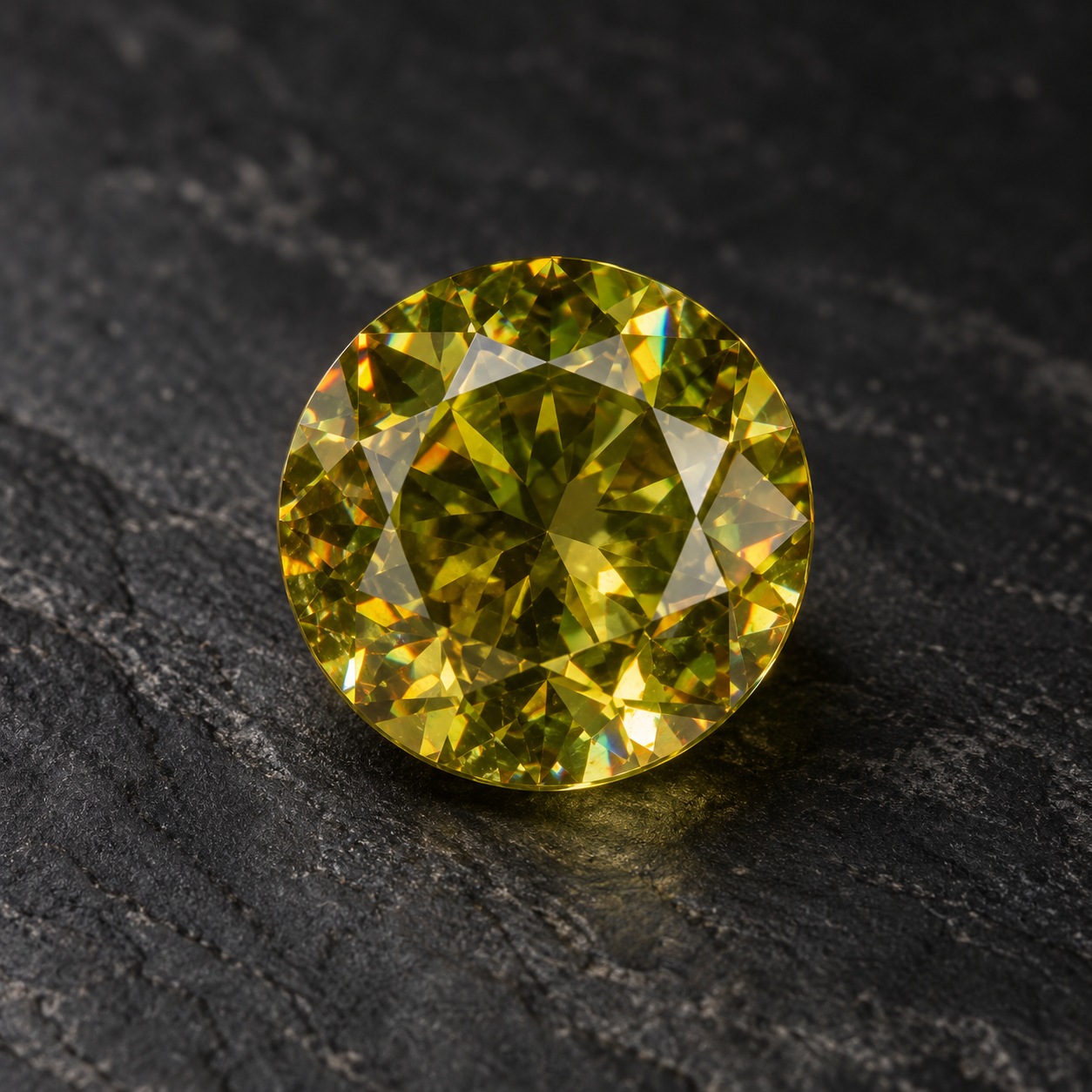
Sphene interests me at the meeting of warmth and green. A turn of a facet can break a steady colour into brief spectral flashes. I want to bring that liveliness into the collection through careful lighting, with the strongest moments held inside the stone.
The material and its origins
Sphene is the gem name commonly used for titanite, a calcium titanium silicate. Transparent gem material can show strong dispersion and pronounced double refraction. Sources include Madagascar, Brazil and Mexico, among other countries. Titanite itself is an accessory mineral in several rock types; exceptional transparent facetable material is a different matter from the mineral’s general occurrence.
| Material | Calcium titanium silicate |
|---|---|
| Mohs hardness | 5–5.5 |
| Optical character | Golden green colour, strong dispersion and double refraction |
What it brings to my work
Its fire suggests vitality to me: colour that appears settled until light reveals another rhythm within it. The relatively low hardness and cleavage also matter to a maker working with physical stones. For this digital study, the challenge is to suggest sparkle through coherent facets and illumination, keeping the image grounded in the appearance of a real material.