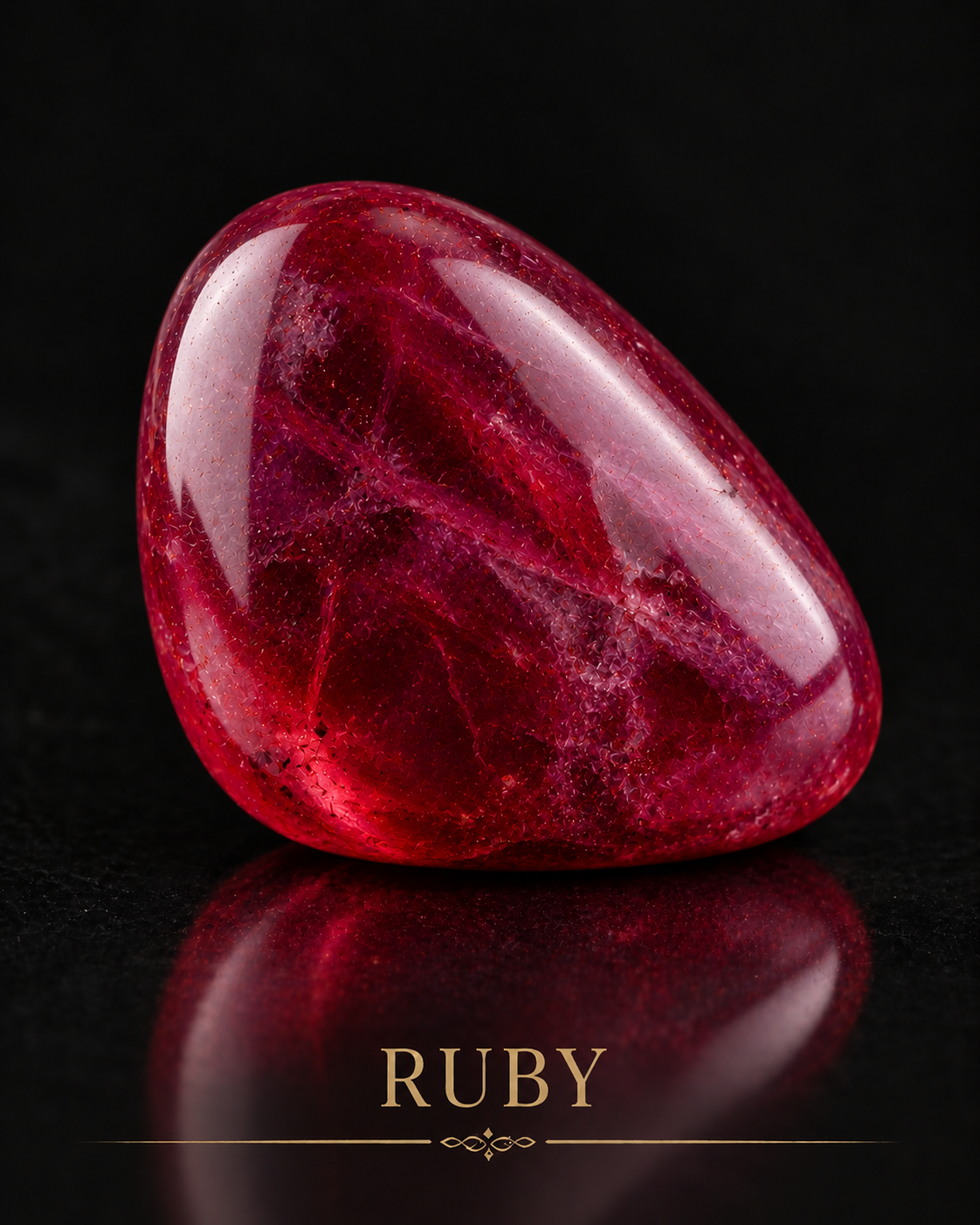
Ruby enters this collection with a different kind of intensity. The generated image presents a polished red form against black, with pale reflections travelling over its curved surface. Within the red, fine irregular details interrupt the colour. Some passages appear clearer; others seem clouded or folded into the interior. The stone looks compact, yet its surface invites a prolonged encounter.
For Jabbi Outside, that combination opens a conversation about vitality, intimacy and the ways a small material detail can change an image. A red ornament can gather attention without dominating the figure who wears it. It may suggest warmth or resolve, but those possibilities become meaningful through the surrounding artwork: the expression, the clothing, the light and the distance between subject and viewer.
Ruby’s documented history gives this visual enquiry depth. Its material character connects it with sapphire. Its sources lead into different geological landscapes. Its use in Renaissance jewellery brings the colour close to love, marriage and remembrance. These connections offer starting points for interpretation while leaving the artist responsible for what a particular work actually says.
Corundum, chromium and the character of red
Ruby is the red variety of corundum, the mineral species that also includes sapphire. GIA identifies chromium as the trace element responsible for its red colour, which can range towards orange or purple. A ruby is therefore more than a red-looking object: its identity concerns the material’s structure and composition.
Geological setting also matters. GIA describes rubies formed in marble through metamorphic processes, as well as material associated with basalt. Differences in iron content can affect colour and fluorescence. Some marble-hosted rubies fluoresce red under ultraviolet light. That response has a physical cause; it does not mean the stone generates an independent flame or shines continuously without illumination.
In an image, the challenge is to give red a believable material behaviour. A broad white reflection should sit convincingly on the polish. A darker passage should help establish volume. A little transmitted light can suggest depth near an edge. Too much uniform brightness would make the object resemble a lamp; too little variation would turn it into a flat patch of colour.
Sources: Mogok and a wider geography
Myanmar’s Mogok region is one of ruby’s celebrated historic sources. GIA’s 2014 field expeditions, reported in 2015, followed mining and gem markets there. The report distinguishes primary deposits within marble from secondary deposits where material is recovered from gravel. It also describes women known as Kanase searching marble tailings for gems.
The account brings labour into a story often dominated by the finished jewel. Sorting, breaking rock and examining small fragments precede the spectacle of a polished stone. These are documented observations from a particular expedition, rather than a claim about all mines or their present-day conditions.
Ruby also belongs to a wider geography. GIA identifies Vietnam and Mozambique among important sources, with Montepuez a notable Mozambican mining area. Other producing countries include Afghanistan, Pakistan, Sri Lanka, Kenya, Tanzania and Madagascar. A particular hue is not enough to establish a stone’s country of origin.
That last distinction matters within this collection. The generated Ruby image can refer to the material’s visual qualities without being assigned to Mogok or Montepuez. A place should enter an artwork through research, intention or verified provenance. It should not become an invented background simply because a red looks especially rich.
Inclusions, polish and the choices of the cutter
Ruby commonly contains internal features. GIA describes fine needles, small crystals, variation in colour and fingerprint-like inclusions. Intersecting rutile needles are known as silk. Such features can scatter light and soften the appearance of colour; appropriately oriented inclusions can also produce a star effect when the stone is cut as a cabochon.
A rounded polished surface and a faceted cut therefore make different visual proposals. A cabochon presents a continuous curve. Facets divide the encounter into planes and flashes. Neither approach supplies a universal meaning, and a polished dome should not automatically be called a star ruby when the characteristic optical effect has not been demonstrated.
For the digital artist, internal variation can resist the sterility of a perfect object. The question is how much detail serves the image. A few quieter inclusions may create depth. An excessive network of cracks may make the stone look damaged or artificially textured. Material credibility depends on restraint as much as detail.
Renaissance jewellery: a stone close to the body
The Renaissance connection is grounded in an actual object. The Met’s Southern German Gimmel ring, dated to the second half of the sixteenth century, combines gold, enamel, rubies and an emerald. Its two interlaced hoops and marriage inscription place precious materials within a relationship between people. The museum explains that this ring type was used as a Renaissance wedding band.
Here ruby belongs to a miniature work of craftsmanship. Colour sits beside engraving, enamel and a structure that can be handled. The jewel has an outward appearance, but also a physical relationship with the wearer. That closeness is useful when considering how a gemstone might function within portraiture.
The Met’s essay on rubies and memento mori jewellery extends the enquiry. It discusses a German ring dated 1631 with a ruby and diamond and concealed images of an infant and a skeleton. Another seventeenth-century ring holds a heart-shaped ruby inside a skull-shaped compartment. These objects bring love and mortality into the same intimate space.
Their force comes from the relationship between material, construction and revelation. The red stone is part of a larger artistic decision. In a contemporary image, a ruby detail could similarly hold a meaning that is not fully declared: a bond, a memory, a promise or an aspect of a life that remains private.
Belief, evidence and artistic interpretation
GIA records historical associations of ruby with blood, power and youthful energy in Indian jewellery, alongside protective beliefs in other traditions. Medieval Europeans attributed benefits including health and success in love. These are records of cultural beliefs, not established effects of wearing the stone.
The museum examples offer a more specific way to work with such histories. Rather than declaring that ruby always means passion, an artist can ask who gives it meaning, in what setting, and through which form. The red in a wedding ring and the red hidden inside a memento mori object may invite related feelings while serving different purposes.
For Jabbi’s practice, this leaves room for a figure’s individuality. A ruby need not instruct the viewer to see confidence or desire. It might introduce a warm accent into a restrained palette, create a visual relationship with lips or fabric, or suggest a keepsake whose story remains with the subject.
Natural material, treatment and digital simulation
Real rubies may undergo treatments. GIA’s July birthstone guide describes heat treatment and other processes, including glass filling of fractures in lower-quality material. Those distinctions can affect handling and interpretation. Natural ruby, laboratory-grown ruby and an artistic simulation are also different categories, even when images of them share a red appearance.
The present image belongs to the last category. It was generated to explore Ruby within the collection’s visual language. Its reflections and inclusions are constructed details, not observations that establish authenticity, treatment, scale, value or origin. Photorealism is an artistic aim here, rather than a certificate.
Red as a place for attention
Ruby’s value to this collection lies in the meeting of material and human intention. Geological histories make the colour possible. Mining and cutting bring it into a worked form. Jewellery places it close to the body. Artistic interpretation asks what that proximity might mean.
A contemporary work can draw on these histories while staying open. Let the red carry warmth without making it shout. Let the inclusions create a believable interior. Let a small ornament support the presence of the person rather than become a substitute for their story.
Then Ruby becomes a study in how attention gathers: around a colour, around a crafted surface, and around something small enough to be held yet powerful enough to remain in memory.