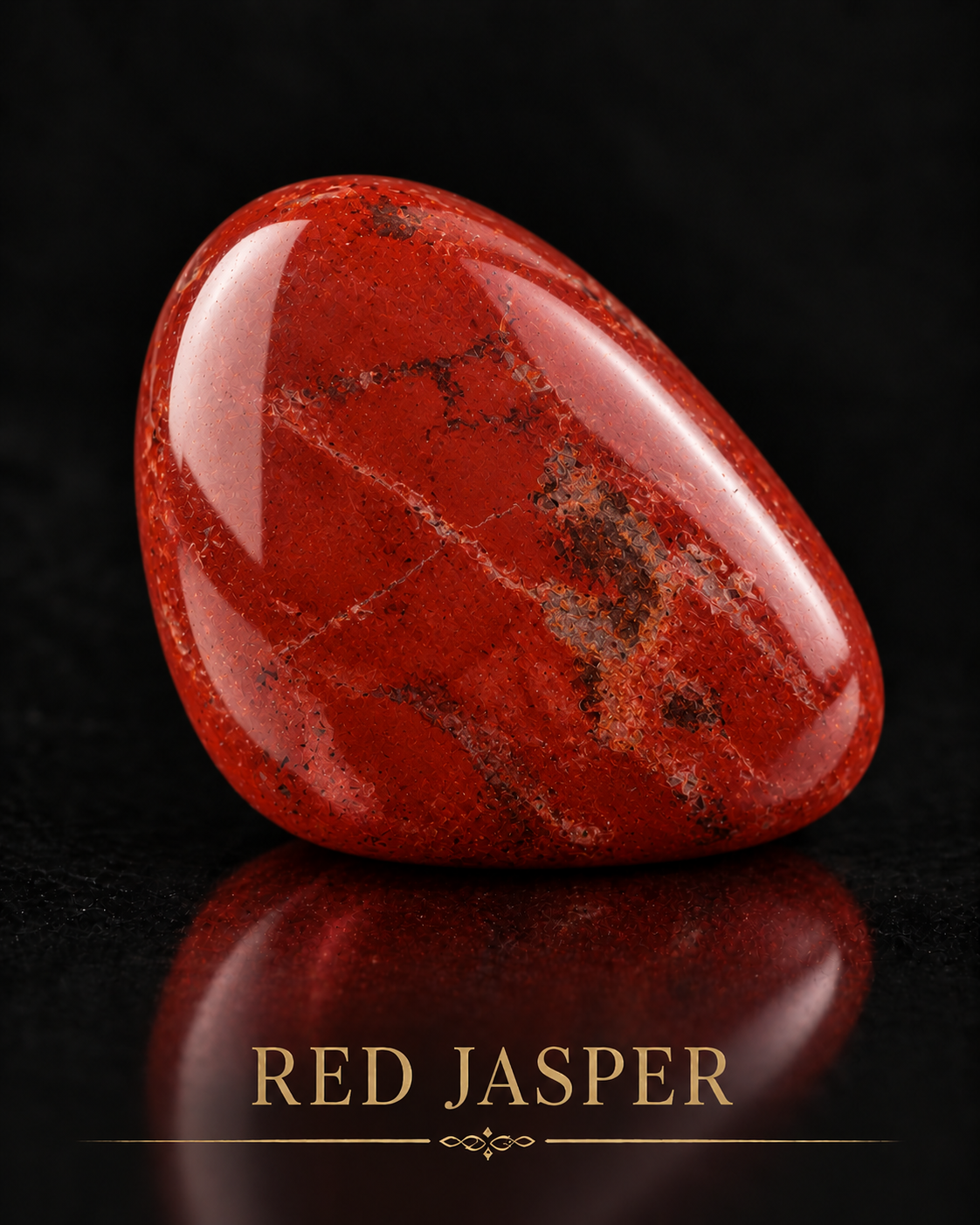
Red Jasper brings an earthy red into this collection: a colour with weight, variation and a close relationship to the worked surface. The generated study presents a rounded polished stone against black, with darker passages interrupting the red and pale reflections describing its contour. It is a visual interpretation rather than a photograph of an identified specimen.
The historical enquiry follows a more concrete path. Red jasper appears in Egyptian amulets and in a remarkable vessel preserved within the Medici collections. These objects allow colour, carving and cultural purpose to be considered together, while keeping their particular meanings distinct from the possibilities of a contemporary artwork.
Red as a material colour
Georgia State University’s HyperPhysics resource describes jasper as a red variety of chert whose colour derives from iron oxide. Chert belongs to the family of fine-grained silica materials. This gives an initial framework for the red: it is associated with constituents within the material rather than simply a colour placed over its exterior.
That framework cannot identify the generated image. Its pattern is an artistic simulation, with no specimen available for testing. The historical examples cited below have their own museum records, and their attribution to jasper is drawn from those records.
For image making, an opaque material asks for a different approach from a transparent gem. The viewer primarily encounters the outside: its colour, marks and response to light. A rounded highlight can establish volume while a darker patch suggests variation in the stone. Those passages should belong to the same physical form, even when they are developed through a digital process.
Egypt: an amulet associated with Isis
The Metropolitan Museum of Art holds a jasper tit amulet from Egypt’s New Kingdom, dated around 1550–1080 BCE. The museum explains that the knotted-cloth form became associated with Isis and her blood. The Book of the Dead prescribed a blood-red stone for this amulet, placed at the neck of the deceased as part of protection in the afterlife.
This is a specific relationship between material, colour, form and funerary practice. Red was not a detached decorative choice. It participated in the intended meaning of a named object. That history deserves to remain connected to the context in which the object was used.
A contemporary artist might learn from the precision of that relationship. A small red ornament can gather significance through its placement and shape. Its meaning need not be announced across an entire composition. The historic belief belongs to its original setting; a present-day work can respond through remembrance, bodily presence or the intimacy of something worn near the throat.
A heart assembled from different stones
Another Met object combines a red jasper heart with a separately made carnelian human head and a chlorite wig. Dated to the New Kingdom or early Third Intermediate Period and probably from Egypt, the amulet joins different materials into one small figure. Its piercings may have enabled attachment to mummy bandages.
The object provides an especially useful link with the Carnelian study already in this collection. Two red materials perform different roles, while the dark chlorite conceals the junction. Material contrast supports the composition, and the assembly becomes part of how the figure is made legible.
For contemporary work, this suggests looking at transitions. Where does one material end and another begin? Is the join concealed, emphasised or allowed to become a meaningful line? Such questions can guide a sculptural object, a collage or a painted ornament whose imagined construction makes its appearance more convincing.
The Met also records a red jasper bull amulet from the Ramesside period, around 1300–1200 BCE. Its different form is a reminder that the same material entered more than one kind of object. A stone’s history is richer than a single association.
Red jasper in the Medici collection
A two-handled red jasper vase with a lid, discussed in the Met’s Art of the Royal Court exhibition, offers a direct connection to the Medici collecting tradition. The stone vessel is attributed to Venetian craftsmen of the late fourteenth century; its gilded silver and enamel mounts are attributed to a fifteenth-century Venetian goldsmith, possibly working in Florence.
The museum identifies it as a survivor of the hardstone collection assembled by Piero de’ Medici and Lorenzo the Magnificent. Some early Medici vessels were later donated to San Lorenzo and transformed into reliquaries. The object’s life therefore extends across making, collecting and religious reuse.
For a practice engaged with Renaissance inheritance, the vase expands attention beyond painted images. A vessel can embody skilled judgement through the relationship between stone, metal and proportion. Its red surface contributes to a larger composition, and its survival brings the choices of earlier makers into the present.
That does not mean every polished red stone should be presented as a Renaissance object. It provides a documented point of comparison: the same broad material category can support a small amulet or a substantial vessel, with very different social and artistic purposes.
Geological pattern and the limits of origin
GIA’s museum account of tiger’s-eye quartz includes a multicoloured rock from Western Australia’s Pilbara region. It describes ancient iron-rich sediments that developed into layers of hematite, magnetite and jasper. This example shows jasper participating in a larger geological pattern rather than existing only as a solitary red gem.
It is a regional example, not a proposed source for the generated study or the museum objects. A colour alone cannot supply that connection. Keeping geological setting, object provenance and artistic simulation separate makes each part of the enquiry more useful.
Working with warmth and density
Red Jasper could give a contemporary portrait a concentrated warmth. Place it near a cooler fabric or a dark collar and its colour may become a point of quiet emphasis. Change its scale and the effect changes: a small stone can feel intimate, while a larger form can establish weight and presence.
Allow the red to vary. A muted passage can make a brighter area more perceptible, and a narrow reflection can describe polish without erasing the underlying colour. The aim is a surface that invites examination, rather than a uniform field that is exhausted at first glance.
Its historical objects also offer different approaches to memory. The amulet keeps material close to the body; the vase carries a history of collecting and reuse. A contemporary work can draw on those relationships while letting its own subject determine what the red ultimately means.