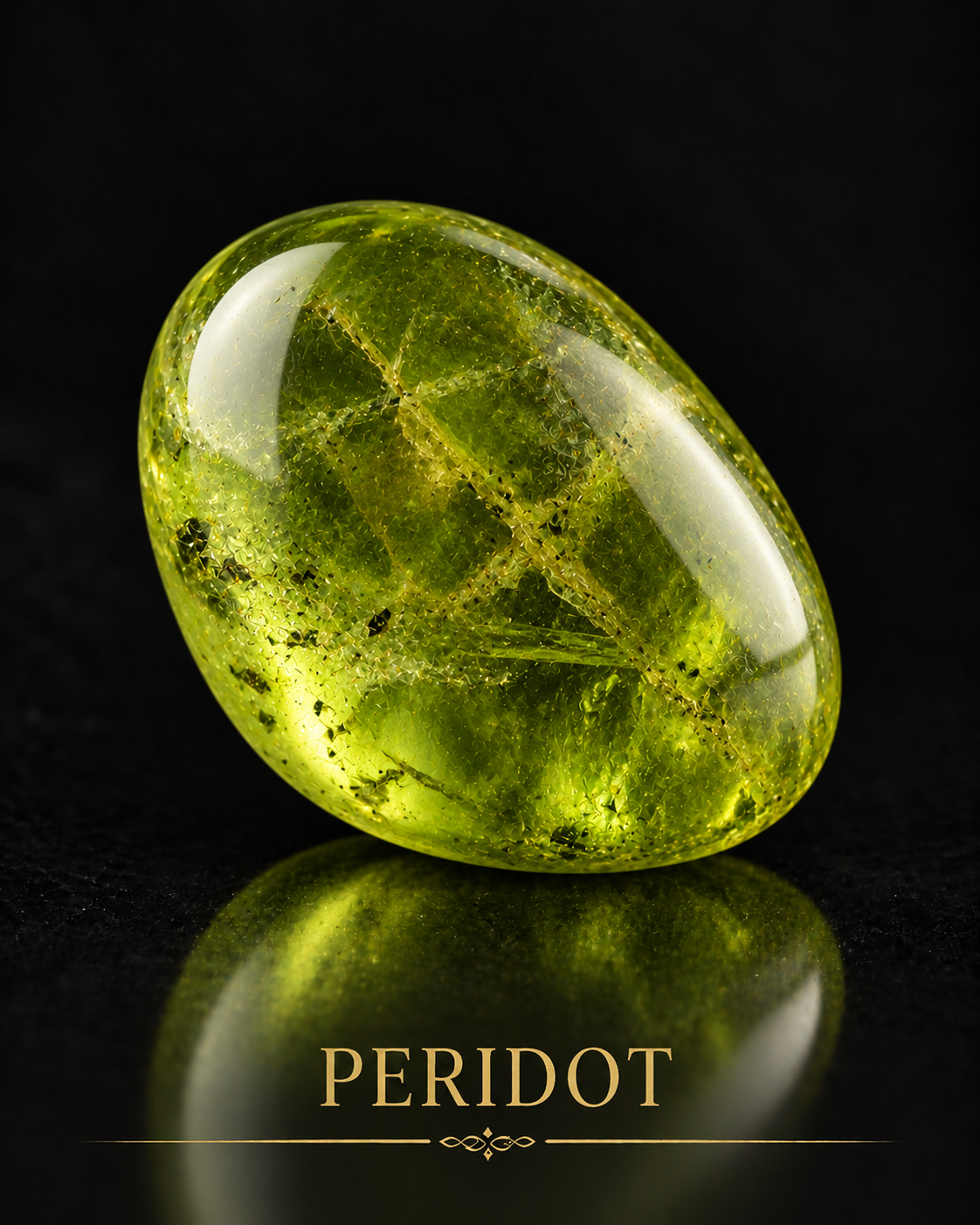
Peridot introduces a yellow-green light into the collection. Its generated study presents a polished rounded form emerging from black, with a warmer green than Emerald and pale reflections across its dome. The colour gathers at some edges and becomes darker elsewhere, suggesting a small volume of light held within a stone.
The accompanying enquiry follows peridot from its mineral identity to Zabargad Island in Egypt’s Red Sea, then into later jewellery and contemporary artistic interpretation. The connections are specific: a historic source, a changing vocabulary of green gems, and objects whose makers used colour in deliberate compositions.
A green connected to olivine
GIA identifies peridot as the gem variety of olivine. Its composition includes magnesium and iron, with iron responsible for its yellowish-green colour. Its range extends from brownish green through yellowish green to purer green, with yellowish green particularly familiar in jewellery.
Peridot occurs in more than one geological setting. GIA describes crystals within nodules associated with lava flows and rarer larger crystals in veins or pockets. Its examples include sources in the United States, China, Vietnam, Pakistan, Myanmar and Zabargad. The material’s identity is therefore broader than one place, even when a particular place becomes central to its history.
For an artist, that distinction is useful. A colour can suggest a landscape without proving it. The image above cannot be assigned to an Egyptian mine: it is a generated visual study. Its purpose is to explore the appearance and artistic possibilities of peridot, while the written history rests on separate evidence.
Zabargad: an Egyptian island and a historic source
Zabargad, also known as St John’s Island, occupies an important place in accounts of peridot. GIA’s historical reading list places it in the Red Sea southeast of the ancient port of Berenike. Ancient writers described a green gemstone from the island, and the source later became associated with notable museum crystals and the history of gem collecting.
The reading list also makes a useful distinction between texts and archaeological evidence. Pliny’s account of gems presented to an Egyptian queen does not itself establish their archaeological use at that date. The historical connection is compelling, but individual claims about antiquity need to be kept at the strength their evidence supports.
This gives the study an island setting without turning it into a romantic certainty. Geography, written accounts and surviving gems reveal different parts of a story. The Red Sea was a space of movement and connection, and peridot allows attention to settle on one small source within that wider world.
A visual response could use the contrast between green and surrounding darkness to suggest an isolated presence. That is an artistic possibility, not a reconstruction of the island. A studio image can carry an atmosphere while leaving the historical landscape to its own records.
Names, light and historical belief
GIA’s history of peridot notes that early records called its island source Topazios, although the green stone associated with it was peridot. Its account also discusses traditions connecting peridot with light and protection from fears of the night. These are histories of naming and belief, not demonstrated powers of a gem.
Such shifting names matter because old descriptions do not always map neatly onto modern mineral categories. A familiar gemstone word can carry an earlier meaning. Reading historical sources therefore involves asking what material a writer actually encountered, rather than assuming that every term had today’s definition.
For contemporary art, the association with light offers an open prompt. Peridot might suggest a held glow, a moment of emerging clarity or a warm green accent within shadow. Those meanings should arise from the particular composition and subject. They are not instructions built into the mineral.
Looking into the stone
GIA describes common peridot inclusions that include tiny dark mineral crystals and reflective disc-shaped features called lily pads. Better-quality material often has no inclusions visible to the unaided eye. Its account also lists many worked forms, including faceted gems, cabochons, beads and carvings.
The generated image deliberately makes an interior visible as part of the visual study. That does not make it a representative high-quality jewel or allow the depicted textures to be identified as particular inclusions. Real gemological observation depends on an actual stone, magnification and appropriate lighting.
The artistic question is how much depth to reveal. A few interruptions may allow the eye to move inside a transparent form. Too much activity can compete with the outline and make the material hard to read. The polished surface and its interior should feel connected, with the light describing both rather than behaving as unrelated decoration.
A Renaissance Revival jewel
A Marcus & Company brooch in the Metropolitan Museum of Art provides a clear later connection to Renaissance design. Made around 1900, it places a large cushion-shaped peridot at the centre of gold, diamonds, pearls and green enamel. The museum identifies its design with the Renaissance Revival style fashionable in the late nineteenth century.
This is a revival object, rather than a surviving Renaissance jewel. That distinction makes it especially relevant to contemporary inheritance: earlier artistic languages can be revisited through the materials, needs and tastes of another period. Historical influence does not require a new object to pretend to be old.
The brooch suggests a compositional dialogue between the green stone and the surrounding enamel. Colour appears in two different materials, while pearls and diamonds establish lighter accents. A contemporary artwork might similarly repeat a hue across gem, fabric and painted surface, allowing their different textures to remain visible.
Material care as an artistic consideration
GIA’s August birthstone guide gives peridot a hardness of 6.5–7 and notes its vulnerability to thermal shock and some acids. That information belongs to handling real material. A digital simulation does not share the same physical risks, but an object made with actual peridot would require decisions informed by its properties.
The wider lesson for a studio is that beauty and suitability are different questions. An image may explore a material freely; a physical edition or embellished object needs a plan for its construction, display and care. Keeping those stages distinct supports a more considered practice.
A new register of green
Peridot adds a warmer green beside Emerald and the dark greens already present in the collection. Its relation to yellow can suggest sunlight or late-season foliage, depending on the surrounding palette. A black ground concentrates that colour, while a warmer background could make it feel gentler and less isolated.
Let its placement determine its role. A small peridot detail close to a face can create an intimate accent; a larger polished form can become a study of light and enclosure. Its reflection can extend the colour beyond the object without giving it a fixed symbolic meaning.
Zabargad’s history, olivine’s material identity and the revival brooch provide different points of contact. Together they offer a framework for making something new: an artwork attentive to evidence, interested in inherited forms, and willing to let colour become meaningful through the act of looking.