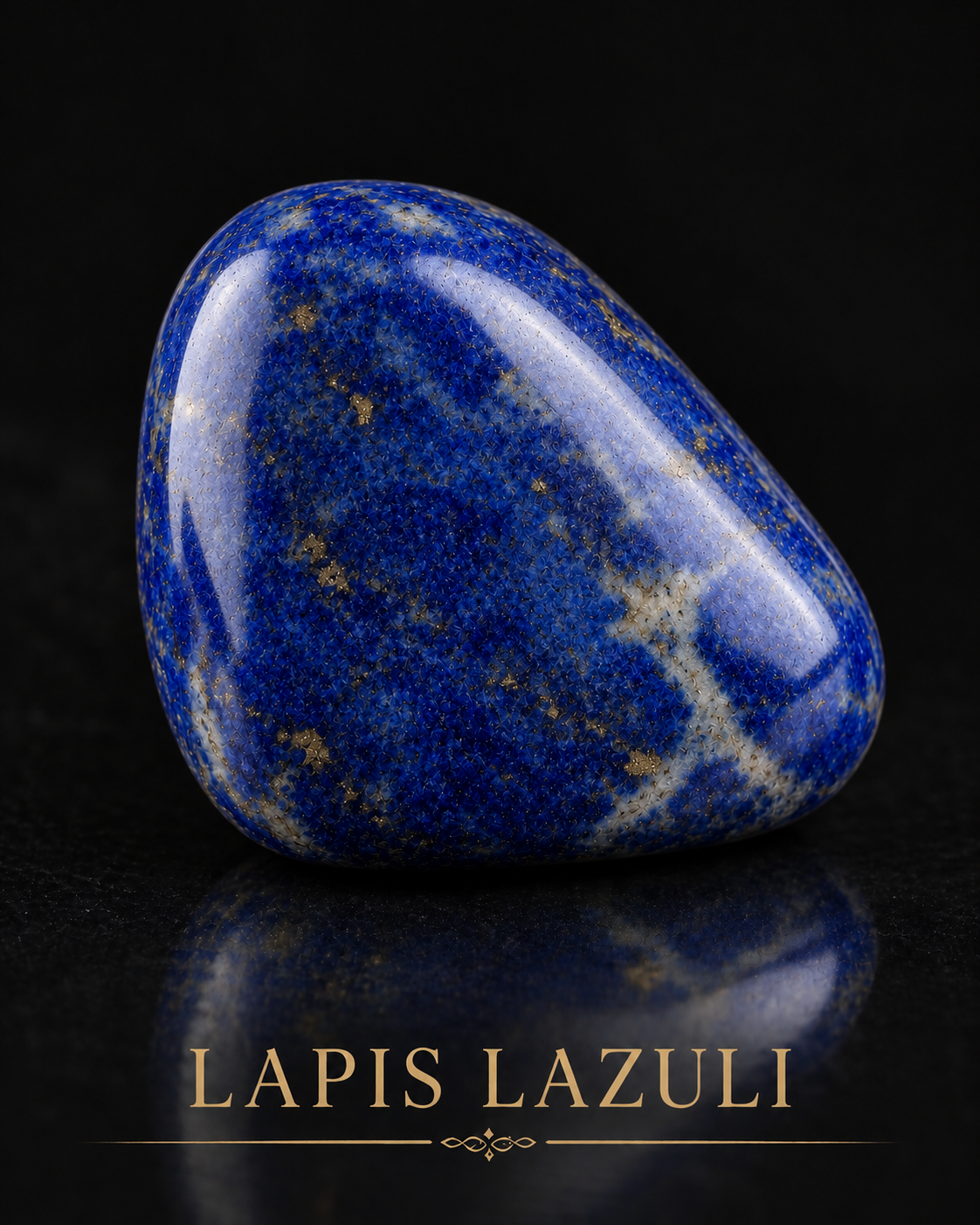
Lapis Lazuli enters this collection as a concentrated field of blue. In the digitally generated image, a rounded stone rises from black, its polished surface carrying small brass-coloured flecks and quieter pale passages. Light moves across the curve without making the body transparent. The blue remains dense: something the eye can rest on, yet cannot see through.
That visual relationship is a useful beginning for Jabbi Outside. A dark setting gives the colour room to gather. A reflection extends the stone downwards, while gold lettering echoes the warmer details within it. The presentation suggests intimacy and ceremony at once. It asks us to look closely at a small object that appears to contain a much larger world.
The histories behind this colour are equally expansive. Lapis connects the mountain mines of Afghanistan with the sacred objects of ancient Egypt and the preparation of artists’ pigments. Following those connections changes the image from a study of an attractive surface into an enquiry about distance, labour, cultural memory and the ways people make matter meaningful.
A blue rock made from several minerals
Lapis lazuli is a rock composed of several minerals rather than one transparent crystal. GIA identifies lazurite, calcite and pyrite as its principal components. Lazurite gives the characteristic blue; calcite can appear as white patches or streaks; pyrite supplies metallic-looking yellow details. The gold-coloured flecks are therefore mineral inclusions, rather than pieces of gold.
Its appearance varies with that mixture. Some material has an even blue field; other pieces reveal stronger pale passages or scattered metallic accents. GIA places its hardness around 5–6 on the Mohs scale, depending on composition, and describes fair toughness. Those qualities help explain why a polished, rounded presentation suits it so well: the surface can display colour and pattern without relying on the transparent brilliance of a faceted gem.
For an artist, these variations are opportunities for attention. A white passage might interrupt a continuous field. A pyrite grain might catch light before its surroundings. None of these details needs to become a symbol immediately. First there is the encounter with a particular arrangement: blue beside pale stone, a warm glint within a cooler mass, a highlight moving over an opaque body.
Afghanistan: the mines of Sar-e-Sang
The mining story belongs explicitly to Afghanistan. Sar-e-Sang, in Badakhshan in the country’s northeast, is a celebrated lapis lazuli locality in the Hindu Kush. The International Union of Geological Sciences places the principal mines near the east side of the Kokcha River and recognises the deposit’s importance to both geology and archaeology.
Its geological account describes lapis in bodies and layers within calcite and dolomite marbles. The proposed formation involves chemical exchange between rocks, including interactions associated with granitoids and marble. The deposit is therefore a record of a particular geological setting, rather than blue material occurring independently of the surrounding mountain.
Sar-e-Sang also has a mining history reaching into the Neolithic period. Lapis travelled substantial distances long before modern international supply chains. Its movement gives the stone two kinds of history: the formation of matter within the earth, and the human decisions that carried selected pieces elsewhere.
In an artwork, naming the source keeps the mountains from disappearing behind the finished object. A polished stone can look self-contained, as though its beauty has always existed in this form. The mining context restores what the surface alone cannot show: selection, extraction, transport and transformation. This article describes a documented historic deposit; it does not claim to verify present-day mine access, labour conditions or the origin of a purchased specimen.
Ancient Egypt: sacred form and material meaning
Ancient Egypt is a central part of this study. The Met records an Egyptian Djed amulet made from lapis lazuli, dated 664–334 BCE. At approximately three centimetres high, it is a compact object in which material and recognisable sacred form meet. Its catalogue entry offers a specific example, rather than a general claim that every blue Egyptian object was made of lapis.
The Global Egyptian Museum explains the Djed pillar’s associations with stability and eternity and its interpretation as the backbone of Osiris. Within Egyptian funerary belief, the amulet was connected with protection and rebirth. The museum notes that Djed amulets could be made from lapis or carnelian as well as the more common faience. Its own illustrated example is faience; it supplies context for the form, while the Met record documents a lapis object.
These distinctions enrich the connection. Sacred significance did not arise from colour alone. The stone was worked into a shape, placed within a tradition and understood through particular beliefs. Material, craftsmanship and religious purpose acted together. Historical claims about protection belong to that cultural setting; they are not evidence that lapis produces protective or healing effects today.
For contemporary portraiture, the Djed offers a question about how much meaning a small detail can hold. An ornament close to a person may suggest remembrance, endurance or an intimate relationship with inherited culture. Such a reading remains an artistic proposal. It should grow from the figure and the work’s intention, rather than treating Egyptian sacred imagery as a ready-made decorative language.
From stone to natural ultramarine
The connection with Renaissance painting is especially direct. Natural ultramarine is prepared from lapis lazuli. The National Gallery’s technical study of Raphael’s Ansidei Madonna identifies the expensive pigment in the final blue glaze of the Madonna’s drapery and links its raw material to Afghan mines. The blue seen in a painting therefore carries a material journey that begins far beyond the panel.
This transformation is not simply the application of a stone’s surface colour to another object. Preparing a usable pigment requires skilled work. In the V&A’s Mughal masterclass film, artist and researcher Anita Chowdry demonstrates traditional pigment preparation from lapis lazuli and malachite. The film places mineral colour within the working knowledge of the book arts and painting in the Islamic world and Indian subcontinent.
These examples prevent the story from narrowing to a single European tradition. Lapis can connect Renaissance painting with other histories of making without flattening their differences. Each workshop has its own practices, purposes and visual language. The shared material gives us a point of contact; close attention to those distinct practices gives that contact depth.
Working with blue in a digital studio
For Jabbi’s digitally simulated practice, lapis invites more than a choice of a blue colour value. It encourages questions about how colour behaves: whether it appears dense or airy, whether a highlight sits above it, and how its relationship with neighbouring materials changes the atmosphere of a portrait.
A blue ornament may echo a garment while retaining a different surface. Small warm inclusions may connect it with a gold border or frame. A pale patch can prevent the object from becoming a perfectly uniform emblem. These are visual choices through which simulated material acquires specificity.
The generated image should consequently be understood as an artistic study. Its photographic appearance does not turn it into evidence of a real specimen, a mining origin or a particular treatment. Naming the simulation allows the viewer to appreciate the image while recognising where the material research ends and the artist’s construction begins.
A colour that carries a journey
Lapis Lazuli brings a valuable continuity to this collection: mountain, object, sacred form, pigment and image. The connections are real, but their meanings are not interchangeable. An Egyptian amulet and a Renaissance painted robe belong to different worlds. Looking at both expands our understanding of the material without making one stand in for the other.
The contemporary opportunity is to keep that richness alive. Let the blue remain visually particular. Let the mining landscape have a name. Let ancient Egypt enter through documented objects and the beliefs surrounding them. Let the history of pigment remind us that a luminous colour can contain patient work.
Then a small polished form becomes more than a luxurious accessory. It can invite the viewer to consider what has travelled into an image: matter, skill, desire and memory, gathered into a blue that still asks us to look again.