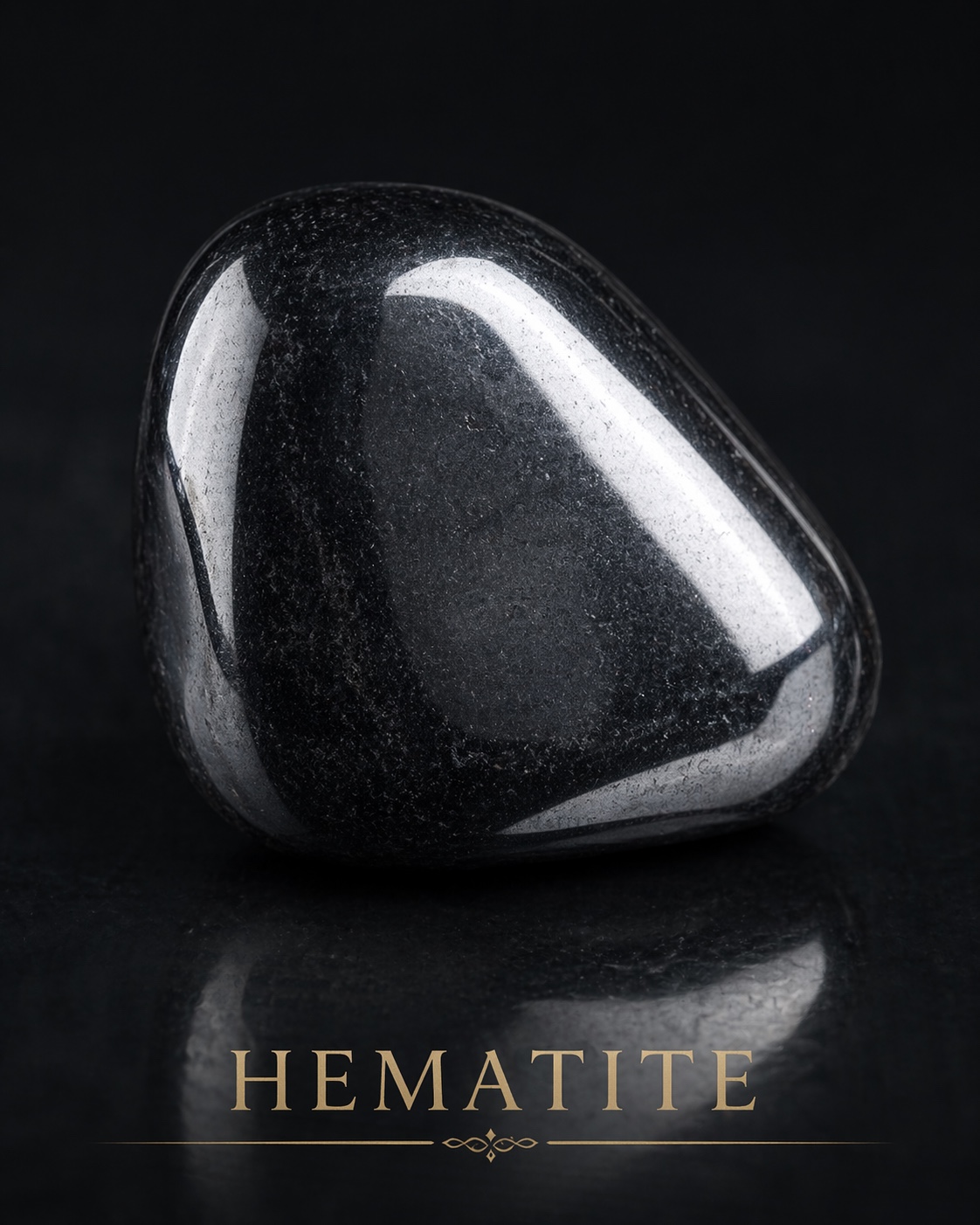
Hematite enters this collection with a different kind of presence. The supplied image is almost entirely dark, yet the stone commands attention through the light it returns. A broad white reflection curves across the upper surface and descends towards the right. A narrower highlight rises along the left edge. Between them, a steel-grey field holds fine, pale details that become visible as the eye adjusts. The rounded triangular outline gives the object an apparent steadiness: a small form with the visual weight of something much larger.
Below it, a subdued reflection repeats the silhouette. The gold lettering introduces warmth without changing the stone’s restrained character. These relationships offer a starting point for Jabbi Outside: darkness as a place where light gathers, reflection as an encounter with the surrounding world, and weight as a language of presence. Another possibility lies beyond what the picture shows. Hematite’s characteristic powdered colour is reddish brown. The dark object and the red mark belong to the same mineral story.
A dark surface, a red trace
Hematite is an iron oxide, with the chemical formula Fe₂O₃. Its metallic appearance can suggest a piece of metal, although it is a mineral compound of iron and oxygen. The Kansas Geological Survey describes both red, earthy forms and black forms with dull or metallic lustre. These different appearances share a red-brown streak: the colour of the fine powder produced when material is rubbed across a suitable rough surface. Earthy hematite can mark paper readily.
This distinction between surface colour and powdered colour matters. A photograph offers the first appearance; mineral identification can depend on another encounter altogether. The supplied label names Hematite, but the picture alone cannot establish composition, origin or treatment. Its bright highlights show the relationship between a smooth-looking surface and illumination. They do not show a streak test or reveal how the object was made.
For artistic thinking, the difference is productive. A material can hold a colour that its most immediately visible form conceals. Red becomes a possible trace of contact, pressure or transformation. In an artwork, that could become a quiet thread passing behind a dark figure, or a red ground glimpsed through a restrained surface. The connection would be an artistic interpretation of a physical property.
More than one geological journey
Hematite occurs in several geological settings. The University of Minnesota describes its abundance in sedimentary environments, including deposits formed through precipitation from water and enrichment involving groundwater. Ancient banded iron formations contain alternating iron-rich layers and chert. Their history reaches into periods when the chemistry of oceans and atmosphere differed greatly from today. Such deposits connect a mineral specimen to changes operating across enormous stretches of Earth’s history.
There are also landscapes where small amounts of hematite have a striking visual effect. Zion National Park explains that the Navajo Sandstone’s earlier reddish colour came from thin iron-oxide coatings on light quartz grains. Later fluids altered or removed iron in some places, leaving pale rock, while iron minerals accumulated elsewhere. Colour in this landscape records changing conditions and movement through the rock. It is a consequence of geological events, rather than a decorative layer added for our benefit.
These histories suggest two scales for the artist: the concentrated presence of a small dark object and the dispersed colour of an entire landscape. A painting might bring them together through a dense reflective passage set against a thin red wash. Their relationship would echo concentration and dispersal, allowing the same material idea to appear as both weight and atmosphere.
Ore, labour and material value
Hematite is an important iron ore, and the University of Minnesota connects the Lake Superior iron ranges with the region’s industrial history. That association widens the idea of value. An ornamental stone invites close looking; ore enters systems of extraction, processing, work and construction. Both belong within a material’s history, even when only one is visible in a carefully lit image.
The Soudan research lecture selected below offers a particular place to explore this relationship in more depth. Its account concerns a historic Minnesota mine and research into the development of its hematite ore. That place should not be treated as the source of the photographed stone: no provenance has been supplied for the reference. Instead, it gives visitors an opportunity to move from a single image towards the geological and human circumstances surrounding one documented deposit.
Within an artwork, weight can therefore carry several associations. It may suggest endurance or assurance, but it can also ask who handled a material and what work brought it into view. A polished object arrives with a finished appearance. Thinking about the stages behind that finish gives its smoothness another dimension.
When the mineral becomes pigment
Hematite also belongs to the history of making colour. The National Park Service’s account of Chaco Canyon identifies hematite as a source of red pigment in pictographs. It describes pigments combined with organic binders and applied to cliff walls, sometimes using yucca brushes. The distinction between painted pictographs and carved petroglyphs is useful here: one deposits material on a surface, while the other changes the surface through removal.
This is a specific cultural context. The meanings of individual images should remain attached to their makers, communities and places. A red pigment does not supply a single universal explanation for everything painted with it. Its significance depends on the image, the setting and the knowledge carried by the people who made and continue to understand it.
For Jabbi’s art, the material connection offers a considered route into pigment and memory. A stone represented as a reflective object can also prompt an enquiry into the colour of a painted ground. The viewer might encounter a dark form first, then discover a red passage nearby. That arrangement could make the mineral’s contrasting appearances part of the work’s visual rhythm, without claiming to reproduce the purpose of another community’s images.
A carved stone that makes an image
A hematite cylinder seal in the Metropolitan Museum of Art supplies another documented history. The museum dates the Babylonian object to approximately the nineteenth to sixteenth century BCE. Its carved scene includes a worshipper offering a goat to the sun god, with other divine figures. The collection record identifies hematite as a characteristic hard, dark stone used for seals in this period.
Cylinder seals could be rolled across clay to leave an impression. The Met explains their use in ownership, identification and commercial or legal transactions; protective meanings may also have been associated with their materials and designs. This object therefore brings carving, imagery and social authority into the same small form. Its significance comes from a particular practice and scene.
The relationship between carved surface and impression is especially suggestive for contemporary art. A compact object can generate an image that unfolds across another material. The original and its trace have different forms, yet remain connected. Beside the reflection in the supplied photograph, the seal offers a second way to think about repetition: an image produced through contact, carrying a mark beyond the object that made it.
The choices within a polished surface
The reference gives prominence to a continuous, rounded outline. Its broad highlights allow the eye to follow the apparent curvature. Small pale details interrupt that continuity, preventing the central area from reading as a perfectly empty field. A painter working from this image would need to judge the balance carefully. Too much detail could scatter attention; too little could flatten the stone into a dark graphic shape.
The lapidary film below follows jasper bearing hematite through shaping and polishing. It offers a working comparison, since its composite material differs from an object labelled simply Hematite. Watching the progression of a worked surface can nevertheless sharpen attention to how makers choose an outline, reveal features and pursue a finish. Those decisions have an equivalent in painting: where to keep an edge firm, where to soften a transition and where a highlight should stop.
Weight, reflection and the memory of red
Grounding is a useful word for an artistic response to this image, provided its meaning is made concrete. Here it could refer to the broad base, compact shape, dark tonal mass and apparent resistance to movement. These are visual relationships through which a composition can suggest steadiness. They do not require a claim that the stone produces an effect on the viewer’s body.
Reflection offers another route. The brightest parts of the object are its responses to light outside itself. In a portrait or symbolic composition, hematite could become a way of considering how identity receives, reshapes and returns the surrounding world. Its darkness remains present even as it carries an intense brightness.
Red completes the enquiry. Although absent from the photographed stone’s dominant appearance, it enters through the mineral’s streak, pigment uses and name, which the University of Minnesota relates to the Greek word for blood. An artist could let that connection remain partly concealed: a red underlayer, an interrupted line or a small warm mark against grey. Hematite would then carry meaning through a relationship the viewer gradually discovers. The image begins with a dark, reflective form; the wider study opens that form towards geological change, human making and the traces materials leave behind.
Sources & further reading
These six sources support the mineral properties, geological examples and documented cultural objects discussed above. The visual and symbolic readings are contemporary artistic interpretations.
- Kansas Geological Survey — Kansas Rocks and Minerals: Minerals · Composition, lustre, streak and the distinction between earthy and metallic hematite.
- University of Minnesota — Hematite · Geological settings, banded iron formations, iron ore and the mineral’s name.
- Zion National Park — Colors of the Navajo Sandstone · Hematite coatings and later changes caused by fluids moving through sandstone.
- Chaco Culture National Historical Park — Petroglyphs & Pictographs · Materials and methods used for painted and carved images in this specific landscape.
- The Metropolitan Museum of Art — Babylonian hematite cylinder seal, 1986.311.39 · A dated carved object, its imagery and the functions of cylinder seals.
- The Morgan Library & Museum — Rolling Stones: Looking at Ancient Mesopotamian Cylinder Seals · Curatorial context for the extended seal lecture in the film selection below.