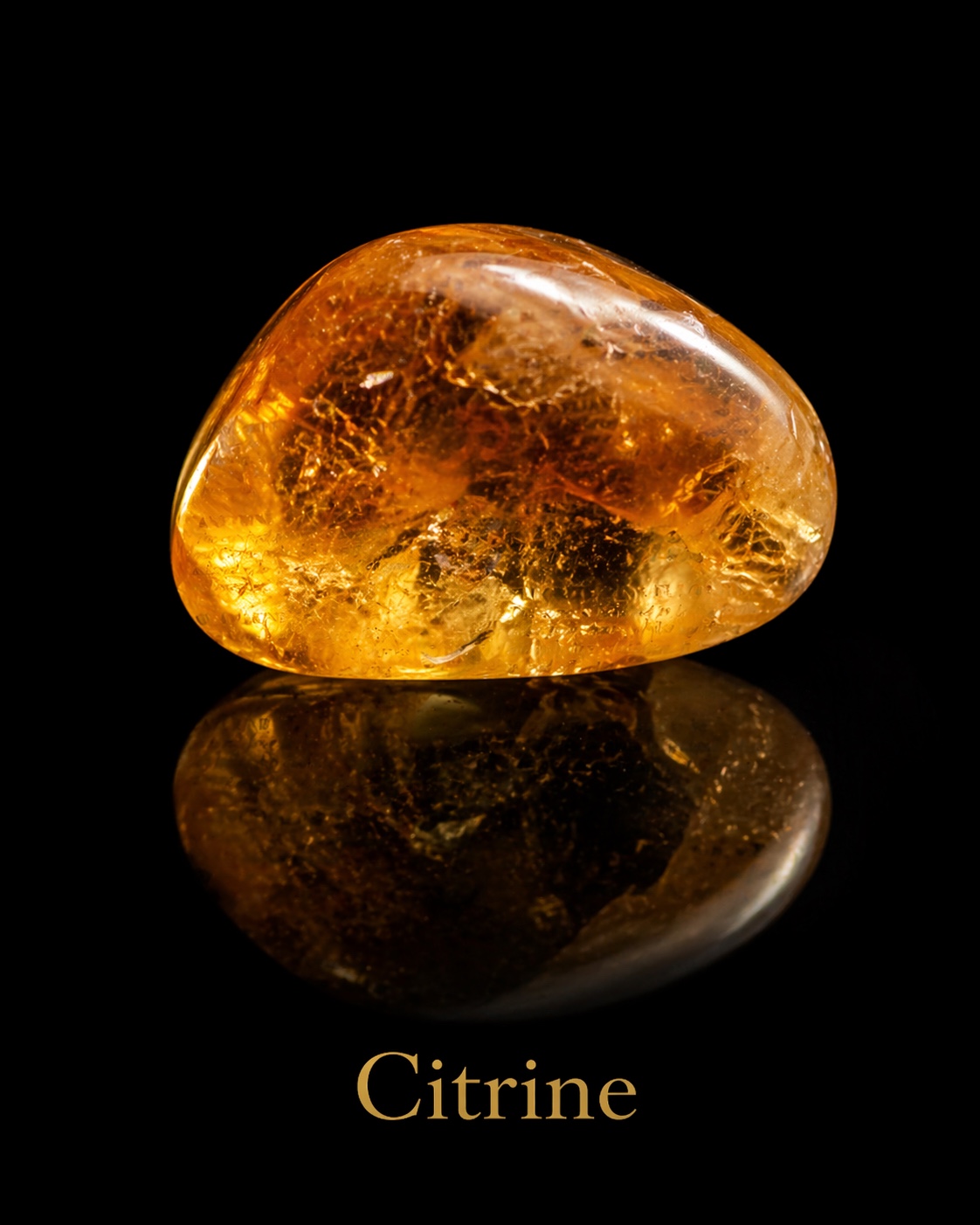
Gold that appears to hold light
The Citrine reference seems to gather light inside its rounded form. Golden yellow moves towards orange, while darker areas give the interior depth. A pale reflection travels over the upper curve. Below it, a web of fine bright details interrupts the transparency, making the stone feel complicated rather than empty.
That complexity offers a strong starting point for Jabbi Outside’s exploration of minerals in art. The eye moves between the smooth exterior and the busy interior, between a clear outline and something less easily understood within it. Brightness becomes more interesting because it contains variation.
Citrine is often approached through associations with sunlight, confidence or abundance. This study begins with the visible material and documented objects, then asks what those associations might become within an artwork. A symbol gains definition when the artist gives it a particular place, scale and relationship to the subject.
A colour within quartz
Citrine is the transparent yellow to brownish-orange variety of quartz. Quartz is composed of silicon and oxygen; the Smithsonian explains citrine’s golden colour through small amounts of iron within the material. The name is associated with the French word citron, meaning lemon.
This connects Citrine with amethyst and ametrine elsewhere in the collection. Their different colours do not require completely unrelated mineral species. A shared quartz structure can support a striking range of appearances, while a finished object adds the choices of the maker to that material history.
The reference’s golden interior is visible, but its precise mineral identity cannot be established from appearance alone. Its label gives a useful entry point into the study. It does not certify a particular specimen’s origin, treatment or condition, nor determine the cause of every bright line inside it.
For an artist, that leaves room to look closely. The intricate internal passages may suggest a held landscape, a network of memories or light finding its way through an uneven space. These are possible readings of the image, rather than geological findings about the pictured object.
Natural colour and deliberate transformation
GIA describes natural citrine as rare. Much of the citrine in the market is produced by heating amethyst, changing some purple quartz towards yellow or orange. The resulting colour can depend on the starting material. This is a documented part of the gem’s commercial history.
The distinction between a naturally occurring colour and one altered through treatment matters when describing a physical object. Neither the warmth of this image nor the intensity of its colour can settle that distinction. A responsible account keeps the question open until there is evidence about the individual material.
For contemporary art, transformation itself can become a subject. The artist may be interested in how a material changes, how people direct that change, and what they value in the result. A digital simulation adds another layer: it represents optical qualities through an image, rather than presenting a tested mineral specimen.
Those different kinds of making can sit together without being confused. Geological growth, gem treatment, cutting and digital construction each contribute different forms of agency. Naming them clearly makes the material story more substantial.
Place and the journey towards colour
GIA lists sources for citrine including Bolivia, Spain, Madagascar, Mexico and Uruguay. It distinguishes these from Brazil’s important supply of amethyst used for heat treatment to citrine colour. Geography therefore needs to be connected with the material’s production history, rather than reduced to a single country attached to a photograph.
Bolivia’s Anahí mine provides a useful link with the ametrine study. GIA identifies it as a source of natural, unheated citrine and describes crystals that contain both purple and yellow quartz. When those colours are retained together in a fashioned gem, the result is known as ametrine.
That connection allows visitors to move through this collection by relationship as well as alphabet. The separate studies of amethyst, ametrine and citrine can become a small enquiry into how colour, geological setting and the cutter’s decisions change the way a related material appears.
No locality is assigned to the supplied reference. Its value to this page is visual: it opens the conversation. The research supplies examples and distinctions that an image alone cannot provide.
A clear gem and an expressive interior
Gem-market priorities do not always coincide with an artist’s interests. GIA notes that dealers commonly favour citrine without obvious inclusions or colour zoning, and much faceted citrine is clear to the unaided eye. Such preferences help explain what is selected for particular jewellery uses.
The reference invites a different kind of attention. Its interior contains conspicuous bright textures and darker interruptions. These details can make the represented form expressive, even though the image cannot establish whether they are fractures, inclusions, treatment-related features or simulated effects.
An artist may want the viewer to linger on precisely the passages that complicate clarity. A dark area gives the surrounding gold greater brightness. A fine line can create an unexpected route through the interior. The material’s appearance becomes a source of compositional decisions, not simply a measure of visual purity.
Cutting offers another form of interpretation. GIA documents citrine in conventional faceted shapes, unusual designer cuts and carvings. A maker can choose to concentrate light, emphasise an outline or develop a sculptural form. Each approach changes what the viewer notices first.
Documented histories before borrowed legends
Citrine’s history benefits from careful distinctions. GIA explains that its warm colour once caused confusion with topaz. A claim made about one yellow gemstone should therefore not be transferred automatically to another. Similar appearance can encourage shared stories without establishing identical histories.
More concrete examples appear in GIA’s Victorian jewellery photographs: a citrine-centred gold pendant and brooches incorporating the stone. These objects give the warm quartz a documented place within ornamental design. They offer a firmer starting point than assigning every contemporary citrine object a universal ancient meaning.
Colour can acquire significance through wearing, giving and keeping. An ornament may become associated with a person or an occasion. For an artwork, that personal dimension can be more compelling than a fixed claim that yellow always signifies one emotion, virtue or spiritual state.
A contemporary object with a public purpose
The Smithsonian’s Jolie Citrine Necklace offers a specific modern example. Designed through the collaboration of Angelina Jolie and Robert Procop, it combines yellow gold with sixty-four graduated cushion-cut citrines and a 177.11-carat pear-shaped drop. It entered the museum’s collection as a gift in 2015.
The museum connects the wider Style of Jolie collection with support for education in countries affected by conflict. Here the object’s meaning develops through design, collaboration, donation and a stated social purpose. That significance cannot be read from the colour alone.
For Jabbi’s practice, the example suggests a useful question: what relationship gives the material its role in the work? The answer might concern a figure, a cultural memory or the intention behind a commission. The strongest material symbolism is connected to something particular.
Golden light with room for uncertainty
Citrine could become a language for illumination in this collection. Its gold might suggest understanding emerging gradually, warmth held within a difficult setting or a small reserve of brightness. These are proposed artistic possibilities, not effects attributed to wearing or viewing the mineral.
The reference’s dark reflection complicates that brightness. It repeats the form while reducing its clarity, allowing the viewer to move between what is shown and what remains obscure. An artwork could use that relationship to explore memory or self-knowledge without forcing a single interpretation.
Physical citrine also deserves careful handling. GIA gives it a Mohs hardness of seven and good toughness, while noting that abrupt temperature changes can cause fracture and prolonged intense light can fade some colour. Its guidance recommends warm soapy water and advises against steam cleaning. Those general facts are not an assessment of this reference.
Making brightness belong to the image
Citrine’s contribution to an artwork need not be an announcement of wealth or optimism. A restrained golden passage can make a figure feel present. A complicated interior can hold attention. A curved reflection can connect the stone to the light falling elsewhere in the composition.
Within Jabbi Outside, this study brings together quartz, transformation, documented jewellery and contemporary purpose. It allows the material’s history to inform the work while leaving the artist responsible for the meaning created in the final image.
The opportunity is to make brightness specific: decide where it gathers, what surrounds it and what the viewer can see through it. In this reference, the gold holds both light and interruption. That is where the enquiry begins, and where the stone’s symbolism can remain open enough to reward another look.