A warm stone in a dark space
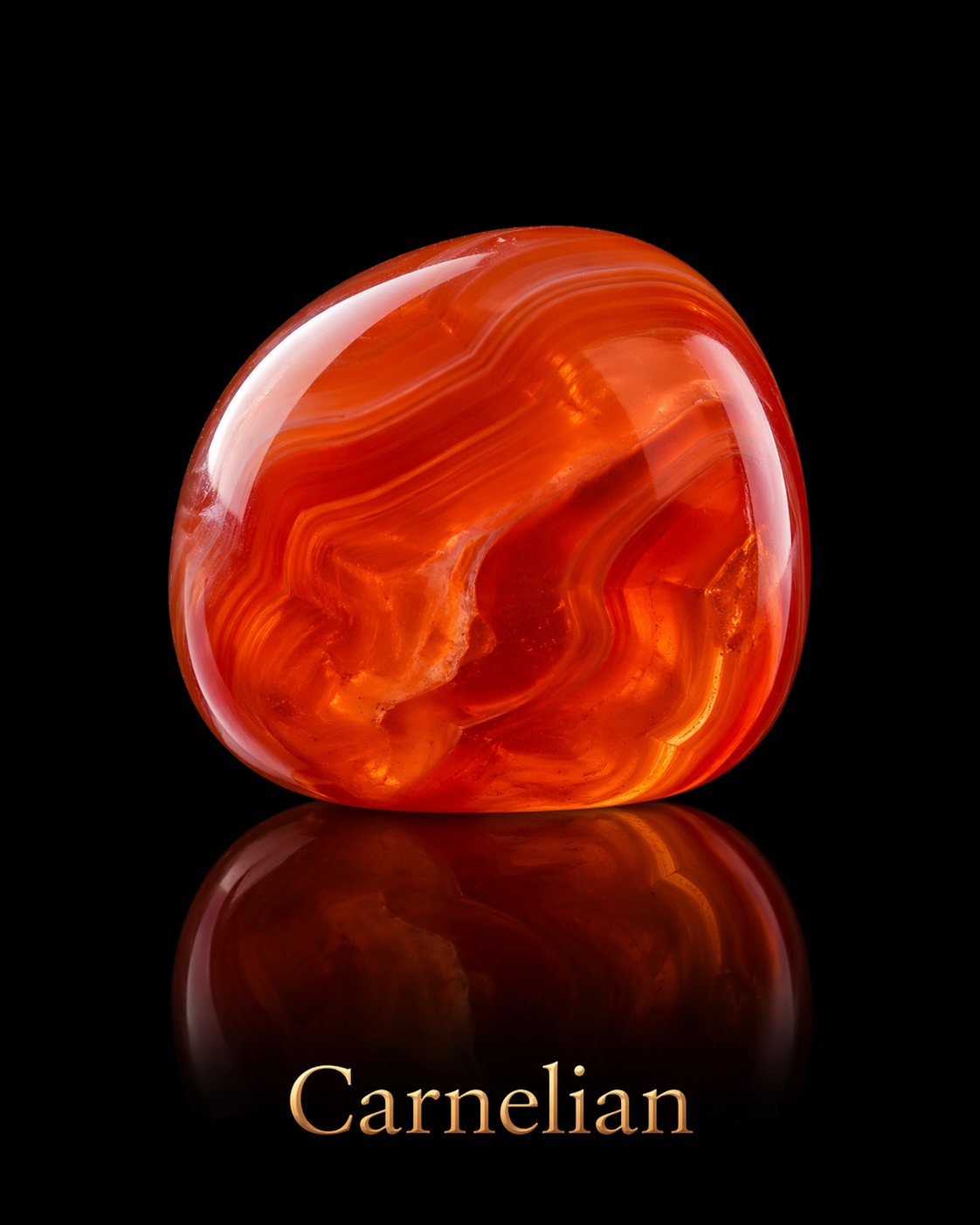
The earlier, portrait-format Carnelian reference has an immediate warmth. Orange and red move through the rounded form, while lighter bands turn across its surface and interior. White reflections describe the polished curve. Beneath it, a darker reflection repeats the stone, drawing the colour down into the surrounding black.
It is easy to reach for the language of fire. Yet there is something more interesting here than a simple resemblance to flame. The image holds brightness within a defined shape. Its lines turn, gather and change direction. Warmth becomes an organised presence, with darker passages giving the luminous areas their weight.
For Jabbi Outside’s growing exploration of sacred minerals and gemstones, Carnelian opens a conversation about colour, identity and the work of making. Its documented histories include carved amulets, engraved rings and a sophisticated bead industry. Each offers a different way to think about how a small piece of material can carry meaning.
Vitality and motivation: a second visual study
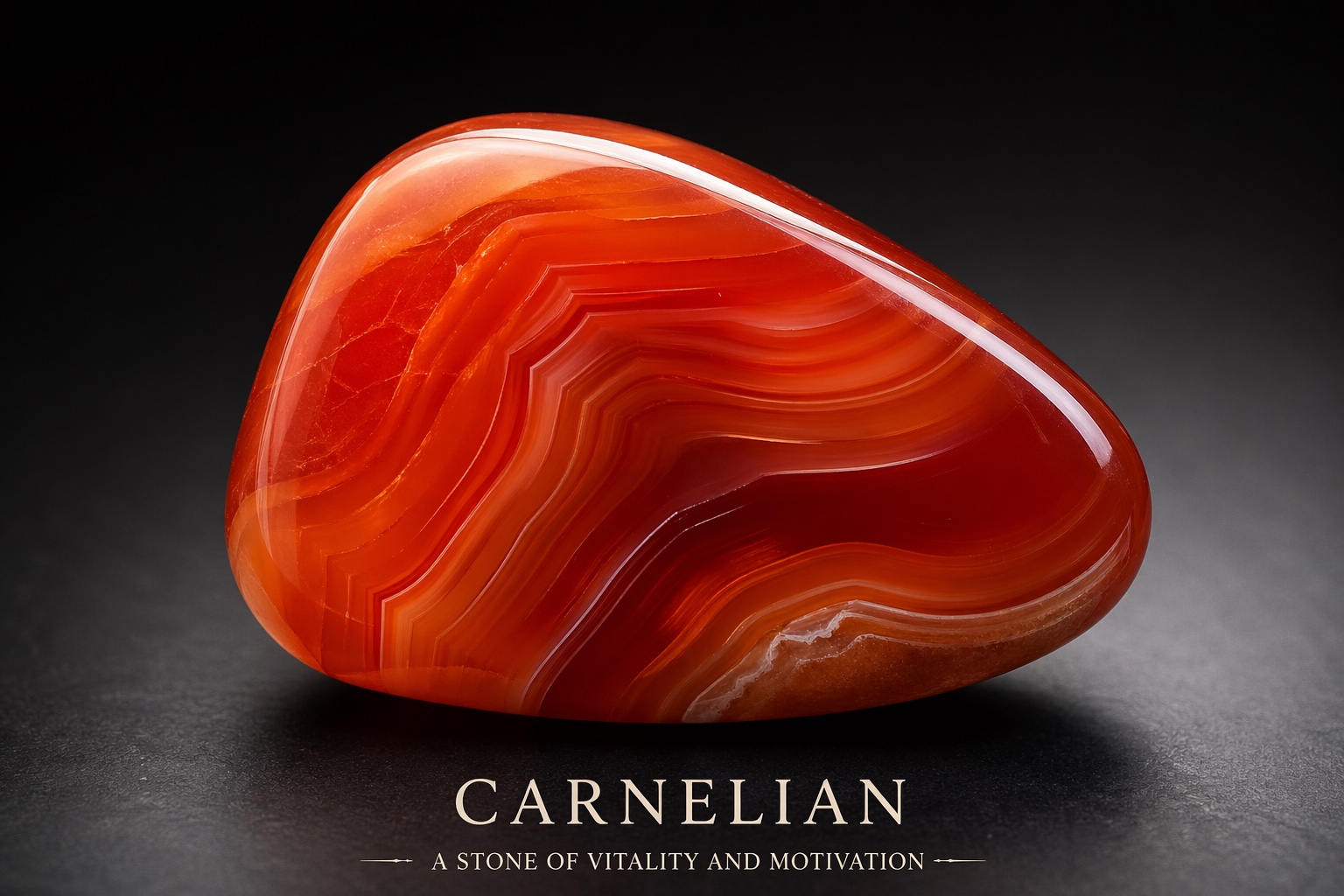
The newer landscape-format image gives Carnelian a more emphatic presence. Its broad red-orange body rests on a dark textured ground. Close bands turn across the face of the stone, changing direction in a sequence of curves and sharper steps. A long white highlight follows the upper edge. Compared with the earlier reflection-led image, this version places greater emphasis on pattern, weight and a grounded silhouette.
The words beneath it, “A stone of vitality and motivation,” propose a reading before the viewer enters the article. In this collection, that phrase can work as an invitation to consider creative momentum. The turning bands might suggest sustained movement; the warm colour might become a point of energy within a darker composition. These are artistic associations, rather than evidence that the represented mineral produces motivation or changes a person’s health.
Seen together, the two references show how presentation changes meaning. One holds luminous colour above a reflection; the other anchors an assertive pattern against a visible surface. For Jabbi’s practice, the comparison offers a choice about the stone’s role: an inward atmosphere, a confident material presence, or a conversation between the two.
Carnelian within the chalcedony family
Carnelian belongs to chalcedony, a microcrystalline form of quartz. GIA’s research places it alongside other familiar chalcedony materials, including agate and onyx. The crystals are far smaller than the large points associated with familiar quartz specimens. What the viewer encounters instead is a body of colour, pattern and varying optical depth.
GIA describes finely distributed mineral impurities, particularly iron oxides and hydroxides, as important to the colours of chalcedony varieties. That wider mineral context helps connect this orange-red reference with other quartz materials in the collection. Different appearances can develop within a related material family.
The visible bands also make this reference a useful companion to the agate study. A viewer can attend to colour and banding as distinct features without assuming that the image establishes an exact laboratory classification. Its label provides a starting point; it does not certify the stone’s composition, treatment or geographical origin.
For an artist, the distinction matters. A material’s name can bring knowledge into an image, but observation should remain active. The curve of a band, a darker interruption or a concentrated area of orange may become more consequential to the composition than a broad symbolic label.
Place, craft and the movement of beads
Carnelian’s cultural history cannot be contained in a list of countries where a stone occurs. Working centres, exchange networks and specialist knowledge are equally important. A mineral travels through human decisions before becoming an ornament or an object that a museum can catalogue.
Jonathan Mark Kenoyer, Massimo Vidale and Kuldeep Bhan’s study of carnelian bead production in Khambhat, India, examines both technology and the organisation of the industry. Their 1994 research connects the study of a working craft with archaeological questions about earlier South Asian societies. Its historical observations should be read in their research context, rather than treated as a current census of production.
The study links the stone bead industries of western India and Pakistan with the Harappan phase of the Indus tradition. Its emphasis on production and trade gives the finished bead a social setting: material selection, specialist labour and exchange all contribute to what an apparently small object represents.
That offers a useful expansion of “sacred material” for this collection. Meaning can reside in the concentration of skilled work, the inheritance of a method or the journey between communities. Those histories deserve attention alongside the more familiar stories of individual belief.
Pattern made by the hand
Not every striking detail on a worked stone began as a natural feature. The British Museum’s research into etched carnelian beads investigates how makers produced contrasting surface patterns. Its account describes experiments informed by ethnographic recipes and processes recorded in the 1930s. Reproducing a technique becomes a way to ask practical questions about an ancestral craft.
The Khambhat study also presents a carnelian bead with white lines and circles made through an ancient bleaching technique. Here the artist or craftsperson does more than reveal a pattern: they introduce a new one. Mineral colour and deliberate intervention work together.
For a contemporary digital practice, this distinction is productive. A simulated stone can show an imagined natural pattern, an engraved motif or a combination of the two. The viewer should be able to understand when a detail belongs to the represented material and when it expresses the maker’s intervention.
The Carnelian reference invites that same care. Its bands can be described as visible features without assigning a cause to every line. The image offers a strong visual vocabulary; it is not evidence that the supplied object underwent any particular historical treatment.
A small head, a heart and a specific belief
The Metropolitan Museum of Art holds an Egyptian heart amulet with a human head, dated broadly to the New Kingdom or early Third Intermediate Period. The museum describes a simplified red jasper heart with a small carnelian head made separately and attached above it. The distinction between the two materials is part of the object’s construction.
This is a precise historical encounter with Carnelian. It does not show that all red stones were interchangeable or that every carnelian object carried the same meaning. A maker combined materials, shaped recognisable forms and created something intended to act within a particular cultural setting.
The Met’s separate discussion of an Egyptian heart amulet explains the heart’s association with intelligence, feeling, action and memory, and its role in judgement after death. That explanatory object is glass, not carnelian. It supplies context for heart imagery rather than proof of a property belonging exclusively to one stone.
For Jabbi’s artwork, the lesson is in the relationship between material and representation. A warm mineral passage could accompany a figure without making an automatic claim about their character. Its significance might develop through placement, scale and the surrounding imagery: close to the body, held in a hand, or positioned as a small point of attention within a larger composition.
Engraving an identity into colour
A different history appears in the Met’s gold ring with a carnelian intaglio depicting winged Nemesis. Catalogued as Roman, Cypriot, and dated from the first to early third century CE, it shows a coloured stone carrying a deliberately carved image. Carnelian becomes a surface for representation as well as an ornament.
The museum places the ring within a wider group of Roman decorative jewellery using coloured gems to create visual richness. That context reminds us that a stone can participate in several kinds of meaning at once. Material, image, setting and the act of wearing all contribute to the object’s presence.
In a contemporary work, an engraved mark could become a language for identity: something chosen, made and carried. Its meaning would need to be developed through the work itself. A new motif should not borrow the authority of an ancient object merely because it appears on a similar colour of stone.
Warmth as an artistic possibility
Carnelian can suggest vitality in this collection, provided vitality remains an artistic reading rather than a promised effect on the viewer. The image’s warm interior could become a metaphor for energy held in reserve, a creative impulse or a presence that stays luminous within a dark surrounding space.
Those possibilities need not make the artwork loud. A small orange-red accent can change how a portrait is read. Beside a cool garment, it might draw attention to the figure’s hand. Within a dark ornamental setting, it might create a restrained sense of warmth. Repeated elsewhere, the same colour might connect details across the composition.
The bands offer another possibility: movement held inside a solid form. Their curves could echo a fold of fabric, a gesture or a passage of light. The mineral would then participate in the whole image, rather than functioning as an isolated symbol with a fixed definition.
Colour that carries the work of making
The reference’s strongest effect comes from the meeting of brightness and structure. The orange does not float freely. It belongs to a curve, a pattern and a polished surface, and it changes as the eye moves towards the darker reflection below.
Carnelian’s histories deepen that experience. Bead production brings skilled labour and exchange into view. Amulets give material a role within specific beliefs. Engraved rings make colour a setting for a selected image. Together, they offer more than a general association with courage or creative power.
For Jabbi Outside, Carnelian can become a material through which warmth acquires form. The artist’s task is to decide where that warmth belongs, what it answers in the subject and how much it should reveal. Meaning becomes convincing when it grows from those decisions and leaves the viewer room to look again.