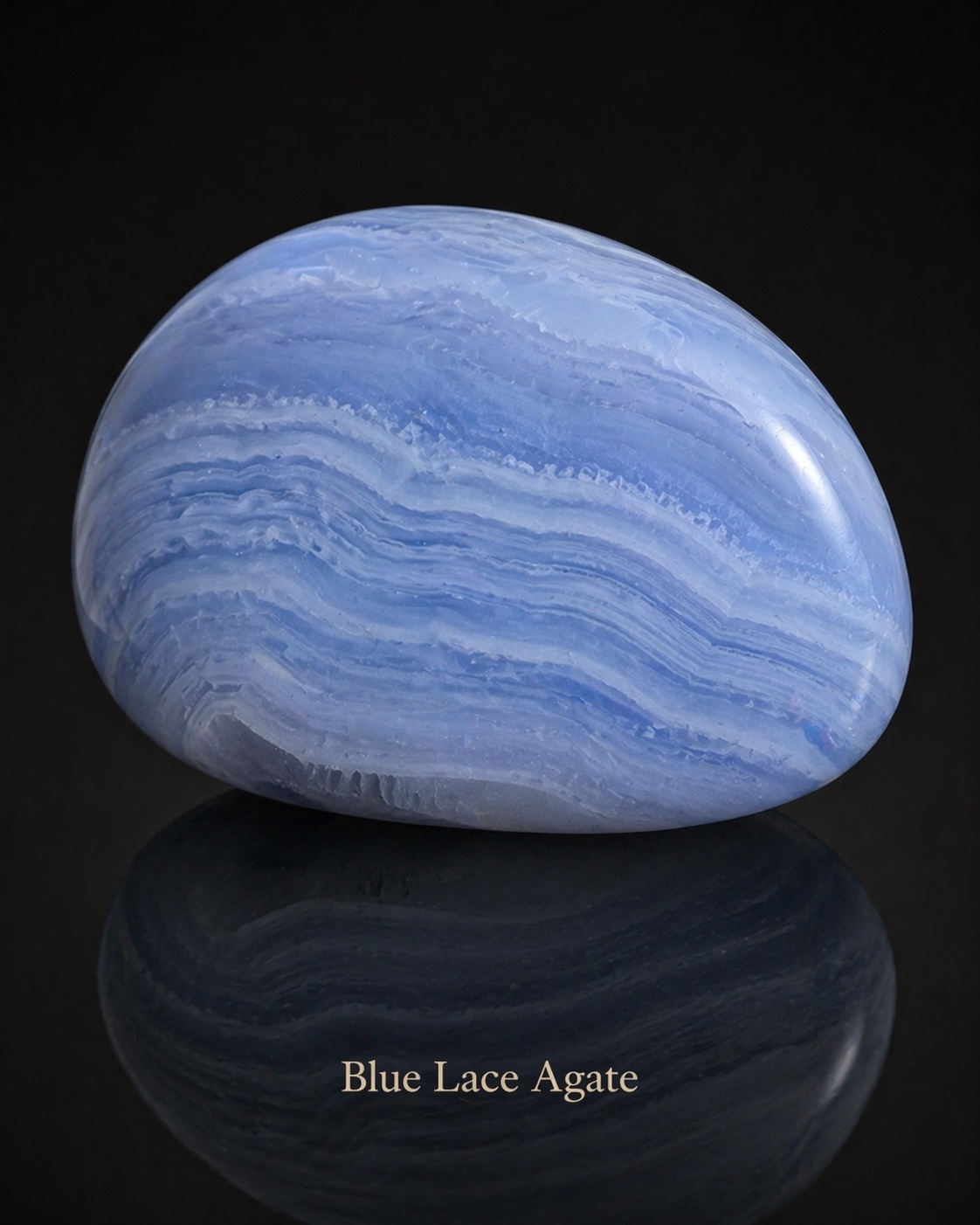
Blue Lace Agate asks for a different kind of attention. In the earlier, portrait-format reference, pale blue bands move across a polished form, interrupted by fine white edges and cloudy passages. The colour is restrained; the pattern supplies the movement. Against black, the stone appears both substantial and almost atmospheric, while its reflection repeats the shape in a darker register.
For Jabbi Delahaye’s developing collection, that relationship offers a way into the material. The image can suggest quietness, layered experience or the effort of finding a voice. Those are artistic possibilities, open to the viewer. The geological stone has its own account, and the two deserve to be brought into conversation with care.
Calm, communication and harmony: a second visual study
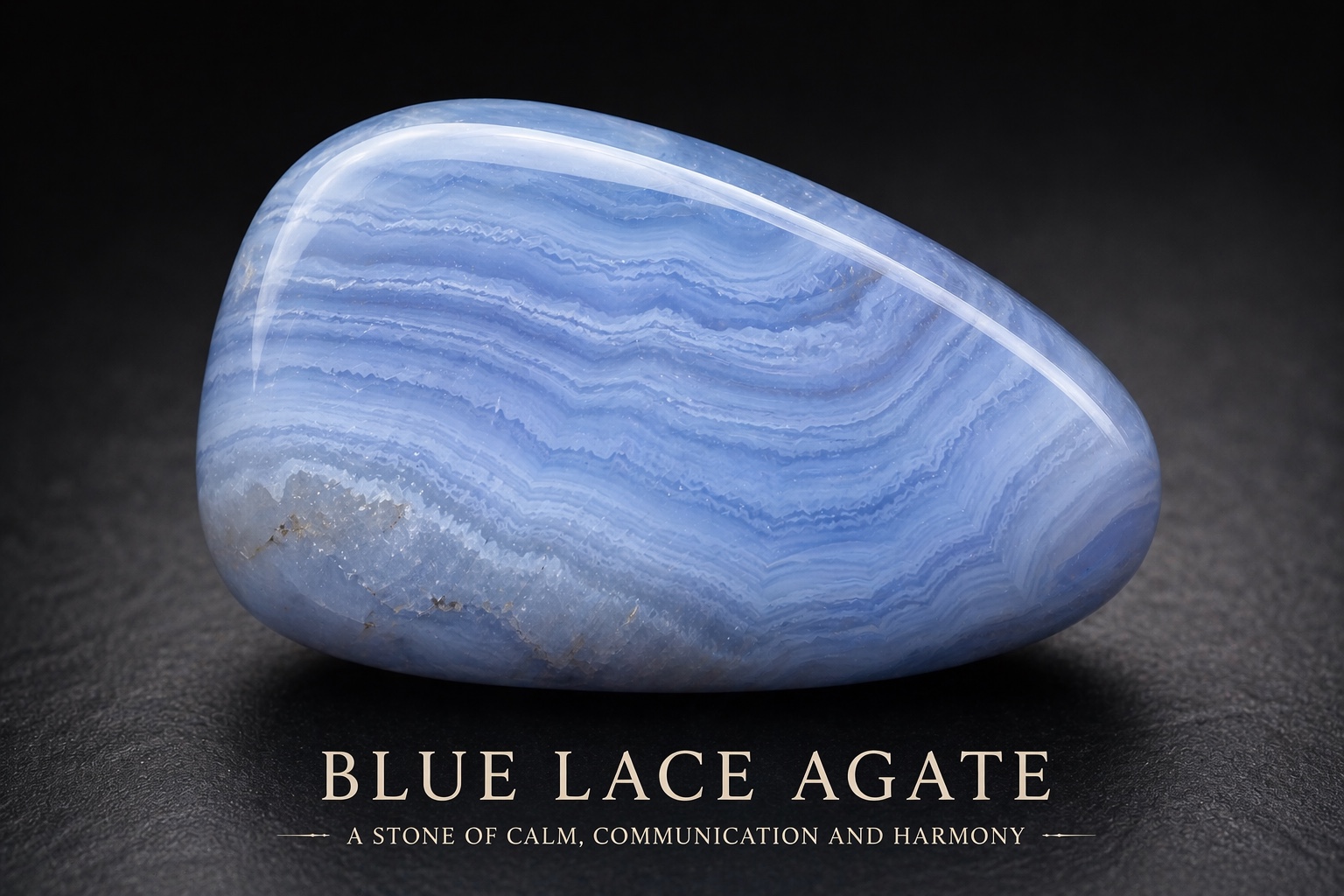
The newer landscape-format reference gives the stone a broad, grounded presence. Closely spaced pale blue and white bands flow across its face. A long white reflection follows the upper curve, while an irregular, lighter passage near the lower left interrupts the repeating pattern. The textured dark surface beneath it makes the rounded form feel settled in a space.
Its caption, “A stone of calm, communication and harmony,” proposes a direction for interpretation. Within this collection, those words can become questions for the artwork. How might a restrained colour support a quiet atmosphere? How could repeated bands echo the rhythm of a voice? Where does an interruption make a pattern more interesting?
Harmony need not mean perfect uniformity. Here the bands change width and direction, and the lighter passage introduces a different texture. An artist could use that relationship to suggest a conversation in which distinct voices remain visible. Calm could likewise emerge from the balance of the composition, rather than an absence of movement.
These are proposed artistic readings, not evidence that the mineral produces calm or improves communication. Seen alongside the earlier reflective image, the new reference shows how presentation changes emphasis: one suggests atmosphere through reflection, while the other makes layered pattern and physical presence more immediate.
A name for a pattern
Blue Lace Agate belongs to the chalcedony family: fine-grained silica, principally silicon dioxide, with a structure too small to resolve by ordinary looking. Agate is distinguished by banding. The name “blue lace” directs attention to the pale blue and white pattern rather than identifying a separate mineral species.
The Kansas Geological Survey gives agate a Mohs hardness of 6.5–7 and a specific gravity of 2.58–2.64. These are general agate reference values, useful for orientation rather than measurements of the pictured object. Scratch resistance supports its use in polished ornaments, but hardness does not make a carved piece immune to damage.
| Mineral family | Agate / chalcedony; fine-grained quartz |
|---|---|
| Principal composition | Silicon dioxide, SiO₂ |
| Visual character | Pale blue and white, with lace-like banding |
| General agate hardness | 6.5–7 on the Mohs scale |
| Documented locality | Ysterputs, southern Namibia |
| Image provenance | Supplied visual reference; no physical specimen locality established |
The fractures beneath the lace
A 2024 study in the Journal of African Earth Sciences describes the Ysterputs deposit in southern Namibia as a hydrothermal vein occurrence. Agate occupies a shear zone and related fractures within a Jurassic dolerite sill that intruded older marine sediments. This is a useful corrective to the familiar picture of every agate forming inside a rounded volcanic cavity.
The authors identified much of its chalcedony as the length-slow variety known as quartzine. They interpret this as indicating deposition in a saline environment, with the marine sediments a probable source. Associated minerals include dolomite, calcite, gypsum and quartz. The scientific account concerns studied material from that locality; it cannot establish the origin of an image from resemblance alone.
In the picture, the bands look like water crossing a landscape. That resemblance is compelling, but it is a visual reading rather than a reconstruction of the deposit. A pale stripe is not a dated horizon in a personal diary, nor can its width reveal a simple number of years. The artist’s interest begins with what such a pattern can evoke while respecting what research actually tells us.
A place behind the colour
The same study reports that the Ysterputs mine operated from 1962 and had been dormant since January 2017. That is a historical statement from the published research, not confirmation of its operating status today. The locality gives the material a specific geographical setting, rather than allowing “African stone” to stand in for a more precise account.
The University of Nebraska–Lincoln’s agate collection also records the changing names and geographical descriptions under which blue lace material appeared in twentieth-century publications and advertisements. Its entry associates the Namibian material with vein deposits at Ysterputs. Such records show why names on a label need to be examined alongside locality information.
A name can travel further than a stone. It can pass through a dealer’s catalogue, a workshop, a jewellery display and an artist’s reference collection, acquiring associations along the way. Blue banded chalcedony from another region should not automatically be treated as material from Ysterputs. For a work of art, geographical specificity can enrich the image even when the actual pictured specimen remains unidentified.
Looking closely at the supplied image
The strongest visual event here is not the highlight on the right. It is the long passage of bands through the middle, where blue and white change thickness and direction. Some boundaries are crisp; others seem to dissolve. The eye follows a line, loses it, and finds another nearby.
This is a useful compositional lesson. An artist need not give every detail equal emphasis. A quiet colour field can hold attention when it contains differences worth discovering. Pale passages may support a face, a garment or a vessel without competing with the work’s principal subject.
The reflection introduces another possibility. It repeats the stone but changes its visibility, turning luminous blue into a darker, less certain presence. Within a portrait or still life, a similar relationship could suggest something remembered, partially concealed or carried beneath the immediately visible surface. The meaning would depend on the whole artwork, including its figure, setting and light.
What craftsmanship reveals
A polished surface is a decision as well as a finish. The maker chooses an orientation, a shape and how much material to remove. In a banded stone, those choices affect which lines become prominent and how the pattern sits within the finished form. A cabochon—a rounded, polished stone—offers a particularly clear meeting of shape, colour and reflection.
The practical films below follow Blue Lace Agate through cabochon making and tumbling. They offer different views of transformation: one concentrates on shaping an individual form; the other records a longer sequence of abrasive stages. For an art viewer, their value lies partly in seeing how much attention a seemingly effortless surface can contain.
GIA’s account of the Dreher family provides a broader comparison. Their gemstone carving practice studies natural colour zoning and the possibilities of individual rough stones, sometimes over years. This is a lesson from the wider world of agate and gemstone carving, not evidence that every example in that tradition uses Blue Lace Agate.
Sacred meaning needs a context
Agate has a documented place in religious objects. The Metropolitan Museum of Art records an Egyptian agate Wedjat Eye Amulet from the New Kingdom, dated approximately 1550–1080 BCE. Its meaning came through the restored eye of Horus and beliefs concerning protection and regeneration.
That object belongs to the wider history of agate. The museum does not identify it as Blue Lace Agate, and it should not be used to invent an ancient tradition for this specifically named variety. The example instead shows how a material, a carved form and a cultural story can work together.
Within this collection, “sacred” therefore opens an enquiry. What makes an object worthy of attention? How does it hold memory? What changes when a mineral is imagined within a portrait, a ceremonial object or a space of reflection? An artist can explore these questions without presenting one symbolic reading as a property that every stone possesses.
A possible language for voice and continuity
For Jabbi’s artwork, the gentle blue palette offers a starting point for thinking about voice. A line can continue through interruption; one band can make room for another. These visual relationships might become a language for listening, measured expression or a presence that holds its place without overwhelming its surroundings.
There is also room for a less settled reading. The lines are not entirely smooth, and the cloudy areas resist a simple image of serenity. A work could use that tension to explore the difference between appearing composed and carrying a complicated inner life. The pattern would then contribute to the subject rather than merely decorating it.
Digital representation gives the artist freedom to place these qualities within a larger composition. That freedom also makes precision valuable: the represented material, the production process and any physical embellishment should be described separately. An image of mineral brilliance does not by itself establish that a print contains gemstones.
Following the pale line
Blue Lace Agate brings together a distinctive visual pattern, a researched Namibian deposit and the choices of people who cut, polish, name and interpret stones. Each layer contributes something different. Geology gives the material specificity; craftsmanship reveals decisions; cultural comparison opens questions about belief and human purpose.
The supplied image is the beginning of that encounter. Follow a white band across its surface, then look at the darker reflection beneath it. What remains continuous? What changes? Those small observations can carry a viewer from an attractive object towards a more attentive relationship with the artwork.
The films below extend the enquiry into movement and process. They invite the visitor to stay with the material, see how it is worked, and return to the image with more to notice.