Small red marks in a dark green world
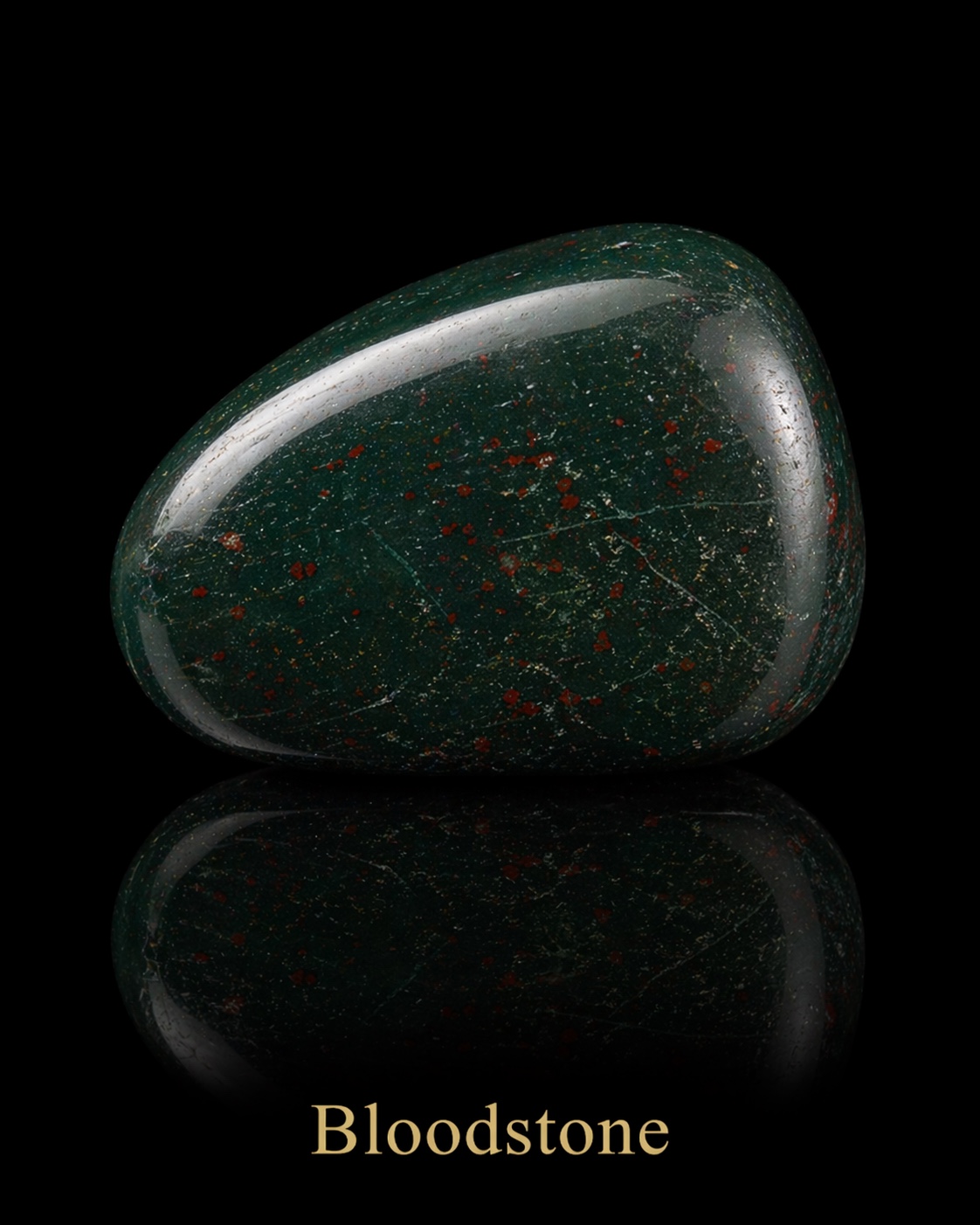
Bloodstone asks the eye to move between a deep field of green and scattered red interruptions. In the supplied image, the dark body almost joins the background. A broad white reflection follows its upper curve, while small red marks keep drawing attention back to the surface. Pale threads and flecks complicate what might otherwise appear to be a simple two-colour relationship.
The name already proposes a story. We see a mineral pattern, but the word “blood” brings the body into the encounter. Before we learn anything about the stone, colour has begun to suggest life, injury, sacrifice or persistence. For Jabbi Outside’s exploration of sacred materials, that meeting between observation and association makes Bloodstone particularly interesting.
Its meaning develops through several different kinds of knowledge: what the material is, how historical objects used it, and what a contemporary artwork might make of its appearance. Keeping those threads visible allows symbolism to become more precise.
The material beneath the name
GIA describes bloodstone, also called heliotrope, as chalcedony: quartz with crystals too small to distinguish individually by ordinary looking. Its familiar appearance is dark green, with red iron-oxide inclusions, especially hematite. It can range from partly translucent to opaque. Jasper is also used in descriptions of this material.
Those names help connect this study with agate and the wider quartz materials in the collection. They also remind us that a striking visual identity need not imply a separate mineral species. The red marks are part of the material’s appearance, rather than literal blood enclosed in stone.
The supplied reference gives us a rounded form, fine pale details and a reflective surface. It does not establish a specimen’s chemistry, treatment or origin. We can describe what is visible without turning every small red point into a confirmed mineral identification or every pale line into a known geological event.
From geological setting to a finished surface
Bloodstone occurs in cavities and fractures in other rocks and as riverbed pebbles. GIA identifies India as a major market source, with occurrences also in Brazil, Australia, China and the United States. This geographical range offers routes for further enquiry; it does not identify the source of the pictured reference.
A finished stone can compress an enormous journey into a small object. Its geological setting, recovery and preparation become difficult to read once the surface has been polished. An artwork can bring that distance into awareness by placing the apparent simplicity of the object beside the complexity of what remains unknown.
For this particular image, the contrast between material and presentation matters. The black setting makes the green subdued. The highlight supplies the strongest indication of the form’s curve. The red points appear intermittently, encouraging close attention. A different light or background would change their prominence, and therefore the story the image seems to tell.
The cutter’s choice: where should the red appear?
Bloodstone is commonly shaped into cabochons, although faceted examples exist. A rounded surface makes a useful setting for observing how a colour pattern travels across a form. In this reference, the red marks are dispersed rather than gathered into a single central motif.
That distribution presents an artistic question. Should a maker centre one strong red passage, place it near an edge, or allow small marks to remain scattered? Each choice could make a different image. A concentrated red area might suggest an event; a dispersed pattern might suggest traces, recurrence or a presence that cannot be reduced to one point.
The practical guidance is modest: GIA gives bloodstone a Mohs hardness of 6.5–7 and recommends gentle soapy cleaning, avoiding harsh chemicals and excessive heat. An artwork’s apparent durability should never be confused with an assessment of an actual object’s condition.
In digital practice, these decisions can be explored through simulated material and lighting. The artist still needs to decide which features carry meaning. More visible detail does not automatically produce a stronger work; sometimes a single restrained red accent can hold the composition together.
When a natural mark enters a sacred image
A British Museum cameo provides a direct example of pattern becoming iconography. Its catalogue describes Christ wearing the Crown of Thorns, carved in heliotrope, with the red markings used to indicate blood. Here the material participates in the representation: the maker gives existing colour a particular role within the subject.
This is more revealing than a general statement that bloodstone is “a sacred stone.” The object shows a specific relationship between a recognisable religious figure, a carving decision and a mineral pattern. The red mark becomes meaningful through its placement and the viewer’s knowledge of the scene.
The Metropolitan Museum of Art records an Italian pendant crucifix from the sixteenth century made with gold, crystal, heliotrope and enamel. Its listed materials establish another concrete place for the stone within Christian devotional objects. They do not, by themselves, explain every intention behind the maker’s selection.
For Jabbi’s practice, these examples suggest a method rather than a symbol to copy. A material can be chosen because some feature answers the subject: a colour, a fracture, a reflective passage or an interruption in an otherwise calm surface. The meaning emerges from the relationship constructed in the artwork.
Carrying belief into everyday objects
Bloodstone also appears in objects outside explicitly devotional imagery. The Met’s gold-mounted perfume bottle, dated to the 1760s and described as probably English, connects a portable luxury object with a material associated with protective and healing beliefs. The museum discusses those associations as historical ideas, not demonstrated effects of the stone.
That distinction leaves room to consider how an object can hold reassurance. Its significance may come from giving, carrying, remembering or repeating a small personal ritual. The cultural life of a material includes what people expected from it, even when those expectations cannot be treated as physical properties.
A George Dutens watch, catalogued by the Met as British and dated around 1740, combines bloodstone with gold and diamonds. A Dresden miniature clock from the first half of the eighteenth century brings heliotrope together with agate, gold and rose diamonds. These objects show the material entering the decorative arts of timekeeping.
They offer a different route into symbolism: the patterned stone beside measured time. For a contemporary artist, the contrast could become a question about what a clock records and what an object remembers. That proposed reading belongs to the present enquiry; it is not claimed as the original meaning of either museum object.
Embodied memory without a fixed instruction
In an artwork, Bloodstone could suggest the persistence of a small mark within a larger field. A red accent does not need to describe an injury to bring the body to mind. It might become a sign of warmth, vitality, vulnerability or something that survives beneath a composed exterior.
The green can also remain open. It could suggest a landscape, a held atmosphere or simply the depth against which another colour becomes visible. No universal colour dictionary can settle that relationship. Scale, placement, light and the subject surrounding the stone will shape its meaning.
This openness is especially valuable in portraiture. A mineral ornament need not announce what the person should signify. It can create a quieter connection: a detail close to the figure, a material presence that supports their individuality, or an accent whose significance remains partly private. The viewer is invited to attend rather than decode.
A pattern that becomes meaningful through attention
The reference’s dark reflection repeats the stone below, but with less certainty. Some colour remains; some is lost. Looking between the object and its reflection could become an enquiry into memory, where a recognisable form persists while particular details recede.
Bloodstone therefore brings more than a dramatic name to this collection. It offers a material pattern that has entered devotional carving, intimate possessions and elaborate decorative objects. Those histories give the contemporary artist useful points of contact without requiring one inherited meaning to govern every new work.
For Jabbi Outside, the opportunity lies in making that encounter specific. Let the green establish its atmosphere. Let the red retain its irregularity. Let the light reveal enough of the surface to invite attention. A stone’s symbolism becomes richer when it grows from what the artwork actually asks us to see.