A darkness that holds the light
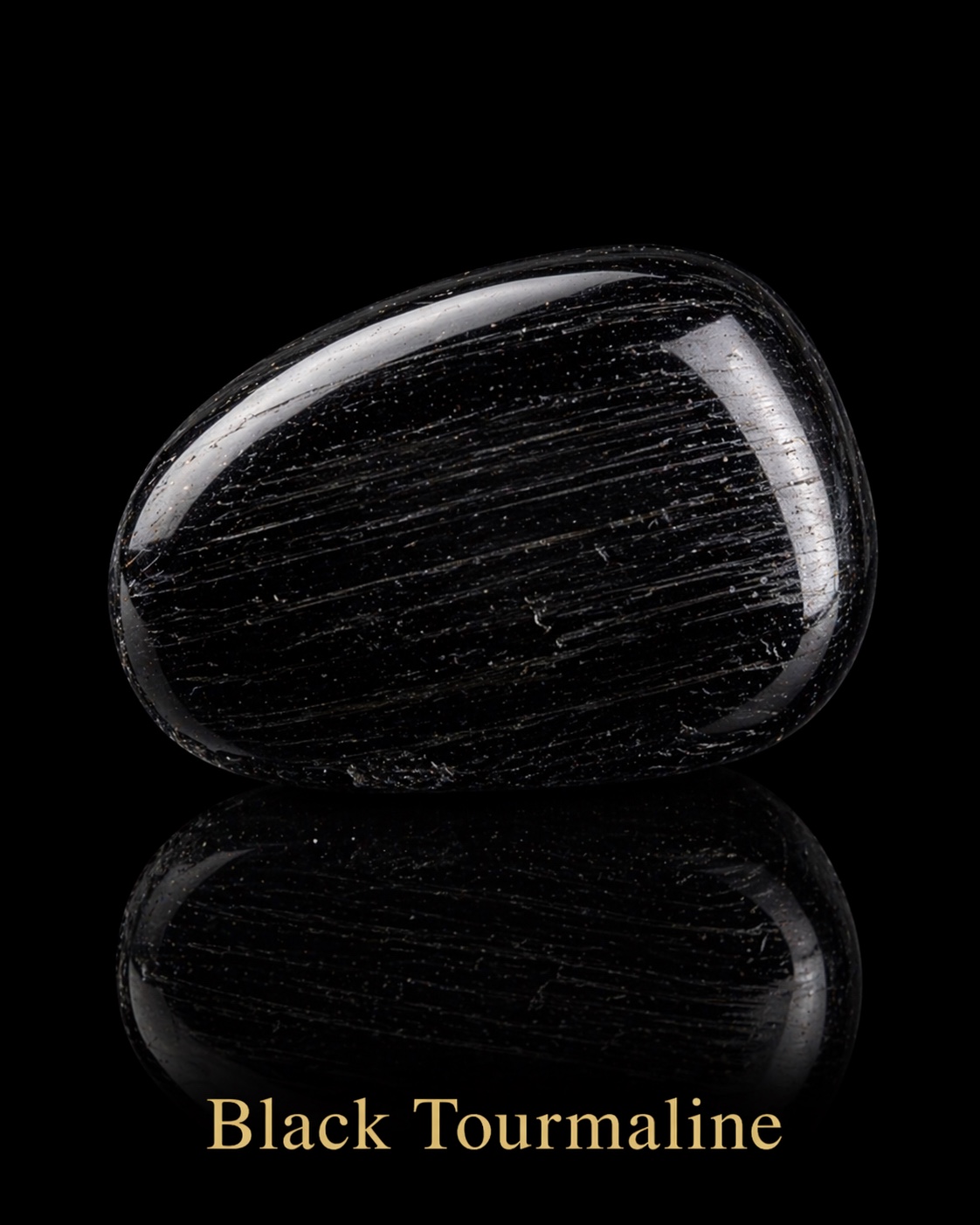
The first impression is of a stone almost disappearing into its surroundings. Black rests against black, and the reflected form below seems to deepen the space around it. Yet the surface refuses to vanish. A white arc follows the upper curve; another bright passage turns down the right side. Fine pale lines cross the dark body. The image becomes legible through these small interruptions.
For Jabbi Outside’s exploration of minerals in art, Black Tourmaline offers a different starting point from the coloured interiors of amethyst or aquamarine. Attention gathers at the surface. Its apparent solidity encourages a slower question: what can a dark material communicate when colour gives way to contour, texture and reflected light?
This study approaches that question through mineral knowledge, documented uses and possible artistic readings. The supplied image is a visual reference, rather than a laboratory identification or an account of where a particular stone was mined.
Black tourmaline and the name schorl
Tourmaline names a family of related minerals, rather than a single substance with one fixed composition. They share a crystal structure while differing in chemistry and physical properties. Boron is part of their complex silicate chemistry. Changes in the elements occupying that structure help explain why tourmaline encompasses such varied appearances.
Schorl is the typically black, iron-rich member familiar to many collectors. GIA describes it as occurring in a wide variety of rock types. “Black tourmaline” is a useful everyday description, but colour alone does not establish the precise mineral species: other members, including dravite and uvite, can also appear very dark. The label beneath this image tells us how the material is presented; it cannot replace analysis.
That distinction enriches an artwork’s interpretation. A name gives a viewer an entry point, while the actual material remains more complicated than its label. An artist can use that gap thoughtfully, allowing the stone to carry both a recognisable identity and the possibility of closer enquiry.
Growth, structure and the evidence of lines
Tourmaline belongs to a borosilicate mineral supergroup with trigonal crystal symmetry. GIA’s research describes tourmaline in metamorphic environments, including marble and schist; many examples from these settings belong to schorl or dravite. The family also has important associations with pegmatites. No single geological story should be assigned to every dark polished specimen.
A useful small-scale example appears in GIA’s examination of a schorl inclusion inside heliodor, a yellow variety of beryl. The researchers documented striations and triangular growth marks, then used analytical methods to investigate structure and composition. The tourmaline proved schorl dominant, with a significant component related to another member of the group. A seemingly simple black crystal held a more intricate chemical identity.
The pale lines visible in Jabbi’s reference can suggest growth, abrasion or accumulated marks to an artist. Their exact cause cannot be determined from this image. Keeping that uncertainty open allows the visual experience to remain specific without turning every mark into invented geological evidence.
From a landscape to a worked object
Tourmaline’s geographical history extends across many regions. GIA discusses sources including Brazil, the United States, Madagascar, Nigeria and Mozambique within the wider family. These are contexts for exploration, not a provenance claim for the pictured stone, and they do not all describe an identical black material.
One documented example is Maine’s Mount Mica, worked for tourmaline since the nineteenth century. A GIA study of renewed mining and material recovered in 2004 found mainly elbaite, alongside smaller amounts of schorl and other members. It provides a concrete reminder that a deposit can contain several tourmaline species. A mine’s name does not make every crystal from it chemically interchangeable.
For an art viewer, this movement from place to object matters. A finished surface often conceals the labour that brought it into view: finding a deposit, recovering material, assessing fractures, choosing an orientation and deciding what to retain. The rounded form in the reference invites us to imagine those decisions, without claiming to know its individual production history.
Polishing as an artistic decision
The bright reflections in this image make the shape readable. They travel across the dark body, describing the curve more clearly than an outline could. A polished surface becomes a meeting place between the object and its surroundings: the stone carries the light of the space in which it is seen.
In an artwork, that offers a practical compositional language. A narrow highlight might make a form feel guarded or remote; a broad reflection might open it to the viewer. Against a pale ground, the same black form would declare its silhouette more sharply. Against this dark ground, recognition arrives through small changes in brightness.
Working the material also requires restraint. GIA gives tourmaline a Mohs hardness of 7–7.5 and describes its toughness as fair. Hardness measures resistance to scratching; it does not make an object immune to fracture. The family’s care guidance favours warm soapy water and advises against ultrasonic and steam cleaning. These general recommendations should not be mistaken for a condition assessment of the supplied reference.
History without borrowed mythology
Tourmaline’s name is commonly traced to the Sinhalese word toramalli, associated with mixed gems. GIA relates its use to Dutch traders and waterworn gem pebbles from Sri Lanka. The word carries a history of naming and movement, rather than proof that every tourmaline colour once shared a single symbolic tradition.
For black schorl, GIA notes a documented use in mourning jewellery, despite its comparatively limited role as a gem material. This offers a credible connection between darkness, adornment and remembrance. It does not establish the meaning of every black tourmaline object, nor authorise a universal account of grief across cultures.
The wider family has other histories. Pink and red Californian tourmaline travelled to China for uses including snuff bottles. Those colour-specific examples should remain distinct from black schorl. Careful separation gives each material’s history greater definition, instead of gathering every tourmaline story beneath one convenient spiritual label.
Protection as a question for the artwork
Protection can be a powerful proposed meaning for Black Tourmaline in this collection. Here it can describe a boundary: the space a person keeps around themselves, the decision about what to reveal, or the quiet authority of a form that remains present without becoming transparent. This is an artistic interpretation, not a claim that the stone physically shields a viewer.
Such a reading could enter a portrait through a small dark ornament, a surrounding field or a carefully placed reflective passage. Its meaning would develop through its relationship with the figure. A stone close to the heart might suggest something privately held; one at the edge of the composition could mark a threshold. Placement makes symbolism particular.
The reflected stone below introduces another possibility. It resembles the visible object but loses definition as it enters darkness. That relationship could become a language for memory: what remains recognisable, what recedes, and what cannot be fully recovered. The interpretation begins with an actual feature of the image rather than an inherited list of supposed powers.
Giving darkness its own complexity
Black need not function as a simple opposite to illumination. In this reference, darkness makes the smallest marks consequential. It holds the highlight, gives the form weight and creates the conditions in which subtle differences become visible. The stone asks for attention rather than immediate disclosure.
Within Jabbi Outside’s growing collection, Black Tourmaline can therefore open an enquiry into boundaries, remembrance and material presence. Geological knowledge supplies precision; documented history offers context; the artwork makes space for a new interpretation. None needs to swallow the others.
The most interesting outcome may be a surface that keeps some of its mystery. We can recognise the curve, follow the lines and understand something of the mineral family, while leaving room for meanings that develop through looking. A dark stone becomes an active participant in the image: holding light, shaping attention and allowing the viewer to decide what its presence brings to mind.