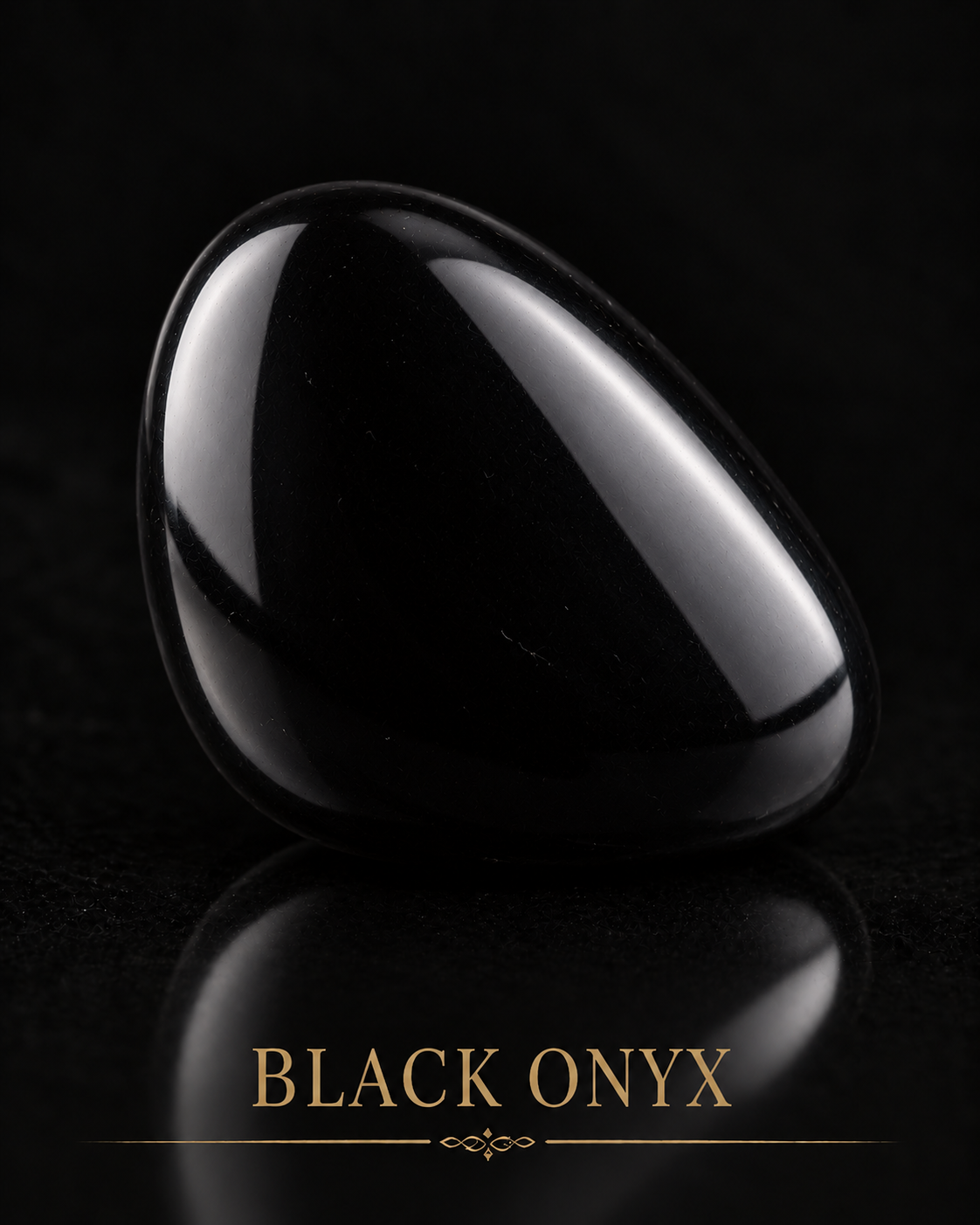
Black Onyx begins with a seeming simplicity: a dark polished stone, a rounded outline and two pale reflections. Yet that restrained appearance asks the viewer to look closely. Its surface separates from the black ground through small differences of tone, and the reflection below returns the form with less certainty. Darkness becomes something shaped and encountered.
Within this collection, Black Onyx opens an enquiry into contrast, composure and the relationship between an image and its ground. Its material history also asks a useful question: how much of what we admire in a gemstone has been brought into being through human decisions about colour, cutting and presentation?
What the name describes
GIA describes onyx as a variety of chalcedony, a microcrystalline or cryptocrystalline form of quartz. In the stricter material description, onyx has straight, parallel layers of different colours. The familiar uniform black stone sold as black onyx is often dyed chalcedony. GIA notes that natural black chalcedony is rare and that virtually all commercially encountered black chalcedony is treated.
The distinction matters because a name can join several different experiences: a layered material suited to carving, a uniform dark gem used in jewellery, and a colour achieved through treatment. A solid black appearance does not by itself identify the original material or explain how that colour was produced.
GIA’s discussion of imitation materials adds another role for black onyx: it can provide the backing layer for an assembled opal. In these objects, a thin layer of opal is supported beneath; a triplet also has a transparent dome above. The finished appearance depends on the relationship between materials, rather than on one isolated substance.
For an artist, that is an invitation to think about making honestly. Treatment and assembly belong to the story of an object. A visual simulation can explore the resulting appearance while explaining its own method. The image above is generated artwork, so no actual treatment, quarry or gem identity can be assigned to it.
A black surface made visible by light
The stone’s light passages do most of the descriptive work in this image. Their curves reveal the dome, while their changing width suggests the surface turning away. The central darkness gives those passages their force. A polished object can therefore be described with relatively few marks when their placement follows its form.
This offers a useful exercise for painting and digital image making. Begin with a black field and introduce a narrow tonal range. Separate the object from its surroundings through controlled differences rather than a bright outline everywhere. Let some edges remain quiet, and let the strongest reflection establish the point of attention.
The reflection beneath the stone creates a second rhythm. It echoes the highlight but softens the outline, extending the object into the ground. The viewer can move between a firm presence and an uncertain trace. As an artistic reading, that relationship could suggest memory: something recognisable persists, although its boundaries have begun to loosen.
Egypt in the Roman period: a carved image in layers
The Metropolitan Museum of Art holds a gold ring from Egypt, dated to the second century CE, with a nicolo intaglio of an ibis. The museum explains that nicolo is onyx agate cut so that a thin whitish-blue layer remains over a thicker black layer. This is a documented example of exploiting contrasting layers in a small worked gem.
The ring belongs to Egypt under Roman rule. Its significance for this study is specific: the material’s layered colour became part of an engraved image. It does not establish the history or meaning of every uniform black cabochon. That difference lets the historical example remain useful without making it carry a larger claim than the evidence supports.
For contemporary work, the thin pale layer over darkness suggests an image appearing at a boundary. The figure is encountered through a material arrangement, not simply placed on an unrelated background. This can inform a painted relief, a portrait ornament or a surface where colour and depth are developed together.
Portraiture, the Renaissance and the question of representation
The British Museum’s Waddesdon Bequest includes a ring with an onyx cameo of an African man. Its account dates the carving to around 1600–1700 and notes that the head was worked in the dark layer of the stone. The object brings onyx into the world of late Renaissance and Baroque jewellery.
For a practice concerned with who appears within inherited artistic traditions, this is a point of enquiry rather than a simple celebratory precedent. The presence of a Black figure in a luxury object raises questions about how a person was represented, who commissioned the image and how viewers understood it. The stone’s colour is a material fact; the sitter’s identity and agency require their own evidence.
A contemporary portrait can respond by making the person’s individuality central. An onyx ornament might establish a dark accent close to the body, but it should support the subject rather than stand in for an identity. The historical object prompts attentive looking and further research; it need not dictate the meaning of a new work.
Carving colour rather than applying it
Benedetto Pistrucci’s Venus Marina, Cupid at Her Side, held by the Met and dated around 1820–30, provides another example of onyx as a compositional material. The museum describes how the carver used different strata to articulate details of the shell, dolphins, drapery and reins. White and pale brown areas are worked against a black ground.
Although this object is later than the Renaissance, it extends the enquiry into inherited classical imagery and skilled material transformation. The colour is already present in the stone. Carving reveals and arranges it through depth. That relationship between subtraction and visibility differs from adding another layer of paint, while still offering a painter a way to think about surface.
In a digital reconstruction, an equivalent question might be: what lies beneath each visible passage, and what would happen if the surface were removed? Even when no actual carving occurs, imagining a layered material can make the form more coherent. Highlights, edges and motifs begin to belong to a shared physical logic.
From a solitary stone to a worn sequence
The Met also records a European necklace of black onyx dated to the nineteenth–twentieth century. Its catalogue gives the material and period without supplying a specific symbolic interpretation. It is a useful reminder that black onyx can form part of ordinary systems of adornment as well as elaborate carved images.
A necklace changes the scale of attention. Repeated dark elements create rhythm around the body. One stone can hold the eye; a sequence can establish movement. A contemporary composition might use that repetition to connect an ornament with a collar, a fold of cloth or the position of a shoulder.
No universal meaning needs to govern the black. In one portrait it might suggest composure; in another, intimacy or restraint. Those possibilities arise from the person, the placement and the surrounding colours. A dark accent gains meaning through the work it belongs to.
A restrained presence in the collection
Black Onyx adds a quieter register beside the saturated colours of Ruby and Emerald. Its image concentrates on outline, reflected light and the small changes that make a dark object perceptible. The historical examples extend that visual enquiry into engraving, cameo portraiture and jewellery worn close to the body.
Let the stone’s black retain variation. Let the gold title provide a measured warmth. Let the reflection remain softer than the object above it. Together, these choices make darkness available to attention without requiring it to announce a single fixed message.