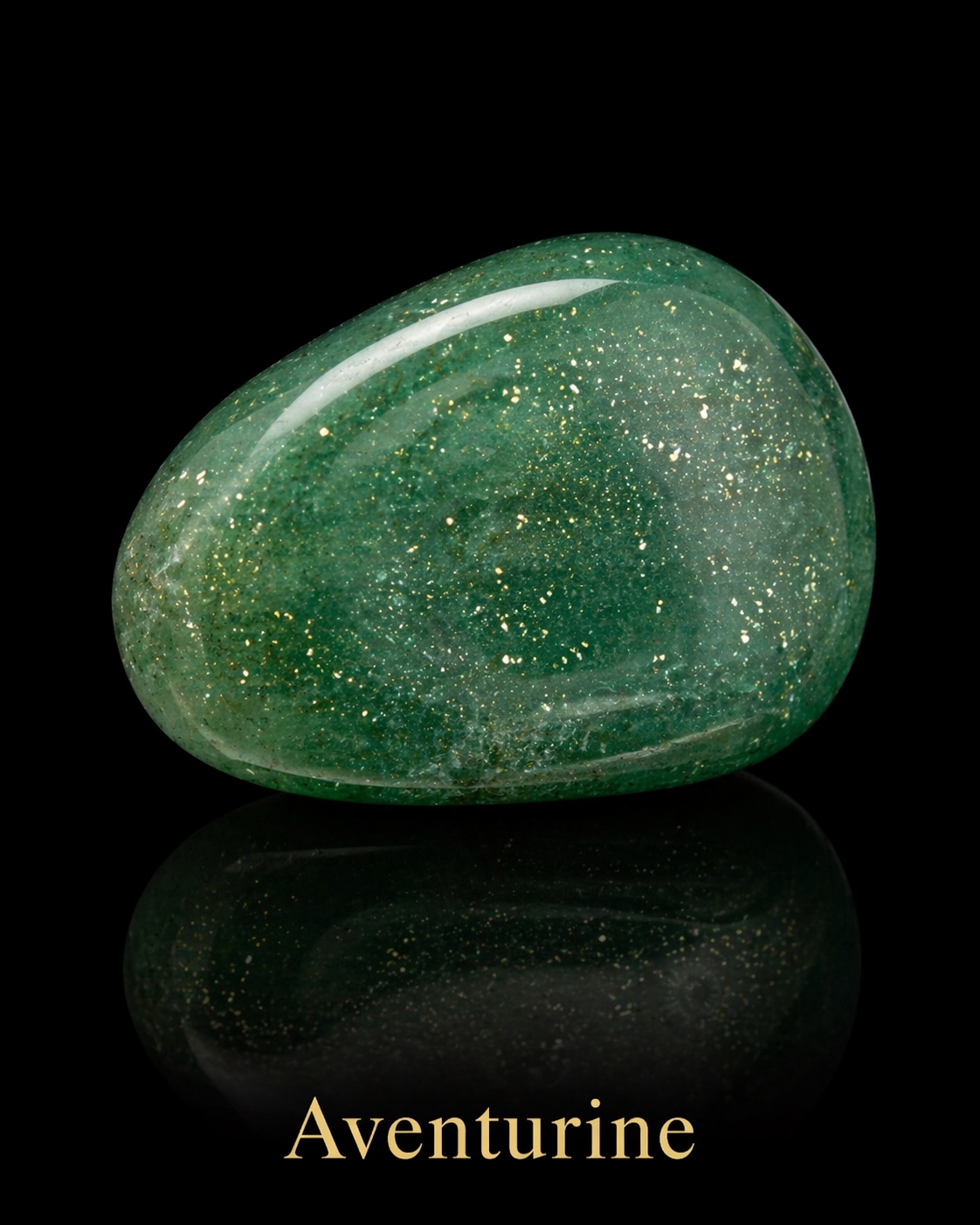
Aventurine changes the pace of looking. In the supplied image, green fills a rounded polished form, while small golden-looking points are scattered through it. A broad white reflection describes the upper curve. The darker reflection below retains some of the flecks but loses much of the green’s brightness. The eye moves between the whole shape and the small interruptions within it.
For Jabbi Delahaye’s developing collection, this offers a way to think about attention distributed across a surface. The image has no single flash that explains everything. Its interest accumulates through many small points. Those points can suggest possibility, quiet richness or the discovery of detail after an initial glance. These are artistic readings of this image, available for the visitor to explore.
What makes the glimmer
Aventurine quartz is a quartz-rich material whose mineral inclusions can create a glittering effect called aventurescence. GIA’s 2025 review describes the effect as reflections from small, discernible interfaces within a transparent or translucent material. Green aventurine commonly contains reflective fuchsite, a chromium-bearing mica. Its appeal depends on the relationship between the enclosing material, the inclusions and the light.
The effect is different from simply polishing a green surface. A polish can produce the broad highlight seen along an object’s curve; internal reflective inclusions produce another kind of visual event. Looking carefully means distinguishing the large surface reflection from the scattered smaller points. Both contribute to the appearance, but they do different work.
The flecks in the supplied image look golden under the represented lighting. That does not establish that they are gold or identify their composition. Nor does a still image show how a physical stone would respond when moved. The reference can be studied visually while its specimen identity, treatment and locality remain unverified.
A rock can carry more than one mineral
The name “aventurine quartz” should not imply a perfectly uniform quartz crystal. GIA describes the material in terms of quartzite containing glimmering mica. The presence of other minerals is central to its appearance. Inclusions that might be treated as interruptions in another gemstone can become the very quality that gives this material its character.
That relationship offers a useful prompt for artistic practice. A surface may gain interest through small differences in reflectivity, colour or density. Uniformity is one possible choice, but a dispersed pattern can reward a different kind of looking. The artist has to decide whether the small events should gather into a rhythm or remain irregular enough to keep the eye searching.
In Jabbi’s image, the green supplies continuity while the flecks provide variation. Removing either would change the encounter. Without the green, the points could become a decorative scatter. Without the flecks, the form would lose much of its particular visual language. Their relationship makes the subject more than a general green object.
A geographical account with limits
A 2005 GIA report records green quartzite, or aventurine quartz, in Brazil’s Precambrian terrains, with small deposits extending through parts of Minas Gerais, Bahia and Goiás. It describes quartz and fuchsite in variable proportions and proposes metamorphism of chromium-bearing sedimentary layers as a likely origin for the rocks discussed.
This is a regional geological account, not a universal formation story. It also does not identify the source of the subject represented here. A finished image cannot supply the evidence needed to trace an individual stone through extraction, trade and working. The distinction allows a place to enter the enquiry without becoming an invented provenance.
The first film below offers broader geological foundations. It helps visitors place a quartz-rich rock within the study of minerals and rock types. The selection does not claim to document an aventurine mine. For this material, the sourced geological text carries the specific regional evidence, while the films deepen understanding of working and interpretation.
A name shared with glass
Aventurine also belongs to the history of glassmaking. The mineral’s name is associated with Italian language about chance and with sparkling aventurine glass, often called goldstone. Similar appearance does not make the glass and the natural quartz-rich material identical. Their reflective features have different material histories.
Corning Museum of Glass’s research summary of Ingeborg Krueger’s study discusses letters written by Philipp Hainhofer in the early seventeenth century. A 1614 letter describes a new artificial stone with golden-looking stars inside, identified by the scholar as aventurine glass. The account includes a maker’s claim that the glass had been produced by chance.
This is a more useful historical foothold than an unqualified tale of an accidental discovery. It gives the story a document, a date and an interpretation. It also leaves room to recognise that a claim of chance may itself become part of how a crafted material is presented. The history invites questions about invention, skill and the stories attached to attractive surfaces.
Worked objects give meaning a setting
The University of Michigan Museum of Art holds an aventurine quartz snuff bottle catalogued as Chinese, circa 1912–1949. The record lists quartz and soapstone and identifies the object as a small worked container. Its material belongs to an object with a particular function and cultural setting, rather than a free-floating list of symbolic associations.
That example opens a careful route into cultural meaning. It establishes the use of aventurine in a documented object. It does not establish that all aventurine has the same significance, or that this polished reference carries the bottle’s associations. The form, purpose and circumstances of an object help determine what its material can mean.
For Jabbi’s collection, this approach can make research more productive. A visitor can move from the supplied image towards a real object and notice how different working choices organise the same named material. A container asks the hand to hold it and the eye to inspect its scale; a large image can turn a small mineral surface into an environment.
Carving with material character
GIA’s study of the Dreher family provides another documented artistic example. Gerd Dreher’s 1979 sculpture “Love Birds” combines aventurine quartz with black agate, yellow jasper and obsidian, arranged above a petrified-wood base. The material appears within a composition built from several stones, each contributing a different visual quality.
The example shows how a gemstone’s role can extend beyond an isolated display of polish. A material can become part of a bird, an accent or a relationship between forms. The accompanying Patrick Dreher lecture expands that craft context across several materials. It is a wider exploration of carving heritage, rather than a film devoted solely to aventurine.
In a digital artwork, similar decisions occur through placement, proportion and visual emphasis. A green passage might support a figure’s surroundings; small points of reflected light might connect it with a garment or architectural detail. The question is how the material’s appearance participates in the whole work.
Polishing as a sequence of decisions
The green aventurine tumbling film follows the material through successive working stages. It offers a maker’s practical account of how a rough surface becomes a finished one. A separate cabochon demonstration introduces deliberate shaping, using agate or jasper as a broader comparison. These approaches help make the polished appearance intelligible as a process.
For an artist, the distinction between shaping and surface finish is especially useful. The outline determines the object’s presence; the finish changes its encounter with light. A calm contour can coexist with an active interior. Jabbi’s supplied image uses that relationship: the smooth edge contains many scattered points without needing a complicated outer silhouette.
Research also reminds us that appearances can be misleading. A 2014 laboratory report published by GIA identified a polymer-impregnated aventurine quartz bangle that had been mistaken for jadeite. This is a specific documented case, not a claim that aventurine is routinely treated. It demonstrates why visual resemblance alone cannot settle material identity.
Possibility without a promised outcome
The language of chance can stimulate an artwork without turning the stone into a promise of luck. In this image, the scattered flecks suggest possibilities arriving unevenly across a continuous field. A viewer might read them as moments of attention, small discoveries or points that remain visible inside darkness.
Those interpretations arise through composition and looking. They are not demonstrated powers of a physical stone. Within the Sacred Minerals and Gemstones collection, the enquiry can remain open to spiritual and personal responses while keeping documented history distinct from contemporary interpretation.
Aventurine contributes a language of distributed light. Its research connects glimmer with structure and its craft histories connect material with deliberate work. Returning to the image after those encounters allows the small points to become more than decoration: they become something to notice, compare and think with.