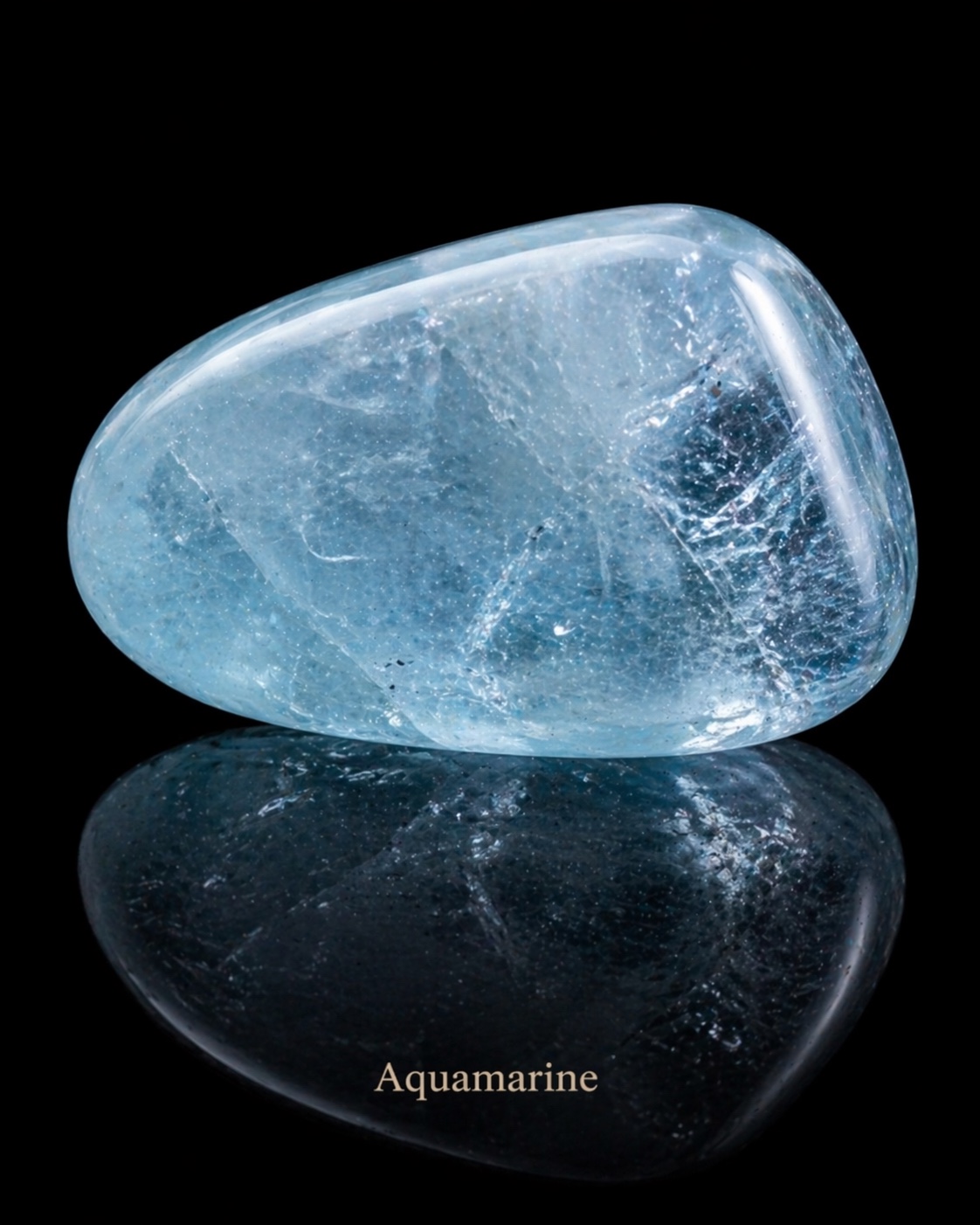
Aquamarine opens the collection towards a different kind of light. The supplied image shows a pale blue polished form against black. White highlights travel along its curved edges, while fine intersecting lines and cloudy passages interrupt the interior. The reflection below is darker and heavier. Above it, the stone seems almost suspended between solidity and atmosphere.
For Jabbi Delahaye’s developing mineral studies, this offers an invitation to think about seeing through a surface. Transparency can suggest openness, yet the image does not surrender all its detail at once. Looking into it requires time. Its visual interest lies in the relationship between apparent clarity and the small interruptions that make the interior complicated.
A blue variety of beryl
Aquamarine is the green-blue to blue variety of beryl. It belongs to a different mineral family from the quartz varieties in the Amethyst and Ametrine studies. GIA describes its colour as commonly a light pastel greenish blue, and notes that heat treatment is often used to give it a bluer appearance. Colour alone cannot establish whether a particular stone has been treated.
The distinction between mineral identity and visual resemblance matters here. Pale blue does not make this image another version of Blue Lace Agate. The materials have different structures and histories, even when their colours enter a similar range. Comparing the studies gives a viewer a way to notice how a banded pattern, a cloudy interior and a more transparent passage produce different experiences.
The supplied image is a visual reference. Its label identifies the intended subject, but the image alone cannot authenticate a physical specimen or establish its origin. In an art collection, that limit need not prevent an informed enquiry. The documented mineral and the pictured representation can be placed in conversation without pretending that one proves everything about the other.
What a cavity can hold
The Smithsonian’s account of the Dom Pedro Aquamarine connects this celebrated Brazilian crystal with a pegmatite deposit. It explains how water-rich portions of cooling magma can concentrate elements that do not readily enter other forming minerals. Large crystals can develop, and cavities may contain crystals of beryl. Iron contributes to aquamarine’s blue and greenish colours.
This is a geological account of a particular kind of setting, rather than an explanation inferred from the supplied photograph. It gives the viewer something more substantial than a general claim that a gem is ancient. It connects colour and crystal growth with a material environment, while leaving the pictured object’s own growth history unknown.
For artistic practice, the cavity offers a useful analogy: an enclosed space becomes the site of a visible development. A painting can similarly make a recess active through a cool colour, a bright edge or a partly concealed form. The analogy serves the artwork’s composition. It does not turn human feeling into a geological process or assign a fixed message to the mineral.
A geography beyond the sea
Aquamarine’s colour and name may draw attention towards water, but its sources lead into mines and mountains. GIA identifies Minas Gerais in Brazil as a longstanding producing region, including hard-rock and weathered pegmatite deposits. It also describes aquamarine deposits in Pakistan’s Karakoram region and records sources in several African countries and the United States.
Those locations give the material a geographical range. They do not determine where the subject of this image came from. A pale blue polished form on a dark background contains no reliable map of its extraction. Any claim of specimen provenance would need additional evidence beyond the photograph.
The Brazilian documentary below follows a dealer into Minas Gerais, including an aquamarine mine and a newly uncovered pocket. It brings the journey towards a gem into view through terrain, people and working practices. Watching it can change the significance of a polished surface: the finished appearance becomes the outcome of discovery and decisions, rather than the whole story.
The name carries a sea
GIA traces “aquamarine” to Latin words meaning water and of the sea. Its birthstone account records mariners’ beliefs that the gem could calm waves and help keep sailors safe. These belong to the history of the stone’s associations. They are not evidence that a gemstone alters weather or provides protection at sea.
That distinction lets an artist work with the imagery of water more precisely. Aquamarine can suggest a voyage, a horizon or the desire for safe passage because those ideas arise from colour, language and recorded lore. A contemporary artwork can develop them as an interpretation rather than presenting them as powers inherent in the object.
The sea is not necessarily peaceful in an image. It can also suggest distance, uncertainty or movement between places. A pale blue mineral beside a figure might introduce the thought of a journey; placed within a darker composition, it might become an opening towards an unseen space. Meaning develops through placement and relationship. The colour is a starting point, not a complete explanation.
When a gemstone becomes sculpture
The Dom Pedro Aquamarine offers a documented example of material transformed through artistic judgement. The Smithsonian’s collection entry identifies a large aquamarine from Minas Gerais, fashioned by Bernd Munsteiner into an obelisk. Cuts on the back reflect light so that the sculpture appears to glow from within. The object demonstrates how carving can organise an encounter with light.
The museum’s account also notes that naturally formed hollow tubes were retained near the base. Their presence allows part of the crystal’s growth history to remain within the finished work. This is a valuable example for a practice concerned with material character: refinement can include deciding which irregularities deserve to stay.
The supplied image has a different form and purpose. Its rounded polish is not the Dom Pedro’s sculptural design. Looking at both nevertheless opens a useful comparison. A surface can be shaped to calm the outline, reveal an interior or redirect attention towards a particular passage. The material becomes an active participant in the design.
Clarity has more than one use
In this image, pale blue and fine white lines share the same interior. Some areas look open; others seem crowded with small marks. The viewer moves between them. That rhythm may be more interesting for an artwork than a uniformly clear surface would be, because it offers more than one pace of looking.
A painter could echo the curved highlight in a fabric fold, allow a cool blue passage to soften a surrounding shadow, or repeat a small interior line at another scale. These decisions would connect the gemstone with the composition around it. Its inclusion would then be structural, shaping the image’s movement and relationships.
The cutting demonstration provides another route into that thinking. Michael Sackos works with a cushion design, making choices about the relationship between rough material and finished facets. The lesson for a wider art practice lies in watching decisions become visible: a change of angle or surface can alter where light gathers and how a form is read.
A reflection with a different weight
The dark reflection beneath the supplied stone gives the image a second presence. Its recognisable shape returns, but some of the apparent lightness disappears. The upper form invites the eye inward; the reflection keeps attention closer to the black surface. They occupy the same arrangement while offering different visual experiences.
Read artistically, this relationship could suggest memory, an echo or the difference between an experience and its recollection. Another viewer might simply enjoy the balance of luminosity and darkness. Both responses can remain available. The essay proposes possibilities rather than claiming an intention that Jabbi has already stated.
Within the Sacred Minerals and Gemstones collection, “sacred” can hold that openness. It invites attention to the relationships people develop with materials, including inherited beliefs and contemporary uses. It does not require a claim that every mineral has one universal spiritual meaning. The image, research and viewer can meet without closing the enquiry.
Care and continued attention
GIA gives aquamarine a Mohs hardness of 7.5–8, while advising protection against scratches and hard knocks. Warm soapy water is a safe cleaning method for a physical stone. Fractures, liquid inclusions or filling can affect which other cleaning methods are suitable. Its care should be based on the actual object’s condition, not on the apparent clarity of a photograph.
Aquamarine adds a language of pale light, interrupted transparency and distance to this collection. Its geology grounds the enquiry; sea-related lore supplies a recorded cultural association; sculptural examples show what skilled hands can make visible. Returning to the image after those encounters gives the visitor more to notice, while preserving the pleasure of looking without a prescribed answer.