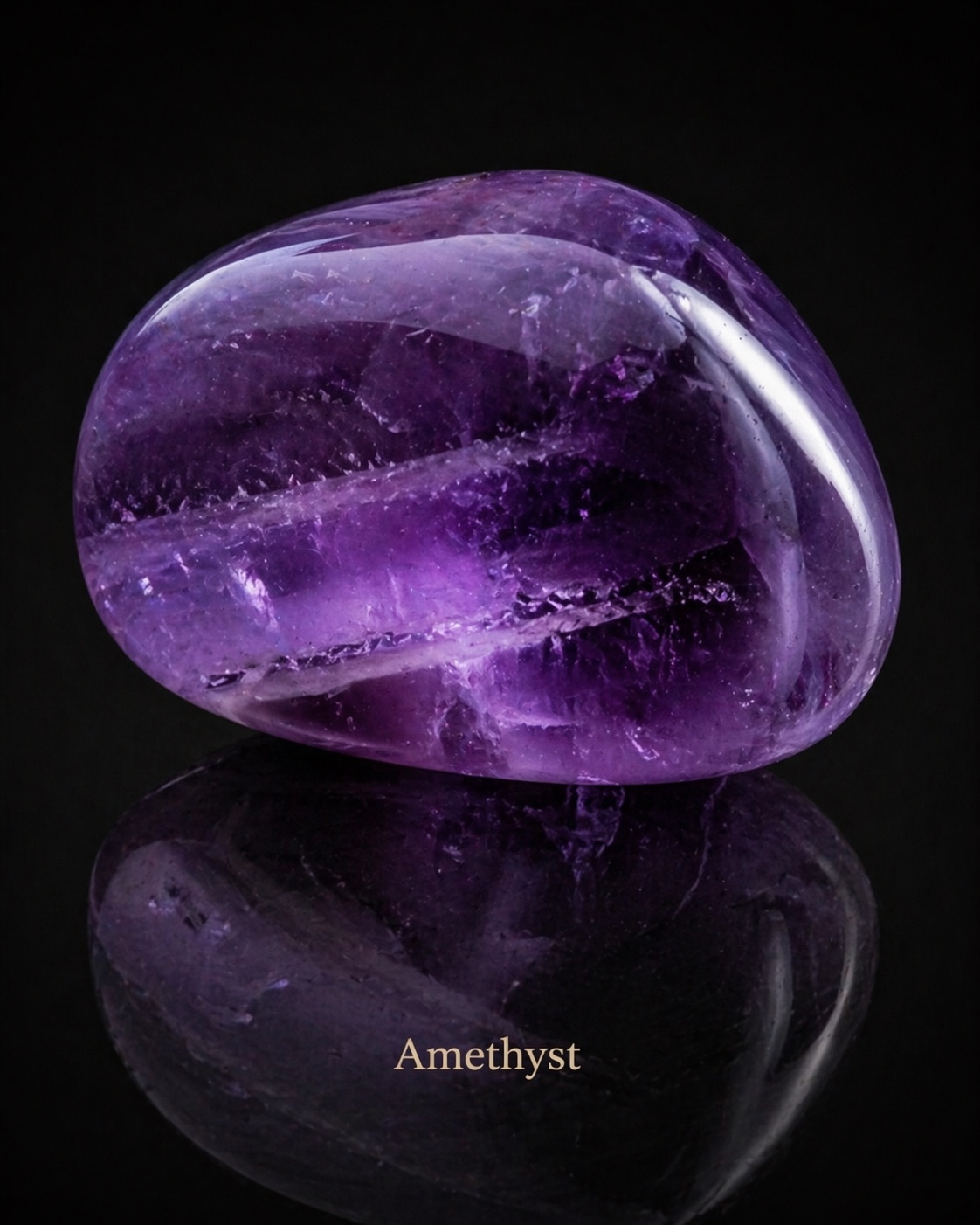
Amethyst brings a different atmosphere to the collection. In the supplied image, purple moves between near-black depth and pale lavender. Light catches the curved surface in a bright arc, while cloudy passages cross the interior. The polished outline is calm; the inside remains complicated. Below it, a dark reflection repeats the form without revealing everything again.
That tension gives the image its interest. It invites the eye to enter, then interrupts the journey. For Jabbi Delahaye’s developing exploration of minerals, it offers a way to consider the relationship between outward composure and inward experience. The stone can become a visual companion to questions about memory, concentration and what remains partly hidden.
Purple, with many registers
Amethyst is the purple variety of quartz. GIA describes a range extending from cool violet to warmer reddish purple, with lighter and darker zones sometimes visible within a crystal. The name identifies a material variety, but does not promise a single shade or a uniform appearance. A pale stone and a deeply coloured one can both belong to the same family.
In this image, colour does much of the work that line performs in the agate studies. Dense purple establishes weight; lighter areas open breathing spaces. Some passages resemble folds or veils. These are observations about the image, rather than a mineralogical diagnosis of every mark. A photograph cannot establish the object’s origin, treatments or internal structure with certainty.
For an artist, that distinction leaves room for attentive looking. One can study the visual effect before trying to name every feature. Where does the eye pause? Which passage appears closest? Does the bright surface reflection strengthen the sense of depth, or briefly pull attention back to the outside? Such questions turn an attractive reference into a resource for composition.
A crystal has a setting
Amethyst can occur inside cavities in volcanic rock. Recent research on the Los Catalanes deposits in Uruguay makes this familiar description more specific. Scientists studied geodes hosted by basalt associated with Gondwana’s breakup around 134 million years ago. Their evidence indicated crystal formation at approximately 15–60°C, involving fluids resembling low-salinity groundwater.
Those findings concern a particular region. The age of the host lava does not automatically give the age of every crystal inside it, and the measured conditions should not be applied to all amethyst deposits. The study is valuable precisely because it replaces a general picture with evidence from a place. It asks how water, cavities and changing geological conditions worked together.
Thinking about a cavity gives an artist an unusual starting point: something absent becomes the site where something visible develops. In an artwork, an empty space can similarly become active through colour, reflected light or repeated marks. This is an analogy for making and looking. It allows geological research to stimulate form without turning a painting into a literal diagram.
Place, labour and movement
Before a gemstone reaches a studio or collection, people have found it, removed it, selected it and moved it. Ancient Egypt offers a documented amethyst history through the Wadi el-Hudi expedition. Archaeologist Kate Liszka’s work examines expeditions into the Eastern Desert about four thousand years ago, connecting the acquisition of amethyst with royal jewellery and with surviving archaeological evidence.
Settlements and inscriptions help bring the human organisation of that activity into view. A finished ornament may occupy very little space, yet its making can involve travel, provisioning, administration and skilled work. The archaeology encourages us to look beyond the jewel to the people and arrangements that made it available.
For this collection, that perspective changes the meaning of a beautiful surface. Beauty is also something transported and worked upon. A contemporary image can hold that awareness through a caption, a carefully chosen film or a compositional suggestion of distance. It need not invent a biography for the pictured stone. Its actual locality is unknown, and historical context should remain clearly identified as context.
The hand changes what light can do
A crystal, a rounded polished stone and a faceted gem give the viewer different experiences. GIA’s quality guidance describes how cutting and colour placement affect amethyst’s appearance. Transparent material may be faceted, while attractive material with visible inclusions can be used for beads or cabochons. Cutters also create unusual forms and imaginative arrangements of facets.
Gem-market preferences often favour strong colour and a clean appearance. An artist may find value in qualities that a commercial grading discussion treats differently. A cloudy passage can supply rhythm; uneven colour can introduce a second focus. These are different questions of purpose. The accompanying image does not provide a basis for assigning a grade or a price.
The cutting demonstration below is useful because it makes artistic choice tangible. A cutter decides where a surface will meet another surface and how light will travel through the resulting form. A painter works with related decisions in another medium: sharp and soft edges, luminous passages and interruptions, the balance between clarity and ambiguity. Watching a process can sharpen those decisions more effectively than reading a list of symbolic associations.
Inherited meanings, carefully held
GIA’s history account connects amethyst with Greek and Roman stories about wine and intoxication, including Dionysus and Bacchus. It also records its place in religious jewellery and royal regalia. The belief that the stone could preserve sobriety belongs to the history of its meanings; it is not evidence that wearing amethyst produces that effect.
Such histories make clarity a possible theme for an artwork, but they do not give the material one universal message. A royal ornament, a religious ring and a contemporary polished reference occupy different circumstances. Their meanings depend on who uses them, where they appear and what practices surround them. The word “sacred” therefore opens an enquiry into relationships rather than assigning a fixed power to a mineral.
Jabbi’s collection can allow those inherited associations to remain visible while developing its own visual language. Purple might suggest concentration in one composition and theatrical richness in another. An amethyst placed beside a face may draw attention towards inward thought; the same form enlarged against darkness may become almost landscape-like. These are proposed readings, available for viewers to accept, question or extend.
An interior that resists complete disclosure
The supplied image is particularly suited to this open approach. Its most striking quality may be the way light makes the interior partly accessible. The brightest areas do not explain the whole object. They reveal a passage, then give way to denser colour. The viewer has to move between what can be seen clearly and what remains unresolved.
That movement could become a compositional principle. A larger artwork might repeat the curved highlight as a quiet line elsewhere, echo the pale internal passage in fabric, or use a deep purple interval to slow the gaze. The mineral would then participate in the structure of the image. Its presence would have a purpose beyond ornament.
The reflection introduces another possibility. It offers repetition with a change of visibility, a darker version of the same form. Read artistically, this could suggest recollection: a recognisable shape returning under different conditions. That interpretation arises from this particular image and its arrangement. It is not a claim about an ancient amethyst tradition or an intention already stated by the artist.
Keeping material and image in conversation
If a physical amethyst is used as a studio reference, its care matters. GIA gives it a Mohs hardness of seven, while noting that impacts and abrupt temperature changes can still cause damage. Prolonged intense light can fade some colour. Warm soapy water is a straightforward cleaning option; steam cleaning is not recommended. A digital image or a fine-art print requires care suited to its own medium.
Returning to the image after research should give the visitor more to notice: a relationship between colour and depth, the work behind a polish, and a history extending beyond the finished object. It should also leave room for looking without a prescribed answer. Amethyst can support a rich artistic language because the material, the histories and the viewer’s response meet without becoming identical.