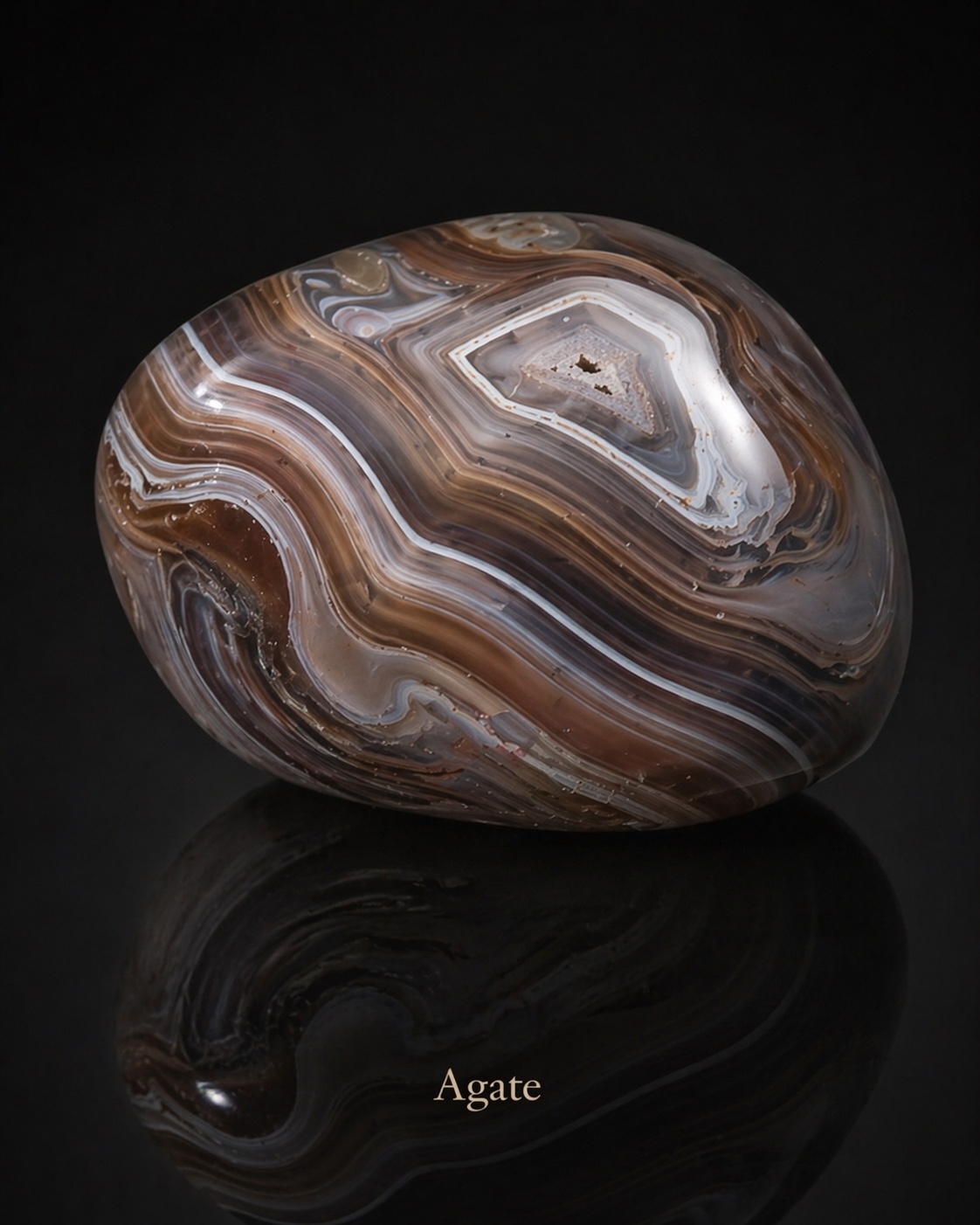
Agate is a banded variety of chalcedony, a fine-grained form of quartz composed principally of silicon dioxide (SiO₂). Its contrasting layers of colour and translucency distinguish it from more uniform varieties of chalcedony. It can be approached as a geological material, a medium for skilled craftsmanship and an object to which people have attached religious or personal significance.
Agate occurs worldwide. The Smithsonian identifies Brazil as its major commercial source. Southern Brazil also has an important place in the history of the European gemstone trade: supplies from near the Uruguayan border helped sustain the carving industry of Idar-Oberstein in Germany when its local deposits were approaching depletion during the nineteenth century. Documented occurrences elsewhere include Chihuahua in Mexico and glacially transported stones in Kansas in the United States. A place where agate is found is not necessarily an active mining centre.
Its mineral properties help explain why it can be shaped into polished objects. The Kansas Geological Survey gives agate a hardness of 6.5–7 on the Mohs scale and a specific gravity of 2.58–2.64. Hardness concerns resistance to scratching; it does not mean that a stone cannot chip or break. Its commonly translucent appearance and waxy lustre are further useful characteristics.
This article brings that material knowledge into conversation with historical objects and contemporary artistic interpretation. As part of Jabbi Delahaye’s Sacred Minerals and Gemstones collection, it explores how agate can contribute depth to digitally simulated artwork. Documented cultural beliefs are considered in their particular settings, while ideas about memory, identity and continuity are offered as possible readings of the artwork.
| Composition | Principally silicon dioxide, SiO₂ |
|---|---|
| Mineral character | Banded chalcedony; fine-grained quartz |
| Mohs hardness | 6.5–7 |
| Specific gravity | 2.58–2.64 |
| Transparency | Commonly translucent |
| Lustre | Typically waxy |
The structure beneath the surface
Agate is a banded variety of chalcedony: a silica material composed of exceptionally small crystals, mainly quartz, often intergrown with another form of silica called mogánite. Its apparently continuous surface contains structures far finer than the eye can resolve. Differences in microscopic structure, inclusions and porosity contribute to the variations in darkness and transparency that make its bands visible. Iron and manganese compounds can contribute stronger colours.
Agates commonly develop in cavities within volcanic rocks, although other geological settings also occur. Their formation remains an active subject of scientific investigation. A band cannot simply be read as one year, one event or one measurable chapter in the stone’s life.
This leaves a useful space between knowledge and imagination. The patterns are evidence of material processes, but their resemblance to rivers, contours or folds belongs to the viewer’s interpretation. A geological explanation can sharpen that experience. Looking at a broad brown ribbon becomes more absorbing when one knows that its appearance depends partly on arrangements too small to see.
The image accompanying this essay explores those visual qualities through an AI-refined representation. It offers a close view of simulated banding and polish, without establishing the origin, age or composition of a particular physical specimen.
An eye carved for protection
A small object in the Metropolitan Museum of Art makes the spiritual history tangible. Its agate Wedjat Eye Amulet, dated to Egypt’s New Kingdom, approximately 1550–1080 BCE, measures just over two centimetres in length. The carved form represents the restored eye of Horus. In Egyptian mythology, the eye was damaged or taken by Seth and restored by Thoth. The wedjat became associated with regeneration and protection, and amulets in this form were used for both the living and the dead.
The scale matters. An object small enough to wear could carry a religious story much larger than its dimensions. In this example, agate became the material through which a sacred image took physical form.
The museum’s account establishes beliefs associated with the eye-shaped amulet. It does not establish that every agate possessed a universal protective quality. Keeping that distinction allows the object to retain its cultural specificity: a particular material, shaped into a particular symbol, within a particular religious world.
For an artist, that relationship is fertile ground. A mineral’s contribution to meaning can depend on where it appears, what surrounds it and how a viewer encounters it. A stone within a portrait may carry a different significance from the same material imagined in a vessel or an architectural setting.
When the stone supplies the palette
Agate’s connection with image-making becomes especially clear in cameo carving. A cameo is carved in relief, with the figure raised above its background. In layered hardstones such as agate, a maker can use contrasting bands to distinguish parts of the image. Natural variations become part of the design.
The Met describes an extraordinary late-sixteenth-century example by Alessandro Masnago. Working with a piece of variegated agate only three inches high, he created a shepherdess and her flock in a moonlit landscape, with a city in the distance. The material’s layers helped the artist build a scene within the stone.
It is a remarkable way to think about authorship. The maker brings an intention, but the material already has differences and limits. A colour cannot be placed anywhere at will; the artist must study what is available and decide what it can become.
This suggests a connection with digital simulation. When an artist represents agate, attention to its bands can shape the composition from the beginning. A pale area might guide the placement of light; a dark passage might draw attention towards a face or create distance. The simulated material can participate in the structure of the work.
Luxury through attention and craft
The Gemological Institute of America’s study of the Dreher family offers a modern example of this attentiveness. Gerd Dreher carved a lily from a single piece of Brazilian agate in 2005. The work uses the stone’s natural colour zoning and includes carefully worked curled petals, with gold and diamond accents. GIA describes a practice in which the carvers may study a rough stone for years before deciding how to develop it.
The wider Idar-Oberstein tradition adds another dimension to the word “precious”. The region’s agate mining and cutting history extends over five centuries. In earlier workshops, river water powered large grinding wheels. The finished object therefore carried the work of bodies, tools and inherited knowledge as well as the qualities of the mineral. That history gives a viewer something concrete to consider when admiring a polished surface.
The history of these objects offers a richer understanding of luxury than brightness alone. A finely worked stone asks the viewer to notice selection, proportion and the relationship between a design and its material. The accomplishment becomes visible through close looking.
For the pictured agate, that attention might begin with the narrow pale bands, their changes of direction, or the small interruption near the upper centre. Its restrained palette allows these details to carry the image. The surface can hold interest without demanding that every part become equally vivid.
In a contemporary artwork, this restraint could support a sense of quiet richness. The viewer discovers detail gradually. The mineral’s role becomes more persuasive when its pattern contributes to the work’s emotional and visual rhythm.
Agate as a language for memory
For Jabbi’s developing exploration, agate offers a possible vocabulary of layered identity, continuity and change. A band can suggest something carried forward. A break can evoke interruption. A line returning around another form can bring remembrance to mind.
These possibilities leave the interpretation open. One viewer may recognise a landscape; another may think of movement through water, or the folds of a body. The image need not impose one answer. Its depth can emerge through the encounter between material reference, artistic intention and the viewer’s experience.
The proposed interactive approach extends that encounter. A visitor could select an agate detail within an artwork, read a short explanation, then follow it to this longer account. The visual experience would lead into material knowledge and cultural history, giving curiosity somewhere to go.
Looking beyond the polished surface
Agate rewards a slower encounter. Its bands offer visual complexity; the objects made from it reveal how people have connected matter with belief, identity and imagination. An Egyptian eye amulet, a Renaissance cameo and a modern carved lily each show a different relationship between a material and a human purpose.
For contemporary art, those histories offer possibilities rather than a fixed code to repeat. A simulated stone can invite reflection on memory or continuity while acknowledging where its historical references come from. The artist chooses the relationship; the viewer helps complete it.
Follow one pale line across the image again. Notice where it widens, where it bends and where it becomes difficult to distinguish from the next. That small act of attention is a fitting beginning for this collection: looking closely enough for a beautiful surface to open into a deeper story.