DIGITAL BRONZE · MY STUDY OF CRAFTSMANSHIP
The Keeper of Living Memory
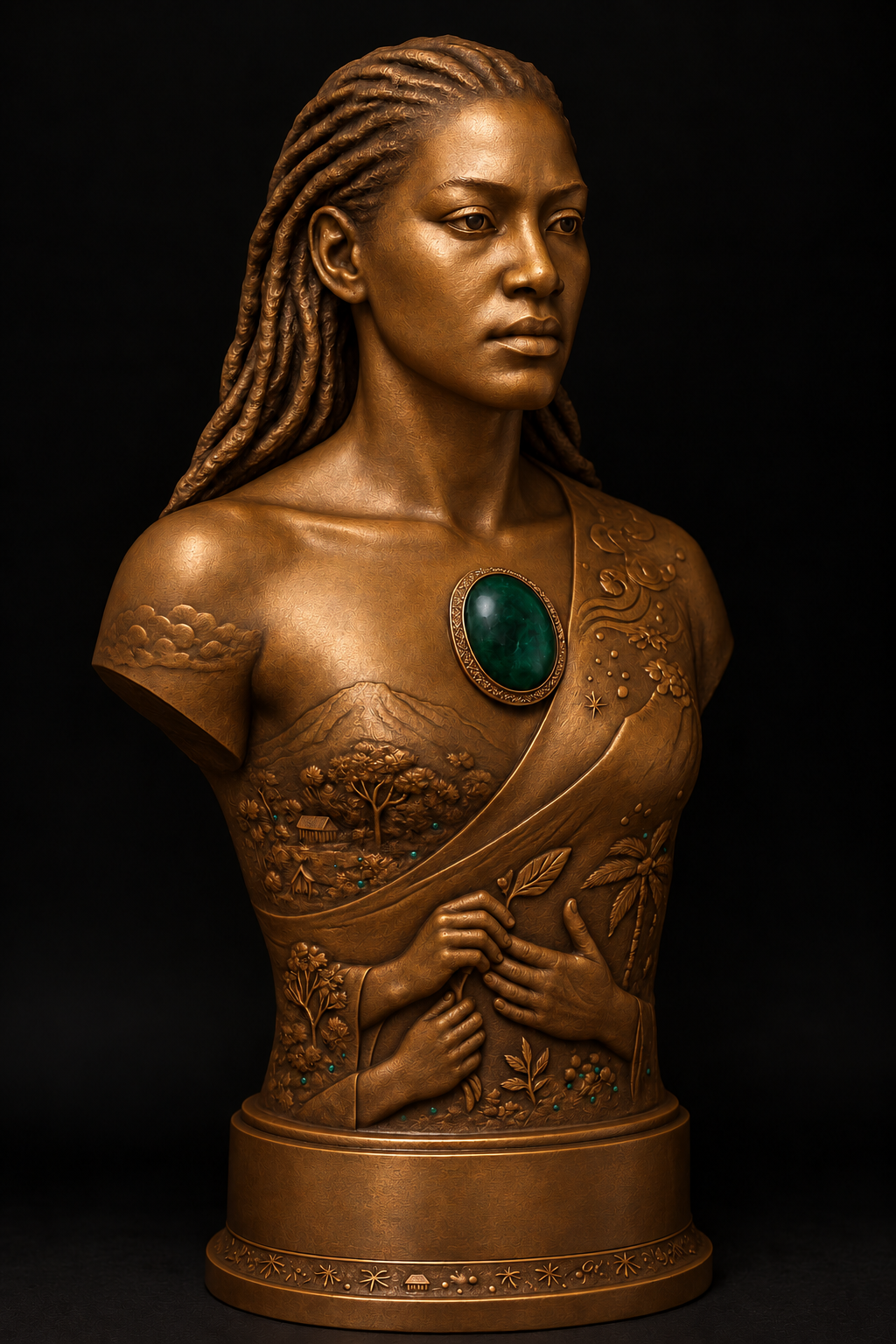
I imagined her as a guardian of the stories, places and knowledge we carry forward through care. Her calm gaze, along with the hands and landscape within her form, suggest a memory that’s alive, rooted and growing still. In this digital work, I tried to carry what I've been learning about bronze craftsmanship into a form that speaks in my own medium.
Understanding Before Creating
My journey into bronze craftsmanship and the first work in my digital bronze collection
This statue is the first work in a digital bronze collection I am developing for Jabbi Outside. It begins with an approach I want to carry through the series: understanding before creating. I wanted to look beyond the bronze colour and study the craftsmanship, histories and artistic decisions that give a sculpture its presence.
I tried to bring the lessons from this study into the work. I wanted the face to have composure, the hands to make sense and the relief to reward a closer look. I wanted the surface to suggest decisions about material, rather than a finish spread indiscriminately across the image. The aim was to let what I was learning influence what I was making.
My statue is a digitally created artwork that simulates bronze. I have not cast it in a foundry. The journey I am describing is one of study, visual experimentation and refinement. Looking at physical bronze work gives me a more demanding standard against which to develop the image, while reminding me of the skills that its appearance alone cannot reproduce.
Learning to look beyond the bronze colour
In the versions we worked through, the surface sometimes became too insistent. Repeated swirls competed with the face. Bright reflections drew attention away from the sculpted form. Adding complexity did not always make the statue more convincing.
I began to concentrate on relationships: smoother areas against textured ones, raised edges against darker recesses, and the green centrepiece against the warm metal. I wanted the detail to belong to the figure. That led me towards the history of how craftspeople have handled these same visual questions in real materials.
Even the word bronze needs care. Conventionally, bronze is an alloy of copper and tin, while brass combines copper with zinc. Historical compositions vary, and the word bronze has often been applied broadly to copper-alloy sculpture. I cannot establish an alloy from colour alone. In my artwork, bronze describes the material I am simulating.
Egypt and the presence of devotional sculpture
Egypt gives me an important African starting point for this enquiry. Bronze and other copper-alloy figures belonged to religious practice, as well as to the history of making. The Metropolitan Museum of Art records that statuettes of Osiris were abundant temple offerings by the first millennium BCE. One example in its collection dates to Egypt's Late Period, 664–332 BCE.
The figure stands in a close-fitting garment, holding the crook and flail. Its pose and attributes identify the deity. What I take from this example is the power of a controlled figure: a sculpture does not need a dramatic movement to establish a strong presence.
This is a visual lesson for my own work, rather than a claim that my statue belongs to Egyptian religious tradition. I am interested in how stillness can hold attention. The composed face of my figure needs to remain clear even when the torso carries a dense landscape of plants, dwellings and hands.
Studying these works also helps me think about the purposes of sculpture. An object now encountered in a museum may originally have been offered, handled or placed within a sacred setting. Its meaning cannot be understood entirely through the quality of its surface.
China and a different route to precision
Chinese bronzes widen my understanding of what technical mastery can mean. During the Shang dynasty, approximately 1600–1046 BCE, and the Zhou dynasty, 1046–256 BCE, bronze ritual vessels played an important role in ceremonial life. Their intricate surfaces were produced through a casting tradition that differed from lost-wax casting.
In piece-mould casting, a clay mould was taken from a model and divided into sections. After firing, those sections were reassembled; an internal core provided the cavity of a vessel. Decoration could be worked directly into the mould's inner surface, helping craftspeople achieve sharply defined patterns.
I find this significant because it changes the story of refinement. There is no single technique that explains every great bronze. A workshop could develop extraordinary control through a method adapted to its own objects and requirements.
For my statue, the lesson is about the organisation of detail. I want a branch to remain distinct from the ground behind it and a fold to have an intelligible edge. Chinese ritual vessels offer an example of precision serving an entire surface. I can study that achievement without treating their motifs as interchangeable decoration for my own image.
West Africa and the intelligence of the portrait
Ife brings me closer to the human figure. The Metropolitan Museum's account of African lost-wax casting discusses naturalistic heads associated with Ife and the hollow-cast Tada figure, dated to the late thirteenth or early fourteenth century. The latter was made through several separate pourings, showing the technical demands involved in achieving a coherent body.
Across West African traditions, lost-wax work required expertise in both clay and metal, including careful management of heating and cooling. This craftsmanship was established centuries before Portuguese contact along the coast. It deserves to be understood through the artists and societies that developed it.
What I want to study in the Ife tradition is the relationship between anatomical clarity and composure. A face can be finely described and still remain quiet. The proportions must work together; realism is not simply a matter of accumulating small marks.
That observation returns me to my own figure's eyes, mouth and neck. Each refinement needs to protect the expression that first made the image compelling. A sharper surface is of little value if it changes the character of the face.
Benin and the craft of a meaningful surface
The Benin Bronzes are central to this study. They come from the historical Kingdom of Benin in what is now Nigeria, rather than the present-day Republic of Benin. The familiar name includes many works made of brass.
Benin's court artists created cast plaques, commemorative heads and other works connected with royal and ceremonial life. The Met attributes its Plaque with Warrior and Attendants, dated around 1540–70, to the brass-casting guild. In that relief, differences in the size of the figures communicate rank; regalia and surrounding details help explain the subject's position.
I take from this the possibility of a surface that carries relationships. Ornament can tell us how a figure belongs within a world. The landscape across my statue's torso is intended to work in that way: the hands, plants and dwellings should contribute to the encounter with the woman, rather than compete to be noticed individually.
Admiring Benin craftsmanship also requires acknowledging the circumstances of its dispersal. British forces invaded Benin City in 1897 and plundered the palace. Many works were subsequently distributed through museums and the art market. I cannot separate the study of their artistry from that history of removal.
My statue is not a reconstruction of a Benin work. I am studying the strength of its relief tradition and the importance of recognising the makers behind it. That distinction matters when a digital image can bring visual references together so easily.
South India and a body shaped by gesture
The Chola-period bronzes of Tamil Nadu add another important reference. Southern Indian craftspeople used lost-wax casting to make devotional figures, including sculptures carried in ritual processions. The Walters Art Museum's late tenth-century Krishna preserves an example of this tradition and describes the detailed wax-resin modelling that preceded casting.
Shiva as Nataraja, Lord of the Dance, offers a different kind of presence from my still figure. The familiar form developed under the Cholas: an animated body, extended limbs and a surrounding ring of fire bring gesture and religious meaning together.
I am interested in the coherence of that movement. Even a complex figure needs its limbs and hands to read as parts of a whole. My own statue uses a much quieter arrangement, but the hands remain consequential. Their contact must be clear enough for the viewer to understand the gesture before searching for its meaning.
Here again, study does not give me a licence to detach sacred symbols from their context. It gives me a reason to look more carefully at the relationship between bodily form and what that form communicates.
The Renaissance and the ambition of the workshop
The Renaissance is especially relevant to my artistic interests. It brought a renewed engagement with classical sculpture alongside demanding new commissions. Bronze had continued to be used during the medieval period; Renaissance artists developed its possibilities within particular workshops, patronage systems and artistic ambitions.
Donatello is a valuable reference for my study of surfaces. His bronze Reliquary Bust of San Rossore, made around 1422–25, was chased, gilded and silvered. The V&A also describes how he used partial gilding and inlay in the Miracle of the Mule relief to distinguish intricate background architecture from darker bronze.
These examples help me understand finishing as part of the composition. A brighter passage can clarify a relationship or direct attention. It need not cover the whole object. In my statue, restrained highlights on the face and raised relief serve a similar visual aim, although I am simulating those effects digitally.
Lorenzo Ghiberti's Gates of Paradise, made for the Florence Baptistery between 1425 and 1452, provide another powerful example. Their gilded bronze narrative panels combine different depths of relief. Some figures project strongly; others barely rise from the surface. These changes create pictorial space within metal.
That is directly relevant to the landscape on my statue. I want the larger forms to establish the structure, while smaller features invite closer attention. If every detail appears equally raised or equally bright, the surface loses its sense of depth.
The scale of Ghiberti's undertaking also reminds me to look beyond the name of an individual master. Such work required a workshop. Donatello likewise worked with assistants and specialist founders. The artistic achievement includes the knowledge brought together to realise it.
What refinement means across centuries
I am beginning to understand refinement as a series of specific achievements. It may mean preserving a finer detail, controlling the thickness of a casting, bringing separately cast parts together, or giving a surface the finish appropriate to its purpose. Different traditions excelled at different problems.
The history should therefore resist a simple climb from crude early objects to sophisticated later ones. Ancient and medieval craftspeople achieved remarkable results. Later tools and materials changed what could be attempted, but chronology alone does not tell me how carefully an object was conceived or made.
A contemporary lost-wax process, such as that described by sculptor Hamish Mackie, may use a silicone mould, a wax version and a ceramic investment. After casting, sections can be joined and chased before patination. Modern resources support the work, while the responsibility to preserve the intended form remains.
That is the part of craftsmanship I want to carry into my digital process: looking again, identifying what has become unclear and making a correction that improves the whole figure.
Returning to the hands and the bronze finish
The hands were one of the clearest tests of the image. Their symbolism depended on believable fingers, joints and overlap. We refined their separation because an ambiguous contact interrupted the sense of a carefully made object.
The finish needed a similar discipline. I wanted quieter surfaces on the face and chest, stronger shadows within the relief, and gentle polishing on the raised edges. The green centrepiece needed a softer reflection so that its suggested internal depth could be seen. I have not identified it as a particular gemstone; it is a simulated polished stone within the artwork.
Patination gives me an important physical reference for these decisions. Getty's demonstration by Andrew Lacey shows how successive treatments build different colours on a bronze relief, and how wax applied at the end changes its appearance. The final surface is the result of choices, rather than an inevitable colour of the metal.
My digital adjustments do not reproduce those chemical processes. They study the visual relationships the processes can produce. Keeping that clear allows me to be ambitious about the image without claiming a craft experience I have not undertaken.
The first work in a continuing collection
I removed the lettering from the base because I wanted the figure to carry the encounter. Her expression, the reaching hands and the landscape should have room to work without an inscription directing every reading. The artwork remains untitled.
Looking across these histories gives me a richer understanding of the image I am developing. Egyptian devotional figures prompt me to consider stillness and purpose. Chinese casting shows me another route to precision. Ife and Benin deepen my attention to the portrait and the meaningful surface. Chola sculpture sharpens my awareness of gesture. Renaissance workshops bring finishing, relief and collective expertise into focus.
These are references for study, each with its own history. I do not want to turn them into a single decorative vocabulary or suggest that my statue inherits all their meanings. I want them to make my looking more attentive.
This first statue brings that enquiry into one image. I tried to apply what I learned through the composure of the face, the clarity of the hands, the depth of the relief and the restraint of the finish. The work is an attempt to give those lessons a visible form, while remaining honest about the digital medium in which I am working.
As I develop the bronze collection for the site, I want each new piece to continue that relationship between understanding and creating. I return to the face, check the hands, follow the drapery and examine the way the light rests on the bronze. Each pass asks whether the parts belong together. The collection begins here, with a figure shaped by study and a practice of looking that I intend to keep developing.
Sources and further reading
- Egypt. The Metropolitan Museum of Art — Statuette of Osiris, 664–332 BCE. Devotional figures and their religious setting.
- China. The Metropolitan Museum of Art — Shang and Zhou Dynasties: The Bronze Age of China. Ritual vessels and piece-mould casting.
- West African sculpture. The Metropolitan Museum of Art — African Lost-Wax Casting, Alice Apley; and Plaque with Warrior and Attendants. Ife, casting expertise, Benin court artists and the 1897 invasion.
- South India. The Walters Art Museum — Krishna, late tenth century; and The Metropolitan Museum of Art — Shiva as Lord of Dance, late eleventh century. Chola sculpture, lost-wax casting and devotional gesture.
- Renaissance and finishing. V&A — Donatello: a master at work; The Metropolitan Museum of Art — The Gates of Paradise; V&A — Sculpture techniques; Hamish Mackie — The bronze casting process; and Getty — Chemical patination, Video 14. Workshop practice, alloy distinctions, relief, chasing and patination.
Ten videos — Studying bronze across time and place
This viewing collection follows the subjects of my study: casting, Egypt, China, Ife, Benin, South India, the Renaissance, contemporary foundry work and finishing. It combines a specialist lecture with shorter museum films and demonstrations. These are educational references for my digital work; none documents the manufacture of this sculpture.
1. The casting process — Lost-wax bronze casting
V&A; featuring Andrew Lacey. Begin with the stages that turn a wax model into metal. The preparation before the pour provides a foundation for the different traditions explored below.
Watch the V&A film on Andrew Lacey's site · Museum context
2. Egypt — A New Look at Old Bronzes: Some Technological Observations on Votive Coffins for Animal Mummies
Museo Egizio · specialist lecture, 18 May 2021. This extends the article's discussion of Egyptian devotional figures into the technical study of bronze votive containers for animal mummies. It offers another way to examine how religious purpose and metalworking meet; it is not a film specifically about Osiris statues.
Watch the lecture · Museum project and lecture reference
3. China — Casting Bronze Vessels: The Piece-mold Process
Asian Art Museum, San Francisco · silent animation. A model of a Shang bronze rhinoceros makes the arrangement of mould sections visible. This helps explain the alternative to lost-wax casting discussed in the article and encourages attention to how a mould shapes surface detail. The film has no audio.
Watch on the museum's education site
4. Ife — Kingdom of Ife: Ife uncovered
The British Museum; with John Picton and Paul Craddock. A discussion of the sculptures' meaning and making, including hollow lost-wax casting. It connects the article's interest in a face's calm presence with the practical decisions that make cast portraiture possible.
Watch the British Museum film · Video and transcript
5. Benin — Lost Wax Brass Casting, Benin City, 2003, 2006
Hosted by the Art Institute of Chicago; footage credited to Kunsthistorisches Museum, with camera work by Agbonifo Osemweri and Barbara Plankensteiner. Footage of the casting process brings the article's discussion of Benin's brass-casting guild into a working context. Notice the detailed wax model, clay mould and the removal of the casing after casting. The title correctly identifies brass rather than assuming every work called a Benin Bronze has the same alloy.
Watch with the museum's explanation · YouTube player link
6. South India — Talking About Art: Shiva Nataraja
Birmingham Museum of Art, Alabama; with Angela May and Lana Beardslee. A discussion of pose, gesture and meaning through a bronze made in Tamil Nadu in 2013. This is a contemporary continuation of the tradition associated with Chola bronzes, rather than an ancient Chola-period object. It accompanies my reflections on balance and the expressive importance of hands.
7. Renaissance sculpture — Donatello, David
Smarthistory. A close discussion of Donatello's bronze figure, offering a companion to the article's Renaissance section. Look at how stance, anatomy and the treatment of the body establish presence. The work discussed here is David, rather than the San Rossore bust referenced in the article.
Watch the Smarthistory film · Artwork context
8. Renaissance relief — Ghiberti, Gates of Paradise
Smarthistory · east doors of the Florence Baptistery. This selection focuses on the visual achievement of bronze relief: depth, narrative and the organisation of figures within a panel. It supports my study of how raised detail can carry meaning without overwhelming the overall composition.
Watch the Smarthistory film · Artwork context
9. Contemporary practice — How a Bronze Sculpture is Made: AB Fine Art Foundry
Ikon. Foundry technician Chloë explains stages from wax casting to patination in the context of work with Barry Flanagan. This returns the collection to the specialist labour and judgement behind a finished sculpture today.
Watch on Ikon's official film page
10. The final surface — Chemical patination demonstrated by Andrew Lacey
Getty · Video 14. A focused demonstration on a replica lion relief shows how treatments and wax applications alter a bronze surface. It closes the collection with the finishing decisions that informed my attention to darker recesses, quieter reflections and restrained highlights in the digital piece.
Ten podcasts — Material, history and the sculptor's life
These episodes extend the technical films with discussion of creative practice, foundry relationships and the histories carried by bronze objects.
1. Figurative Sculpture with Michael Speller
Sculpture Vulture, hosted by Lucy Branch. A conversation about figurative form, learning practical skills, bronze, patina and the realities of working with foundries. Especially useful for thinking about how an artist's intention survives the making process.
Listen and read the transcript
2. Episode 145: Sculptor Jonathan Trayte
Clever, hosted by Amy Devers. Trayte discusses his development as a maker, including acquiring fabrication and foundry skills and working with bronze. A broader account of how experience with materials shapes artistic choices.
Listen and read the transcript
3. Episode 12: Metal Sculptor Don Rambadt Talks Process and Shares His Perspective on Being a Career Artist
Passionate Painter Podcast. An artist conversation with a sculptor whose background includes casting and fabricating monumental bronze. This is a perspective on professional practice, rather than a step-by-step casting lesson.
Listen on the official episode page
4. Encore: A Bronze in the Haystack
Antiques Roadshow Detours, GBH · 24 minutes 44 seconds. A story involving a Rodin bronze that introduces questions about foundry production and an object's history. A useful companion for viewers interested in how cast sculpture acquires a life beyond the studio.
Listen and read the transcript
5. Egypt — I'm Ready for My Closeup Meow
Getty, If Objects Could Talk · season 1, episode 5 · 12 minutes 56 seconds. A playful, scripted account told through an Egyptian bronze cat statuette, with discussion of offerings and conservation science. This accessible episode accompanies the article's Egyptian devotional context; the personified narration is a storytelling device.
Listen and read the transcript
6. China — Chinese Zhou Ritual Vessel
BBC, A History of the World in 100 Objects; presented by Neil MacGregor · approximately 14 minutes. A bronze vessel introduces the Zhou world, ritual feasting and political change, with contributions from Jessica Rawson and Wang Tao. Listen alongside the piece-mould animation to connect making with the purposes these vessels served.
Listen to the BBC episode on Apple Podcasts
7. Ife — Ife head
BBC, A History of the World in 100 Objects; presented by Neil MacGregor · approximately 14 minutes. Ben Okri and Babatunde Lawal contribute to a discussion of a cast brass head and the society that produced it. The episode provides historical context for the article's reflections on naturalism, dignity and presence, while recognising uncertainty about the head's exact function.
Listen to the BBC episode on Apple Podcasts
8. Benin — Benin plaque: the Oba with Europeans
BBC, A History of the World in 100 Objects; presented by Neil MacGregor · approximately 14 minutes. A discussion of court art, trade and the violence of the British raid of 1897, with Sokari Douglas Camp and Wole Soyinka. This gives the casting film a historical companion and keeps the study of skill connected to the people and context behind the objects. It is a 2010 episode, rather than a current report on restitution.
Listen to the BBC episode on Apple Podcasts
9. South India — Shiva Nataraja
Smithsonian's National Museum of Asian Art · museum object podcast. This focused audio selection accompanies a bronze Shiva Nataraja in the museum's collection. Use it beside the article's South Indian section and the video on a modern continuation of the tradition. It is an object-focused museum podcast, rather than an extended workshop interview.
Listen or download from the museum
10. Renaissance — Episode 50: Donatello
The Italian Renaissance Podcast · 34 minutes. An overview of Donatello's development, major works and influence, including the bronze David and the Gattamelata monument alongside works in other materials. It supports the article's interest in how Renaissance sculptors gave figures presence and expressive force; it is not solely a technical bronze-casting episode.